
Mexico leads Latin America’s pushback against Trump’s migrant crackdown
Mexico’s decision to pursue criminal legal action over the deaths of 17 Mexican nationals at the hands of ICE represents the region’s strongest response yet to the Republican’s immigration policy

In just 10 days, two people have been shot dead during Immigration and Customs Enforcement (ICE) operations, another died in the agency’s custody, and a fourth was struck and killed by a truck while fleeing from an agent. Mexican national Lorenzo Salgado Araujo, 53, was driving his van to work in Texas when agents stopped him and mistook him for another man they were actually seeking. Johan Sebastián Durán Guerrero, a 26-year-old Colombian, was on his way to work in Maine when ICE officers intercepted him. His last words were: “I tried to stop.” He, too, was not the person they were looking for. José Manuel Arenas, a 45-year-old Venezuelan, suffered a heart attack while being transferred between detention facilities in Georgia.
The offensive launched by the Donald Trump administration against immigrants in the United States has claimed at least 62 lives in just 18 months, 52 in detention centers and the remainder during enforcement operations, according to an Associated Press tally that also includes U.S. citizens, and has created a climate of fear in cities across a country where immigrants make up 15.4% of the population. The largest and most deeply rooted immigrant community is the Mexican one, numbering 11.1 million people. It is also the nationality that has suffered the highest number of deaths involving ICE: 17. Following the death of Lorenzo Salgado Araujo, Mexican President Claudia Sheinbaum stepped up her protests, announcing that her government would turn to the U.S. courts to demand an investigation into each of those 17 deaths.
Mexico has moved from diplomatic complaints to legal action on two fronts: through the U.S. Department of Justice and through state prosecutors’ offices in the states where the deaths occurred. It has also referred the matter to the U.N. High Commissioner for Human Rights. The Mexican government’s decision makes it the country that has most forcefully condemned these policies, compared with others whose nationals have either been shot during arrest operations or died while being held in detention centers run by private contractors that, according to numerous human rights organizations, fail to meet even basic standards of hygiene and healthcare while detainees await deportation.
The response from Gustavo Petro’s outgoing government in Colombia to the death of the 26-year-old, whom ICE agents handcuffed after he was already lying dead on the ground, has been more restrained. In a statement, Colombia’s Justice Ministry called for a “prompt, transparent, and impartial investigation,” expressed its condemnation, and lamented the “killing” of Johan Sebastián Durán.
Petro had a major clash with Trump over the first deportation flights carrying Colombian nationals in 2025. “A migrant is not a criminal and must be treated with the dignity every human being deserves,” he said at the time, insisting that he would not allow the flights to land. In retaliation, Trump imposed 25% tariffs on Colombian imports. The crisis eased when Petro backed down and agreed to accept the flights. Now, in a post on X, he has called on Colombia’s consulate to “file a formal complaint against the ICE officer who killed Johan Sebastián Guerrero,” accompanying the message with a photo of the agent.
Colombia’s President-elect Abelardo de la Espriella, who is a staunch Trump ally, has said nothing. Nor has Venezuela, which has effectively become a de facto U.S. protectorate, issued any response to the death of José Manuel Arenas while in ICE custody.
In a Latin America that Trump regards as part of the United States’ sphere of influence, and where most governments are now aligned with the political right or far right, Mexico is one of the few countries attempting to push back against pressure from Washington. Whether those legal complaints will lead anywhere remains to be seen.
“Seventeen Mexicans have died, and nothing has happened, not even the slightest apology. That is serious and speaks volumes about the cruelty of this policy and the disregard for the rights and lives of detainees,” said Tonatiuh Guillén, former head of Mexico’s National Immigration Institute and a researcher at the National Autonomous University of Mexico’s (UNAM) University Program on Development Studies. In his view, “Mexico’s response has come late, but it is important.” According to Guillén, the limited reaction from other countries to the deaths of their citizens “reveals an inability to mount a meaningful challenge to U.S. policy.”
Brazil’s government under President Luiz Inácio Lula da Silva also protested in January 2025, at the outset of Trump’s tumultuous second term, when a deportation flight carrying 88 Brazilians arrived with passengers restrained in handcuffs, leg shackles, and waist chains. The deportees had also traveled aboard a malfunctioning aircraft with no working air conditioning, leading some to fear for their lives. Brazil denounced the treatment as “degrading,” summoned the senior U.S. diplomatic representative, and secured permission for a member of the Brazilian Embassy to oversee future departures.
The economic, security, and immigration leverage Washington exercises over Latin America shapes how each country responds when it comes to defending the rights of its citizens living abroad. The same is true of Mexico, which must tread carefully at a particularly tense moment in its relationship with its northern neighbor. President Claudia Sheinbaum’s rhetoric has focused on denouncing U.S. interference and defending Mexican sovereignty, a message she has amplified since April, when U.S. authorities sought the extradition of 10 politicians and senior officials from the state of Sinaloa over alleged ties to drug trafficking. For the first time, the list included a sitting state governor, Rubén Rocha Moya of Sheinbaum’s Morena party, who subsequently took a leave of absence from office.
Mexico’s response to the extradition requests was to demand that U.S. authorities provide sufficient evidence of the officials’ alleged links to organized crime. The dispute remains unresolved, with the DEA making statements about a “deadly connection” between the Mexican government and the cartels. Meanwhile, the United States has announced that its crucial trade agreement with Mexico and Canada will be subject to annual review, adding a new layer of uncertainty for businesses and investors.
Sheinbaum has insisted that her government’s new legal strategy is not intended to provoke “a conflict” with the United States. Last week, she said the U.S. ambassador to Mexico had been “very receptive to our concerns.” Yet Washington’s response soon suggested otherwise. On Friday, U.S. authorities returned the letters of protest that the Mexican government had submitted to privately run immigration detention centers as a preliminary step toward possible civil lawsuits. The State Department sees the letters as an effort “to dictate the actions of U.S. government personnel operating on sovereign U.S. territory,” a warning sign that Sheinbaum’s effort to defend Mexican nationals in the United States has not been well received in Washington.
Mexico already made concessions on migration policy during Trump’s first presidency to avoid tariffs, a policy that continued under Democrat Joe Biden, as the two countries forged a partnership to curb migrant flows from the south and increasingly militarized border enforcement.
Mexican immigrants in the United States, like many other foreign nationals, live with the daily fear of an encounter with ICE, detention, and deportation. That fear affects both those with legal status and those without.
““In a family, for example, sometimes the father is undocumented, but his children, who were born in the United States, are not, and that creates fear among all family members. Every day they fear going to work, picking up the children… Even going out to the store to shop is a challenge,” said Efraín Jiménez, general coordinator of the Collective of Mexican Migrant Federations and Organizations, which is active in around 30 U.S. cities.
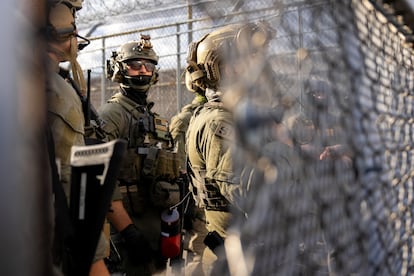
In recent months, ICE has tried to operate with a lower profile, but it has not stopped detaining migrants using what critics describe as heavy-handed tactics, involving armed agents who are masked, unidentified, and traveling in unmarked vehicles.
“They hire them on the fly, without checking their records,” said Jiménez, who is demanding that the United States investigate the deaths and provide proper training to agents. He welcomes Sheinbaum’s initiative, “which should not be viewed as a confrontation between countries,” and urges her to “strengthen the consular network’s capacity with more staff, financial resources, and a permanent policy of support” for a migrant community that is “transgenerational and bicultural.”
The effectiveness of the criminal legal avenue that Mexico is seeking to pursue is uncertain and “will not be swift,” predicts Ariel G. Ruiz Soto, an analyst at the Migration Policy Institute in Washington. “The Department of Justice conducts independent investigations, but as part of the executive branch, the outcomes of politically sensitive cases do not usually run counter to federal agencies backed by the White House,” he explains.
The Mexican government announced that it has already begun filing complaints with prosecutors’ offices in the states where the deaths occurred, in addition to the action brought before the Department of Justice. For now, “it is doing more for its nationals than any other Latin American country. It is among the most critical and outspoken opponents of this policy, and that is important,” says Ruiz Soto.
Sign up for our weekly newsletter to get more English-language news coverage from EL PAÍS USA Edition









































