
Guillermo and Zafar’s last known movements before their tragic deaths in Mexico: ‘Authorities had all the information and did nothing’
Friends of the US couple, whose bodies were found in a grave on June 19, say that Mexico City prosecutors failed to act despite receiving information about their whereabouts


Nearly a month after the bodies of Guillermo Hidalgo and Zafar Padamsee Mawani were found in a mass grave in the State of Mexico, Mexico City prosecutors have provided no updates on a case that has shocked the country. The two men’s bodies were discovered on June 19, buried together behind a cabin in La Marquesa National Park, in the State of Mexico, alongside two other corpses. Seven people have been arrested for their alleged involvement in the disappearance and murder of the U.S. couple, who went missing on May 20.
Relatives and friends of the victims, who reported their disappearance, say they conducted their own inquiries and provided authorities with clues about the couple’s whereabouts. They told EL PAÍS that shortcomings in the Mexico City Attorney General’s investigation may have made the difference between finding them alive and finding them dead.
According to Hidalgo’s friend Silvia — a pseudonym used to protect her identity — she, her husband Miguel, who also requested anonymity, and Marcia, a relative who likewise asked not to be identified by her real name, filed the missing-person report on May 22, two days after learning of the couple’s last known whereabouts. They were also the ones who alerted the anti-kidnapping unit and prosecutors handling the case about a possible lead.
Silvia says that on May 23, Hidalgo’s kidnappers switched on his cellphone in an attempt to make an online purchase through the e-commerce platform Mercado Libre. Guillermo’s assistant in the United States received a bank alert and activated the device’s tracking function. The location data indicated that the phone was at the cabins where the victims were later found dead. That information was shared with authorities 27 days before the bodies were discovered.
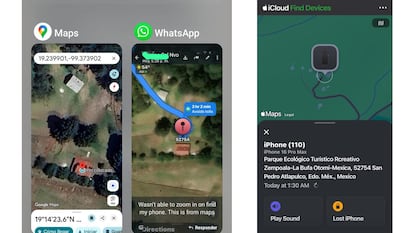
“They told Marcia they went to the place and didn’t find anything, but they lied to us,” says Silvia by phone. “Through contacts we have in the prosecutor’s office, we know that one of the officials in charge of the case failed to carry out the necessary procedures to coordinate a joint operation with prosecutors in the State of Mexico, since the area fell under that jurisdiction. They had to work together to investigate the location. They didn’t want to do it — that’s how we feel. They had all the information they needed to rescue them alive, but they did nothing.”
This newspaper contacted the Mexico City Attorney General’s Office for comment on these allegations, but had not received a response by the time of publication.
Chronology of a kidnapping
Hidalgo’s friend says that from the moment the couple disappeared on May 20, she and others effectively became detectives, tracking down and sharing every detail they could uncover about their whereabouts.
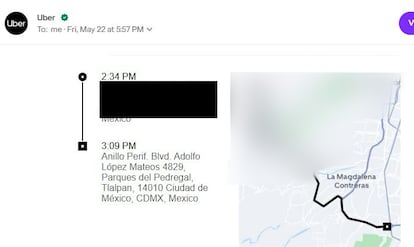
According to the information they pieced together, Hidalgo and Mawani left their home in the Jesús del Monte neighborhood — an important commercial and residential district in Huixquilucan, in the State of Mexico — at 2:30 p.m., heading for the Parques del Pedregal area in the Mexico City borough of Tlalpan.
The couple was on their way to a showroom where prospective contractors were due to demonstrate an elevator that Hidalgo and Mawani were considering installing in their home for Zafar’s mother, who suffered from Alzheimer’s disease. The couple had brought her with them from the U.S. to care for her.
Silvia says the kidnappers’ first contact with Hidalgo took place at Maizajo, a taco restaurant popular with tourists and expatriates in La Condesa, one of Mexico City’s most exclusive neighborhoods. The encounter occurred about a month before the couple’s disappearance, in late April. After overhearing Hidalgo speaking in English about the elevator he wanted to purchase and install for his mother-in-law, one of the kidnappers approached him and claimed that a relative who had worked with such equipment in San Diego and San Antonio “had a lot of experience” with that kind of machinery.
Silvia’s brother-in-law, a civil engineer, had been advising Hidalgo on the elevator purchase to help him avoid being scammed. However, when the purported contractors arranged a meeting with the couple, he was away in Querétaro on business. He advised Hidalgo to wait until his return so he could accompany him, but Silvia says Guillermo — an energetic and proactive person — always preferred to deal with problems quickly.
“Because Guillermo was eager to resolve the elevator issue, Leticia [a pseudonym used to protect her identity], another mutual friend, asked him to share his location if he was going to meet these people. But Guillermo was a genuinely kind person. He didn’t believe the worst of people and didn’t want to be distrustful,” Silvia recalls.
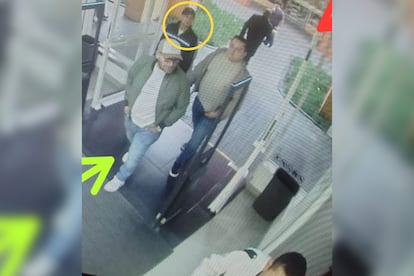
The couple was summoned to an office building on the Anillo Periférico, almost next door to the Radisson Hotel. Surveillance footage later reviewed by relatives shows Hidalgo and Mawani getting out of the Uber they had taken to the location. Investigators believe they were told that the showroom was actually elsewhere and were offered a ride there. They then got into the contractors’ vehicle.
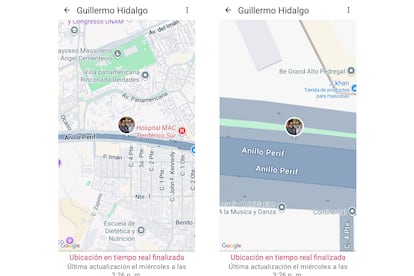
The last location Guillermo and Zafar managed to share was sent at around 3:30 p.m., barely a mile (about 1.5 miles / 2.4 kilometers) from the spot where they were ultimately taken.
The last location Guillermo and Zafar managed to share was at approximately 3.30 pm, about less than a mile from where they were taken.
Leticia grew concerned when she had not heard from Hidalgo and contacted Silvia on Friday, May 22, to say that the couple had not returned home. The information came from the woman who cared for Mawani’s mother, who, because of her condition, was never left alone. That same day, Silvia, Miguel and Marcia filed missing-person reports with the Mexico City Attorney General’s Office and the city’s Missing Persons Commission, a process they say took roughly 13 hours. “And that was only because we had a contact helping us. Imagine what it’s like for everyone else,” she says.
Later that Friday, at 7:35 p.m., Mawani’s assistant alerted them to suspicious activity on his employer’s bank account. New beneficiaries had been added and attempts had been made to transfer money. Silvia says their first lead took them to the Punta Norte shopping center in Cuautitlán Izcalli, in the State of Mexico.
“They went into Adidas and Nike. They made purchases of about $200 in each store. In fact, there is a video that was later sent to us in which you can see these [the alleged kidnappers] bringing Guillermo with a baseball cap on. He was being held captive and forced to make purchases using Zafar’s card,” Silvia says.
Hidalgo’s friend says the Federal Bureau of Investigation (FBI) was involved in the case from the beginning, although the family believes its role was limited because the investigation was taking place on Mexican soil. This newspaper contacted the U.S. Embassy in Mexico seeking information about the involvement of both the diplomatic mission and the FBI, as well as whether any actions by Mexico City prosecutors may have restricted their participation, but received no response.
Silvia says that when Hidalgo’s cellphone was switched on on May 23, they shared the location data with both Mexico City prosecutors and the FBI.
“We told them, ‘They’re there! They’re there!’ Supposedly the Attorney General’s Office was going to go, but what Marcia was later told, according to her, is that when they went there were only some empty cabins and they didn’t find anything,” says Silvia.
An operation spanning several states in Mexico
According to Silvia, a few days before Hidalgo and Mawani’s bodies were discovered in the grave where they had been buried, authorities identified one of the first suspects. From there, investigators gradually arrested the remaining members of the group accused of kidnapping and murdering the U.S. couple. It was Yesenia N., a former police officer and allegedly one of the leaders of the criminal organization, who ultimately revealed the location of the bodies.
“They tortured them terribly until they died. They showed them no mercy,” Silvia says.
Based on what friends and relatives of Hidalgo and Mawani have been told, investigators do not believe the case is an isolated one. Authorities suspect that the U.S. couple — who had left the United States in October in protest against the Trump administration’s anti-immigration policies — may have fallen victim to an international criminal network operating across several Mexican states and targeting foreigners or people perceived to have money.
According to the information shared with the victims’ inner circle, members of the alleged organization sought to gain the trust of potential targets before tracking their movements, infiltrating their social circles through platforms such as Instagram, and cultivating relationships with them over time. Friends believe this may have been how Hidalgo was approached.
The investigation remains open on multiple fronts, with key questions still unanswered, as friends and some relatives of the victims continue to wait for justice.
Sign up for our weekly newsletter to get more English-language news coverage from EL PAÍS USA Edition









































