
A year on from Mexico’s crematorium scandal: 131 bodies still unidentified and families in limbo
State prosecutors say 251 sets of remains have been returned to relatives. The owner remains on the run, and no sanctions have been imposed on public officials

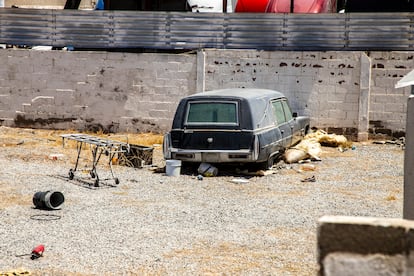
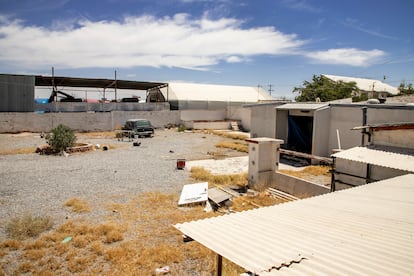
An aerial shot of the site reveals a black hearse abandoned inside, alongside an overturned stretcher. As archive images show, it remains in exactly the same position as a year ago, on June 26, 2025, when the horror hidden inside the Plenitud crematorium in the Mexican city of Ciudad Juárez came to light. A strong smell of decay still hangs in the air and grows stronger the closer one gets.
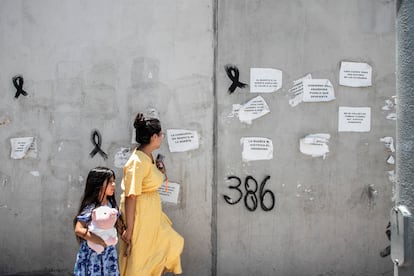
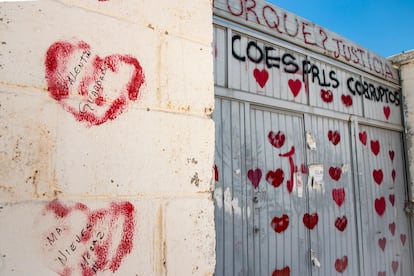
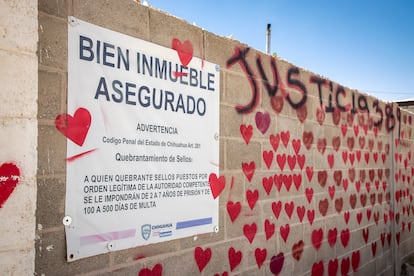
The same door, sealed by the Chihuahua State Attorney General’s Office (FGE), bears small painted hearts, each with a name and a date of death, for every one of the 386 people whose bodies lay inside, left to decompose for years in unsanitary conditions.
Hundreds of families were deceived and defrauded, believing that their loved ones’ remains had been cremated and that they held their ashes, when in reality, according to complaints, they received cat litter, gravel, or the remains of another deceased person.
A year after the discovery, more than a hundred families are still waiting to identify and recover their loved ones so they can give them a proper farewell, while continuing their struggle for even a glimmer of justice.
The remains of the Plenitud Crematorium are located in the south of Ciudad Juárez, almost on the outskirts of the municipality, in the state of Chihuahua. The site lies along dirt roads that convey a sense of desolation. It borders abandoned lots and spaces used as dumping grounds — whether for blown-out tires or for storing machinery such as cranes.
If the 38-degree midday temperature could make a sound, the searing heat would be the only thing you would hear, apart from the occasional trucks that pass through the area carrying mix from a cement plant located just a few meters away.
One of the crematorium’s entrance gates is secured with two padlocks and a rusted chain. On it are several signs placed by the FGE, worn down by time and weather, bearing the words: “Seized property.”
A limbo of impunity
This Tuesday, FGE personnel announced at a press conference that, over the past year, they had managed to identify the remains of 251 people, 247 of whom have been recognized and returned to their families. Héctor Jácome, head of Forensic Services for the Northern District Prosecutor’s Office, said that about 35% — equivalent to 135 sets of remains — still have to be identified.
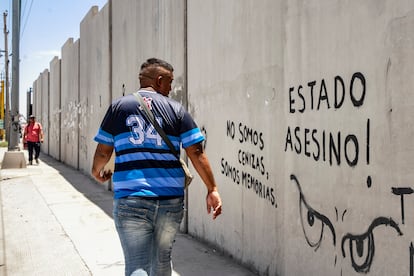
The affected families have not only spent all this time navigating a sea of grief, unsure whether their loved ones are among the remains discovered, but have also endured the repeated trauma of an endless mourning process, along with a justice system that has failed to hold those responsible accountable. Of the eight funeral homes involved, only two owners have been detained and formally charged, while to date, 157 fraud complaints have been filed against funeral homes linked to the Plenitud Crematorium.
However, for the crimes of improper handling, burial, and respect of human remains, only two individuals have been charged: Luis Arellano Cuarón, owner of the Plenitud Crematorium, and Facundo Martínez, the employee in charge of the incineration, who was caught red-handed at the site on June 26, 2025. The owner was released on February 13 after obtaining an injunction and was later declared a fugitive in May. The operator, meanwhile, died in prison due to health complications in late October 2025. FGE authorities have said they are seeking an Interpol Red Notice to locate Arellano Cuarón, who is believed to have crossed the border into El Paso, Texas, thanks to his dual nationality.
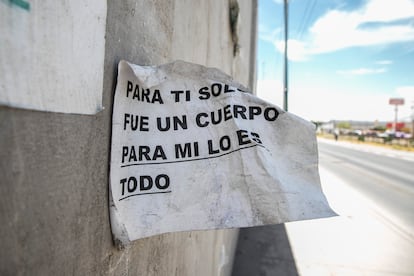
The indictment document for both defendants states that between March 7, 2022, and June 27, 2025, these two people kept 386 corpses hidden in Plenitud Crematorium in a state of decomposition, “stacked on the floor of different rooms” without meeting the necessary requirements for their preservation or for their “dignified and respectful handling,” such as functioning electricity, water supply, and refrigeration facilities.
The judge’s ruling also notes that they lacked a valid environmental impact permit issued by the City of Juárez’s Department of Ecology, as well as the documentation required to justify their legal presence at the site.
On this point, Dora Elena Delgado, spokesperson for the group Justicia para Nuestros Deudos (Justice for Our Loved Ones), said that no officials responsible for overseeing the proper operation of the facility — particularly those from the State Commission for Protection Against Health Risks (COESPRIS) — have been criminally prosecuted or removed from their positions.
Alma Vázquez, general coordinator of prosecutors at the FGE, stated that the Attorney General’s Office referred the case to the Ministry of Public Administration to determine possible administrative misconduct by COESPRIS officials and municipal authorities. However, the matter was redirected: cases involving state officials were handed over to the State Health Ministry’s internal oversight body, while those involving municipal public servants were referred to the municipal comptroller’s office.
Multiple complaints in a ‘no man’s land’
When searching for the Plenitud Crematorium on Google Maps, it no longer appears in the results. The few people seen in the area around the site are reluctant to speak about it, as if they would rather pretend it never existed. One neighbor recalls the constant smell of burned hair and the black smoke that rose from its only chimney, visible from nearby businesses bordering the property. Abel — an assumed name to protect his identity — runs a small business near the crematorium and says the “foul stench” was constant: “Some days it was so strong I would rather not have gone to work.”
Back at the sealed crematorium. Over the site’s entrance, a black graffiti reads “Justicia 386.” Through the narrow gap in the door, secured by two padlocks and a rusted chain, a soot‑stained wall is visible where the oven once stood.
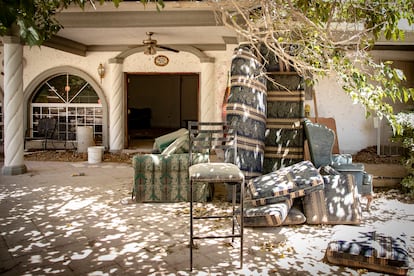
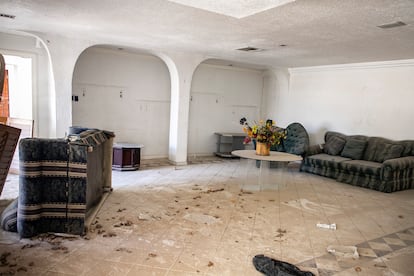
The property covers just over 1,900 square meters — roughly the size of one and a half Olympic swimming pools — and was divided in two. On one side, a house contained several rooms that functioned as a kind of reception area and waiting room for families, along with a small garden. According to images of the interior seen by this newspaper and provided by a source close to the case, these spaces are now completely abandoned.
The padlock securing the gate facing the Pan-American Highway — which connects Ciudad Juárez with the state capital, Chihuahua City — has been opened, and the security seals are broken. Another neighbor, who also asked to remain anonymous, says that “many dark things” happen in the surrounding area. But, he adds, the Granjas Polo Gamboa neighborhood, where the crematorium operated, “has always been a lawless place.”
“The media, municipal officials — they always came whenever there were complaints about the place going back years. It had been reported for a long time. No one ever did anything until it became impossible to ignore,” Abel says.
In the days before the discovery, it had rained, and the smell of decomposition spread through the surrounding area. According to the 911 report, someone noticed the odor, looked over the wall, and managed to spot the hearse. It was open, and inside lay the abandoned body of a man.
On the other side of the property, municipal authorities entered the area where the crematorium, now out of order, was located. Inside, in a space measuring roughly 15.9 meters long by 10 meters wide, they began counting the bodies.
“Three, five, 11 bodies,” local media reported over the course of the weekend. Finally, the toll stopped on Monday, June 30, 2025: nearly 400 bodies had been found in that confined space.
“Imagine you’re working in a mass grave, but it’s inside a room,” Jácome recalls.
A forensic challenge in an ‘unprecedented case’
Delgado says that, given a corpse becomes completely immobile over time and its center of gravity shifts downward — making it difficult to move and transport — it is impossible that Martínez, the only employee detained from the crematorium, could have been operating on his own. According to the authorities, the bodies were piled on top of one another like a mountain of human remains, placed wherever and however they would fit.
Jácome, speaking from his office at the forensic medical service (SEMEFO) in Ciudad Juárez, says that as the months have passed, they have had to deal with increasingly complex cases in identifying the bodies found. He describes it as an “unprecedented case,” explaining that while they are used to working with bodies in different stages of decomposition, they had never before handled remains altered by chemicals.
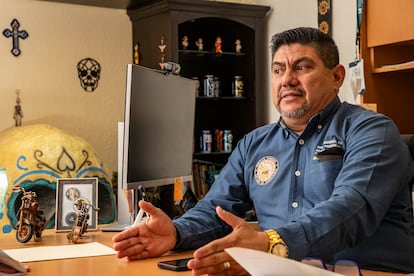
The forensic specialist explains that for a process like embalming — a funeral and sanitary technique meant to preserve a corpse, disinfect it and slow natural decomposition — fluid is injected at high pressure through the arteries, saturating the entire body, especially the abdomen. This, he continues, causes bodies to become very rigid, or “stiffened,” making it difficult even to remove clothing or open the mouth for dental analysis without causing damage.
“Existing techniques to rehydrate fingers and obtain fingerprints are based on normal decomposition, not chemical alteration,” he explains. “This has been a task of trial and error. At the genetic level, they are also altered at the cellular level, which makes obtaining genetic profiles difficult.”
From SEMEFO, officials have worked with and gathered information from families — from photographs of their loved ones and the clothing they were wearing at the time of the funeral service to details such as tattoos and distinguishing features, including scars or dental characteristics.
A painful uncertainty
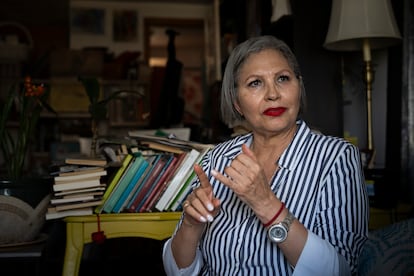
For the past year, Delgado’s home has served as a kind of nerve center for organizing the affected families, who continue to protest against the Plenitud Crematorium in their search for justice. From there, Miriam Flores, 43, says she was fortunate to recover the remains of her mother, María de Jesús Arenas, last October. She was identified through her fingerprint, as she had died six months earlier.
A little over a month later, in November, the family was called in for the cremation. They were allowed a few minutes — her, her children, and her father — to be with the remains. She describes those five months of waiting as a journey marked by “very painful” uncertainty. She says she felt a kind of anguish similar to that experienced by mothers searching for missing relatives.
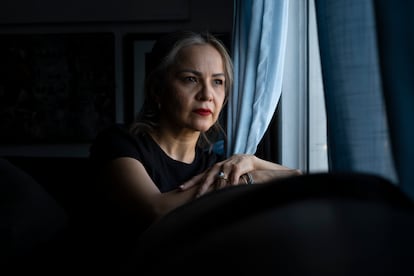
She says the situation has affected her family’s health in different ways. She herself has been prescribed medication for anxiety and depression. Seven months after identifying her mother’s body, she still cannot stop taking them.
“When they returned the body to us, we saw the mistreatment she suffered, the lack of respect for her memory,” she says. “That pain is too deep. It hurts the soul, it hurts. I’d rather they pay with prison. There’s no amount of money that can compensate for the way they treated my mother.”
Eleuterio Palacios, 60, criticizes the authorities for only pursuing fraud complaints against the funeral homes while they continue operating without any sanctions. He points out that, in the absence of criminal charges, many of these companies are reaching financial settlements with some victims for sums ranging from 5,000 to 40,000 pesos (about $280 to $2,280). “If the affected person reaches an agreement with the funeral home, we can no longer do anything and that, in some way, weakens the case for everyone,” he says from Delgado’s home.
Like many, Palacios learned about the case from the news. “I thought: ‘This can’t be. I mean, this couldn’t have happened to my mother,’” he recalls, remembering the moment he watched the reports on television a year ago
His mother, Soledad Ojeda, died on February 17, 2021. Despite following up on all the information requests from the prosecutor’s office, he has yet to receive any notification confirming whether his relative is among the 135 bodies still to be identified.
Jácome explains that the identified bodies fall within the period between 2022 and 2025, especially the last two years, which data shows were when the site saw the highest number of bodies. “I can’t yet rule out 2020 or 2021, because I don’t have enough evidence either way, but the hard numbers right now point to that range [2022 to 2025],” the forensic expert adds.
Delgado says that Arellano Cuarón, according to his testimony, admitted that in some cases the ashes from a single body were given to as many as four different families. They also learned that the Plenitud Crematorium charged between 1,800 and 2,800 pesos (about $102 to $160) for cremation, while other companies charge no less than 8,000 pesos (around $457) for the same service.
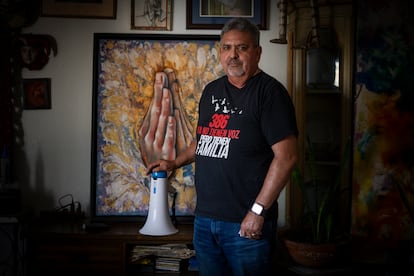
The collective Justice for Our Loved Ones has asked that the search collective Madres Buscadoras de Sonora (Searching Mothers of Sonora), led by activist Ceci Flores, be allowed onto the site where the Plenitud Crematorium once operated to search or dig the ground in case the owners concealed more bodies. “My mother died in 2021, and, according to them, the timing of the bodies is from the second half of 2022. So they have already ruled me out. What will happen? Who can assure me that the ashes really are my mother’s?” Palacios asks.
“The use of ground-penetrating radar, in collaboration with the Local Search Commission, has completely ruled out the existence of clandestine burials at the site,” Jácome clarifies in response to these concerns raised by some of the affected families.
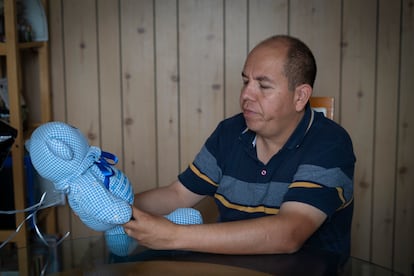
Omar Pérez, 46, is in a situation similar to Palacios’s. He believes it should not be difficult to identify the remains of his father, Fernando Pérez. He explains that his father was large — size 4XL — had two surgical scars and was missing several teeth. They provided a photograph taken six months before his death in which these features can be seen. However, in these 365 days, they have received no response from the prosecutor’s office. Before he died in December 2022, he says his father had specifically asked to be cremated so that the family would not have to worry about his body.
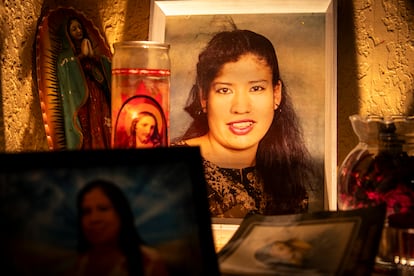
Pérez left what were supposed to be his father’s ashes in a church and has not claimed them since. Fernando’s photo remains on the top shelf of a small cabinet in his dining room. In the image, his loved one is wearing a light blue checked shirt. It was taken on the last Father’s Day he was able to spend with his family. That garment is also the last tangible memory they have of him. Omar’s son graduated just a week ago, and as a gift, they made him a teddy bear from the fabric of that shirt, because of the close bond he had with his grandfather. “True love binds us forever in the beating of your heart,” reads the message stitched on the plush toy’s belly.
“We don’t trust the authorities because of the way they have handled things,” Pérez says resignedly. “They want to wear us down so we give up. It’s a constant burden that creates anxiety […]. We have not been able to close the grieving process because we don’t know whether my father is among those bodies or not; I even dream about him frequently because of this uncertainty.”
Jácome explains that one of the main obstacles to returning the remaining bodies is the lack of information from families. He notes that in some cases — especially involving families from other states — people were not even aware of what had happened at the Plenitud Crematorium.
“I may have postmortem data, genetic profiles and fingerprints, but if I have nothing to compare them with, I cannot identify them,” he says. “There is currently a campaign by the prosecutor’s office encouraging families to submit DNA samples and provide life-history information about their loved ones in order to build identity hypotheses. […] Identification is dynamic and we do not set definitive timelines; we will continue working until the last one is identified.”
A year after the horrific discovery at the Plenitud Crematorium, hundreds of families are still living with the uncertainty of whether their relatives will be found among the bodies yet to be identified — or whether the ashes they received truly belong to the loved ones they believed they had already said goodbye to. The wounds from this case remain open in Ciudad Juárez, with no clear sign of justice on the horizon.
Sign up for our weekly newsletter to get more English-language news coverage from EL PAÍS USA Edition









































