
Former US ambassador Ken Salazar says López Obrador tied migration cooperation to infrastructure funding in Mexico
In his memoir, the politician recounts the Mexican president’s frustration over limited Biden support for the Isthmus of Tehuantepec railway
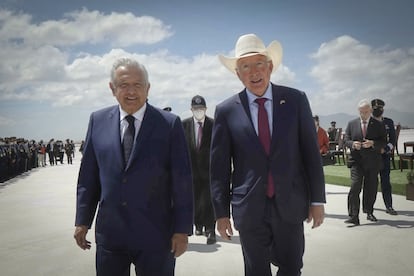

Former Mexican president Andrés Manuel López Obrador believed that migration to the United States would not be solved by building border walls, but through investment to create opportunities. He made that position public dozens of times in Mexico. What was not known was that the former leader expected the U.S. government to invest in some of his main infrastructure projects, especially those he conceived as “development corridors” that would generate jobs for locals and migrants and curb the flow toward the United States.
Perhaps the project he promoted most strongly in Washington was the Isthmus of Tehuantepec railway, which would link two ports on the Pacific and Gulf coasts and aimed to compete with the Panama Canal. Washington found it appealing, as it saw an opportunity to establish security controls and halt the movement of traffickers and migrants — a sort of intermediate border located hundreds of miles away.
The administration of Joe Biden pledged support, but the funding never materialized, which deeply “frustrated” the former Mexican leader, Ken Salazar, who served as U.S. ambassador at the time (2021–2025), writes in his memoir Borderlands.
Salazar writes that he and López Obrador collaborated to promote development in the Isthmus of Tehuantepec, not only for its economic potential but also because it could function as a modern, technology-driven corridor that would make it harder for human and drug traffickers to operate undetected.
Another project López Obrador considered a priority to contain migration was the Otay Mesa East border crossing in Tijuana, which, according to Salazar, would be financed by both countries and would be the “most modern and technologically advanced.” While Mexico did its part and committed significant investment, the former U.S. official acknowledges, the Biden administration fell short.
In fact, Salazar admits he left office with a deep sense of disappointment over the Biden administration’s handling of the issue and the limited importance it gave to migration. The former ambassador — descended from a Texas family dating back to when the state was still part of Mexico — shared López Obrador’s diagnosis of how migration should be addressed.
At the time, as the COVID-19 pandemic intensified asylum requests, as many as 10,000 people a day were crowding the border. It was an “emergency,” Salazar says bluntly. He warned that if the problem was not addressed, it would become a burden on Biden’s administration — one that figures like Donald Trump could exploit to stir political tensions among Americans, as indeed happened. Salazar writes that Biden’s failure to effectively address the border crisis significantly undermined his presidency.
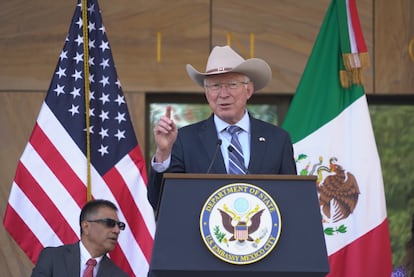
Salazar recounts that the Biden administration had promised Mexico support for building the Tehuantepec railway. At López Obrador’s request, he says, the U.S. president even appointed Amos Hochstein — then the White House’s international energy envoy — to assist with infrastructure projects in the Isthmus. However, U.S. funding never materialized, which, according to Salazar, increasingly frustrated the Mexican leader. López Obrador even sent some of his most senior cabinet members to Washington with Salazar to seek backing for the project, but those efforts produced little in the way of concrete results, he writes.
At one meeting with Biden’s envoys, Salazar warned that López Obrador was growing impatient. Drawing on his understanding of the Mexican president, he added that unmet infrastructure commitments were affecting the broader relationship: when Washington failed to follow through, López Obrador began to question the reliability of all U.S. pledges. From his perspective, the Mexican government was investing billions in flagship projects — the Isthmus corridor, the Dos Bocas refinery, and border developments like Otay Mesa — and expected a comparable level of commitment. When that did not happen, it was perceived as a lack of respect, Salazar writes in his memoir.
According to Salazar, as his administration neared its end, López Obrador effectively stepped back from implementing measures to curb irregular migration. For example, the government stopped funding transport — buses and flights — to return migrants rejected at the border to southern Mexico. With the 2024 U.S. elections approaching, Salazar pressed urgently for resources, raising the issue with then–migration chief Francisco Garduño and finance minister Rogelio Ramírez de la O. They confirmed there were no funds available, as López Obrador was prioritizing the completion of his major infrastructure projects before leaving office. In Salazar’s account, Ramírez de la O made clear that the president’s priorities were fixed: the Maya Train was about to be inaugurated, the Isthmus railway was nearly finished, and these projects were seen as transformative for the country.
Salazar sought a face-to-face meeting at the National Palace to persuade López Obrador to allocate funds to migration. In the memoir, Salazar writes that the Mexican leader returned to his usual argument about U.S. investment. He pressed for timelines on projects like Otay Mesa East and again raised the need for U.S. support for development in what he described as the long-neglected southeast of Mexico. He also repeated his longstanding complaint that the United States was not investing in Latin American development as it had during the Kennedy-era Alliance for Progress. Salazar recalls sensing an unspoken doubt: whether Washington was genuinely committed to modernizing the border and supporting development in the Isthmus, or merely offering empty assurances.
During a trip to San Francisco for the APEC summit in November 2023, López Obrador again pressed Salazar on financing for the Isthmus railway. This time, he invoked China — Washington’s main global competitor — as leverage, noting Beijing’s interest in investing in industrial parks and ports linked to the project. Recognizing the implications, Salazar responded that this made it all the more important for the United States to act as a full partner.
On several occasions, Salazar conveyed to Biden what he saw as the price of López Obrador’s cooperation, including the Mexican president’s direct complaints that the United States was failing to meet its commitments. He raised the issue again with Biden during APEC, stressing the urgency of delivering visible progress on infrastructure and development — particularly in Otay Mesa East and the Isthmus — because they had become symbolic tests of whether the partnership was credible. Biden, he recounts, continued to assure him that the investments would come.
In his memoir, Salazar also reflects on his many interactions with López Obrador — whom he describes as an extraordinarily hard-working and notably stubborn leader. He recalls how the Mexican president pushed for Biden’s plane to land at the new Santa Lucía airport (AIFA) in January 2023, his wish for Biden to attend the inauguration of the interoceanic railway, and how relations cooled after the controversial capture of Ismael “El Mayo” Zambada.
On a personal level, Salazar writes about moments when he considered resigning, his clashes with senior U.S. officials, his brief flirtation with a presidential run, his decision to seek advice from a priest in Oaxaca, and his disappointment when Biden ultimately stepped aside to allow his vice president, Kamala Harris, to run for president in the 2024 election.
Sign up for our weekly newsletter to get more English-language news coverage from EL PAÍS USA Edition









































