
The Interoceanic Train, the Mexican alternative to the Panama Canal
The deadly derailment of a passenger train in Oaxaca on Sunday has put the spotlight on the least scrutinized of López Obrador’s railway megaprojects
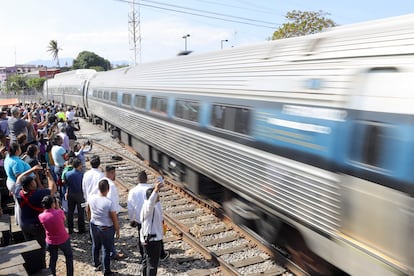

The deadly derailment of a passenger train Sunday in Oaxaca has brought the Interoceanic Corridor of the Isthmus of Tehuantepec into sharp focus — the black sheep of the rail megaprojects developed during the administration of Andrés Manuel López Obrador. Conceived with the aim of competing with the Panama Canal for freight transport between the Atlantic and Pacific Oceans, the corridor remained largely under the radar while the Maya Train garnered most of the media attention.
The project consists of the complete rehabilitation of three lines. The main route, and the one where the accident occurred, is the Z line, which connects Coatzacoalcos in Veracruz with Salina Cruz in Oaxaca. It is 308 kilometers (191 miles) long and has been in operation since the early 20th century, although passenger service was suspended in the 1990s, leaving only freight transport. The second line, at 330 kilometers (205 miles), is Line FA, which runs from Coatzacoalcos to Palenque in Chiapas and connects with the Maya Train. These sections were inaugurated in December 2023 and September 2024, both behind schedule. A third line, Line K, which will connect Ixtepec in Oaxaca with Ciudad Hidalgo on the border between Chiapas and Guatemala, has a section already inaugurated and another under rehabilitation. It is projected that the entire 459 kilometers (285 miles) of track will be completed by June 2026.
It was in 2020 that the López Obrador administration promised a complete rehabilitation of the tracks and the restoration of passenger service, with the aim of increasing the freight train’s speed from 20 to 70 kilometers per hour (43.5 mph). The construction of a dozen development hubs was also announced, essentially industrial parks with tax advantages and streamlined administrative processes, in the towns along the Z line. This system bears similarities to the Special Economic Zones promoted by the Enrique Peña Nieto administration, also with the goal of fostering development in southern Mexico.
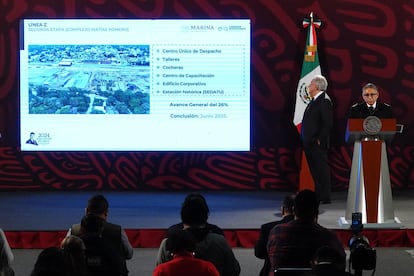
As with the Maya Train, as construction fell behind schedule, López Obrador decided to involve the military. In early 2021, it was announced that the Secretariat of the Navy would take charge of the project, overseeing both its construction and management. With the Maya Train now under the purview of the Secretariat of National Defense, the government continued its policy of distributing responsibilities and projects equally between the army and the navy. The government justified this allocation as a way to prevent future privatization of the project, and Admiral Raymundo Pedro Morales Ángeles, the current Secretary of the Navy, served as Director General of the Interoceanic Corridor of the Isthmus of Tehuantepec.
During its construction, there was criticism of the rush to meet political deadlines, with complaints from local residents that the consultations to approve the project were carried out without regard to the law, while dozens of opponents of the project claimed to have been criminalized by the authorities.
One of López Obrador’s sons, Gonzalo, was appointed honorary supervisor of the project. According to the then-president, he helped him monitor the progress of the works, the laying of the tracks, and other aspects of the infrastructure — all without pay. However, in an audio recording released by the organization Mexicans Against Corruption and Impunity, businessman Amílcar Olán is heard claiming that Gonzalo López Beltrán intervened to secure the supply of basalt for the Interoceanic Railway and the Maya Train. Olán is accused of using his friendship with López Obrador’s sons to obtain construction and supply contracts for major projects under the previous administration.
Sign up for our weekly newsletter to get more English-language news coverage from EL PAÍS USA Edition









































