
The Chilean woman seeking her family’s artworks looted during Nazism
After fleeing Hitler’s regime, the Zoellners suffered the theft of a major collection of paintings and antique furniture. Over five decades later, Deborah Zoellner resumed the search and has already managed to locate part of that lost family treasure
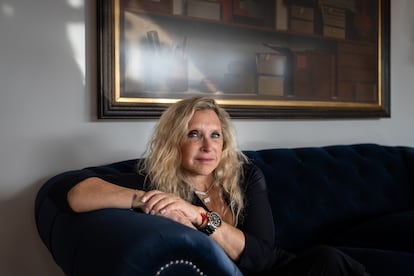
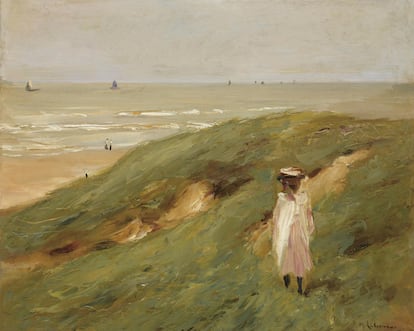
“The painting found me.” That is how Deborah Zoellner (Santiago, Chile, 1963) sums up the beginning of her search for her family’s artworks, stolen during the years of Nazism in Europe. It was in 2000 when Zoellner, a descendant of a prominent German-Jewish family, received a surprise call from the Netherlands informing her that a painting in a museum in the Dutch city of Groningen had belonged to her paternal grandmother, Elsbeth Isaac, and therefore belonged to her heirs. The work was a painting by the German artist Max Liebermann (1847–1935) titled Düne bei Nordwijk mit Kind (Dune near Noordwijk with a child), which Elsbeth, along with a number of valuable possessions, had entrusted in 1940 in Amsterdam to a confidant when she decided to leave for the United States in the face of the advancing Nazi threat and persecution of Jews, but which she never recovered after the end of World War II (1939–1945).
Elsbeth Isaac was the wife of Arthur Zoellner, whose family owned the then well-known automobile and ship paint factory Zoellner-Werke in Berlin. A lover of art and antiques, she assembled a significant collection of paintings, carpets, and furniture with which she decorated her home. However, the Zoellners’ lives, like those of most European Jews, changed radically when Adolf Hitler came to power in Germany in 1933. Facing Nazi threats and harassment, Arthur Zoellner killed himself in September 1933. The paint factory was seized by the regime and used to produce the cyanide-based pesticide known as Zyklon B, which was used to murder millions of people in the gas chambers installed at Nazi extermination camps, including Auschwitz-Birkenau.
Between 1934 and 1938 the Zoellner-Isaac family left Germany and sought refuge in the Netherlands. First their son, Rudolf Zoellner, left, and later Elsbeth and her daughter, Marianne Zoellner, followed. In the move they also transported much of their belongings and art collection. They hired the services of a firm led by the German Gerard Neumann to remove the remainder of their possessions from Germany, which he did, gaining the Zoellners’ trust. However, the Nazi threat and the imminence of war led the family to decide to leave again. While Rudolf left the Netherlands in October 1939, a month after the start of the conflict, and later settled in Chile, Elsbeth and Marianne departed Dutch territory in April 1940, less than two weeks before that country was invaded by Germany, and headed to the United States.
But the Zoellners could not take all the paintings and furniture, so they entrusted Neumann to store them and to send them to Elsbeth in New York, where she had established residence, at a later date. Furniture, paintings and other objects were catalogued and itemized in a document. However, except for some boxes, those belongings were never dispatched to the United States and, on the contrary, their whereabouts were lost. After the war ended, Elsbeth Isaac traveled to the Netherlands to search for what belonged to her, but Neumann washed his hands of the matter and said that the Germans had appropriated the paintings and furniture. With her catalogue in hand, she appealed to the institutions created after the war to claim her property. But she achieved nothing and returned empty-handed to New York, where she died in July 1975. Despite evidence that Neumann did appropriate the Zoellners’ furniture and paintings, he was not convicted; in 1947 he was deported from the Netherlands as an “enemy subject” under the Nazi regime, and emigrated to the United States with his family.
The painting and the former mayor
However, while Elsbeth Isaac was searching in 1946 in the Netherlands for her lost art collection, one of those paintings, Max Liebermann’s Düne bei Nordwijk mit Kind, began a long journey to be reunited with its rightful owners. In those postwar days, the former mayor of Haren, Hubert Nauta, was walking along a street in Groningen when he saw the Liebermann painting at the door of a used-book store. He spoke with the bookseller, who said he had bought the painting from some German soldiers during their retreat and was willing to sell it to the former mayor at an absurdly low price. Suspecting it had been stolen from its Jewish owners, Nauta decided to buy it and take it to the local police so they could investigate. Years later, Nauta asked the police what had happened to the painting and learned it was still in the lost-and-found office. The former mayor contacted another city authority, and it was decided that the work would be taken to the Groninger Museum, enter the collection as a “loan,” and be exhibited.
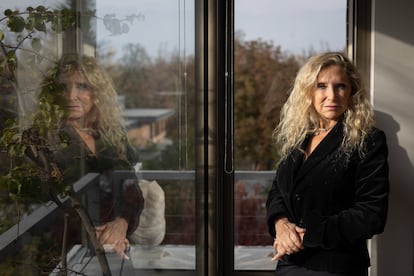
The provenance of the Liebermann painting remained a mystery for more than five decades. Although the testimony of the former mayor and his children about how it had been found and their suspicion that it had been stolen prompted several investigations, those inquiries produced no results. But in May 1998, the former mayor’s eldest son, Hendrik Nauta, went to the Groninger Museum and asked for a renewed effort so that, if the painting was wartime loot, it would be returned to its rightful owners. This time there were results: thanks to research carried out by expert Eelke Muller, the painting was linked to the Zoellners’ lost art collection. Thus, in March 2000, Deborah Zoellner, daughter of Rudolf Zoellner (who died in 1993), was surprised in Chile — where she was born and lives — by a call from the Netherlands informing her that her grandmother’s Liebermann was in a museum. “I always believed I could find those works. I told myself ‘I’m going to find this, it will appear.’ Everyone said I was crazy, until the Liebermann showed up,” Zoellner tells EL PAÍS.
At the invitation of the Groninger Museum, Deborah Zoellner traveled to the Netherlands in April 2000 and was able to see Liebermann’s Düne bei Nordwijk mit Kind, measuring 49 by 60 centimeters. She had managed to complete the circle her grandmother had tried to close for so long. The painting was restored to the Zoellner family in 2007 and auctioned at Sotheby’s. But the case did not end there, and Elsbeth Isaac’s granddaughter managed to recover her grandmother’s catalogue and resume the search for the other stolen works and belongings. Of a total of 13 paintings, whereabouts unknown since the early 1940s, Deborah Zoellner has already located five and recovered — on behalf of herself and the descendants of her aunt Marianne — four: the Liebermann painting, the work Der Netzflicker (The Net Mender) by the Swiss Ferdinand Hodler (1853–1918), and two works by the Flemish artist David Teniers the Younger (1610–1690). A painting by the Dutch artist Jacob van Ruisdael (1629–1682) was discovered in Poland but has not yet been recovered. Zoellner stresses that, for her, the important thing is not merely rescuing the artworks themselves. “What matters here is reclaiming my history, that of my family and my ancestors. Repairing a family tradition that was broken by the persecution of the Jews,” she says.
Sign up for our weekly newsletter to get more English-language news coverage from EL PAÍS USA Edition









































