
Mexico steps up its anti‑piracy drive ahead of the 2026 World Cup
Mexican authorities are stepping up the crackdown on counterfeit merchandise related to the soccer tournament, which is one of the points of contention with the United States in the USMCA review process
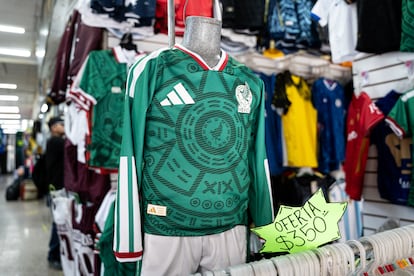

In downtown Mexico City, the so‑called “sports street” has become a hub for football knockoffs. Several blocks of shops selling jerseys, balls, and keychains with dubious logos illustrate a new economic battleground: the Mexican government’s campaign against piracy.
“Sales have been a bit stagnant, precisely because people are afraid of raids. But we’re just waiting for the first match to bring the World Cup frenzy,” said one shopkeeper, who withheld his name. Moments earlier, he had sold a counterfeit Mexican national team jersey for about 200 pesos — roughly a third of the price of the official version.
As Mexico gears up to serve as one of the host countries for the 2026 FIFA World Cup, it also remains on the United States’ “priority watch list” for piracy. Washington places Mexico on this list for failing to address major intellectual‑property concerns — including trademark counterfeiting, copyright violations, and obligations under the U.S.‑Mexico‑Canada Agreement (USMCA). Mexico appears alongside Argentina, Chile, China, India, Indonesia, Russia, and Venezuela.
At the end of March, the U.S. Trade Representative (USTR) updated its annual inventory of non‑tariff barriers affecting bilateral trade — a list that will be crucial ahead of the upcoming review of the USMCA, a process central to the economies of all three member countries. The report notes that “Mexico has one of the highest rates of music and video game piracy in the world” and highlights weak coordination across government levels, insufficient resources, and ineffective judicial processes for imposing fines and penalties.
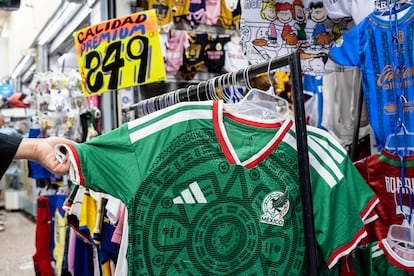
“Although Mexican authorities have conducted some IP enforcement raids against markets across Mexico, the markets of El Santuario, Mercado San Juan De Dios, and Tepito [...] continue to flourish,” the document states.
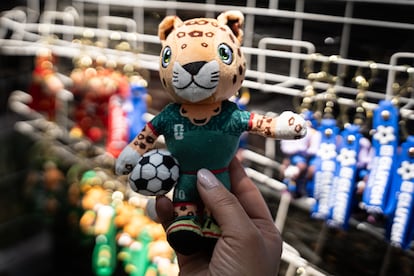
This is made clear by the storefronts in Venustiano Carranza Street, in the historic center. Isabel, another vendor who withholds her last name to avoid trouble, says authorities have been visiting regularly. Her kiosk sells books and World Cup memorabilia — keychains of Maple, Zayu, and Clutch, the tournament’s official mascots — along with small replica trophies. “They’re looking to seize jerseys and balls, because that’s what counts as piracy. Keychains and souvenirs are allowed,” she says, addressing a customer’s concerns.
The Mexican government of President Claudia Sheinbaum has intensified its “Operation Clean-Up.” The Mexican Institute of Industrial Property (IMPI) reported this week that it has carried out 21 operations, resulting in seizures equivalent to $901 million. This includes the confiscation of at least 25 tons of counterfeit merchandise — mainly from China and featuring brands such as Adidas, FIFA, Nike, and Puma — confiscated in Tepito, where a sports market sets up at least once a week.
Porous borders and smuggling
According to figures from merchants, this is just the tip of the iceberg. Mexico’s Tax Administration Service (SAT) said last year that it had quantified a tax loss of up to 22.843 billion pesos (about $1.3 billion) due to smuggling, amid announcements to redouble its monitoring efforts, both administrative and anti-corruption. The figures represent a substantial increase compared to 2024, when the agency reported a loss of 7.254 billion pesos ($414 million), primarily due to smuggling.
However, the true scale of tax evasion — a crime closely linked to piracy — is very difficult to estimate. The problem has been growing. Reflecting the country’s informal economy, Mexico maintains the lowest tax revenue among the Organization for Economic Cooperation and Development (OECD), standing at 18.3% of gross domestic product (GDP) in 2024, well below the average of 34.1% for OECD countries.
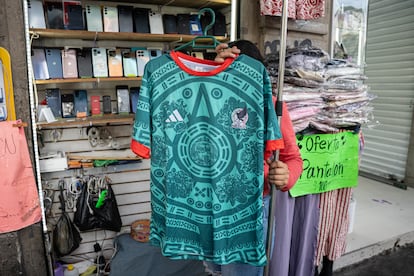
“The World Cup can become an opportunity for legitimate businesses and a window for illegal activity,” says Octavio de la Torre, president of the Confederation of National Chambers of Commerce, Services and Tourism (Concanaco Servytur). The group estimates that, in the past decade, the counterfeit goods market has grown by almost 50%, with some 63 billion pesos ($3.6 billion) spent annually on fake goods. “This isn’t a minor trade, nor is it a marginal phenomenon; it’s a large-scale economic distortion. And when the market is distorted, those who do pay taxes are penalized,” he adds.
This suggests that the textile, sporting goods, retail, promotional materials, audiovisual rights, and sponsorship sectors will be the most negatively impacted. “Significant efforts have been made in previous years,” says Héctor Magaña, coordinator of the Center for Economic and Business Research at Tecnológico de Monterrey. “However, there hasn’t been a turning point where a downward trend can be observed. And now that the issue is gaining relevance in international discussions, particularly in the renegotiation of the USMCA, it will be important to review what our country’s government will propose to try to mitigate the effects of these problems.”
Sign up for our weekly newsletter to get more English-language news coverage from EL PAÍS USA Edition









































