
The opaque limbo of foreigners deported by the US to Mexico
Thousands of people from Cuba, Haiti, Venezuela and other countries are being sent by the Trump administration to Mexican territory, where they are trapped without being able to regularize their status
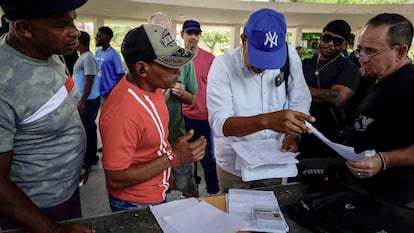

In the purported paradise city of Cancún, Jean, a Haitian citizen deported from the United States to Mexico in late October 2025, is consumed by frustration and feelings of helplessness. He was originally transferred on a bus from the northern border to Villahermosa, the capital of Tabasco, by Mexican immigration authorities who took over from their U.S. counterparts. The moment he got off the bus in southern Mexico, however, was the last time he received any official assistance in the country. Instead he was left to his own devices in a place where he knows no one and doesn’t even speak the language. “They’re just sending people here. They’re not helping with anything. And then, when you try to do something for yourself, it’s a problem. I don’t know how to explain it, but it’s crazy,” says desperately over the phone Jean, a pseudonym for the 33-year-old Haitian. He fears that speaking publicly will jeopardize his legal proceedings in both Mexico and the United States.
Jean’s case is one of thousands of what are known as third country deportations: a practice that involves expelling people to countries other than their own. It’s not illegal, but it was very uncommon until the Trump administration began aggressively promoting it. According to a congressional report, the current Republican administration has spent more than $40 million to send a few hundred migrants to countries as far away as South Sudan or the small African kingdom of Eswatini, at an average cost of $130,000 per deportee. However, these figures don’t include the most common destination: Mexico.
Since Trump’s return to power, thousands of foreign nationals, primarily Cubans, Haitians, and Venezuelans, have been deported to Mexico. The exact number is unknown, as authorities from neither country have released concrete figures. But there are clues. Just over a week ago, federal judge William G. Young of Massachusetts stated in a ruling that the Department of Homeland Security (DHS) informed him that, based on an “unwritten agreement,” the United States deported 6,000 Cubans to Mexico in the past year. Similarly, Mexican President Claudia Sheinbaum stated in December that the country had received 11,886 foreigners up to that point.
The situation is not entirely new. Mexico has been receiving deported foreigners from the United States for years as a “safe third country.” During the administration of former Democratic President Joe Biden, an agreement was reached to receive 30,000 per month, although they were people who had just crossed the border illegally and were being returned immediately, which is very different from the type of deportations being conducted now. Furthermore, the flow appears to be occurring under an “unwritten agreement,” the details of which are unknown. This newspaper inquired about it with Mexican authorities but has not received a response. The few certainties that exist, then, are those made evident by the growing reports of deported foreigners stranded in Tapachula, Villahermosa, and Cancún.
Tran Dang, an American citizen of Vietnamese descent who has lived in Mexico for 10 years and leads the Rhizome Migrant Center in Guadalajara, one of the few organizations dedicated to providing legal support to deportees, has witnessed this shift firsthand. “The majority of the people we serve have traditionally been Mexican migrants deported from the United States. But this past year we’ve also seen a considerable increase in people of other nationalities. Cubans, Haitians, and Venezuelans are also contacting our organization and others. Their lawyers in the United States are reaching out to us, really seeking more information about what’s happening,” she says via video call.
Jean in Cancún is one of the individuals who contacted the Rhizome Center seeking help. He has been trapped for months in a bureaucratic limbo from which there seems to be no escape. He submitted his asylum application in mid-November to COMAR (Mexican Commission for Refugee Assistance), but he hasn’t even received the notification that it has been received, which should be sent within a maximum of 90 days. Much less has he received his Humanitarian Visitor Card (TVRH), which grants an identity number and work permit while the asylum application is being processed. And when he has tried to contact the agency directly, something complicated in itself because he doesn’t speak Spanish, he hasn’t received any information or guidance other than to wait.
Running into that wall again and again seems to be the only option available to him. He can’t get a job in Cancún because he’s undocumented. He can’t leave the state of Quintana Roo because that’s where he filed his asylum application. Receiving money from relatives is difficult, since he doesn’t have access to a bank account and can’t open one. And returning to Haiti isn’t possible either, given the humanitarian situation in the Caribbean country and the fact that his entire family has been living in the United States for years.
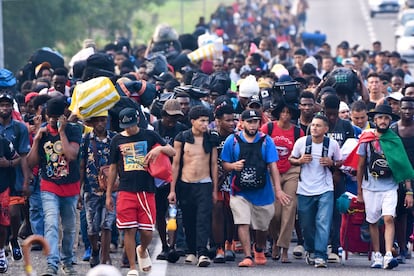
Dang, from the Rihzome Center, warns that this pattern repeats itself time and again with numerous migrants and that things are headed toward a critical situation. “Everyone knows how to survive. But if you create the conditions that the Mexican government has created, where they don’t give migrants identification numbers or work permits, where people can’t even open a bank account or receive money, then you’re going to have a lot of homeless people.” This exact scenario has been playing out for at least several weeks now, particularly in Tapachula.
A recent report by the UN’s International Organization for Migration (IOM) also points to this same problem. Although the IOM also lacks access to government data, it conducted 400 interviews with migrants over several months in 2025 and, through these, reached some key conclusions about the phenomenon of returns to Mexico from the United States. First, generating income and accessing employment is the primary need for most foreign nationals returning to Mexico. This is followed by the need to resolve bureaucratic procedures and obtain documentation, which is closely related to the first point, as it is a prerequisite, at least for securing legal employment. The IOM also reports that a significant portion of these foreign nationals in Mexico also require safe housing and food.
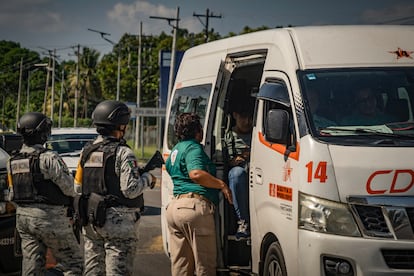
The situation forces people to find ways to make a living. On the streets of Tapachula, deportees look for any informal work, even if it’s just for the day. Others have found jobs where they are paid in cash. This is the case of Roberto, a Cuban man (also a pseudonym), who works as a barber in Cancún while he waits for fate to decide his future.
So far, he hasn’t had much luck. He was deported to Mexico in mid-February after being detained at a supposedly routine immigration appointment where he was informed that the document he thought protected him from deportation—the I-220A form he received when he entered the country during the large wave of Cubans who left the island after the pandemic—was invalid and that he would be deported. He was detained for three weeks before ending up in Tapachula, where he arrived without money, identification, or any way to contact his family or his girlfriend, a U.S. citizen who remained alone in Michigan.
He eventually managed to get in touch, and she, who prefers to remain anonymous, traveled to deliver his passport and several other documents so they could get married. Now they are hoping that Roberto will be granted a spousal visa so he can return to the home, life, and future they shared in Michigan. Roberto is naturally optimistic and believes that moment will come sooner rather than later. But the outlook for deported foreigners sent to Mexico is uncertain, given the lack of information and transparent, effective planning.
Sign up for our weekly newsletter to get more English-language news coverage from EL PAÍS USA Edition









































