
Mexico confronts drug trafficking
The fall of El Mencho marks the end of a policy of non-aggression that was in practice an abdication of state authority
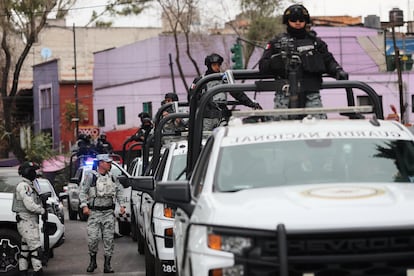

The death of Nemesio Oseguera, “El Mencho,” in a security forces operation is not just another episode in Mexico’s long and painful war on drugs. It is a watershed moment. With the fall of the man who was for years the country’s most wanted criminal, Mexico is sending an unequivocal message: the state has decided to exercise its power without ambiguity. The era of euphemisms is over. The country is burying — with actions and not speeches — the “hugs, not bullets” policy of former president Andrés Manuel López Obrador.
For too long, the security strategy hovered in a gray area between containment and surrender. Everyone knew where El Mencho was. They knew his movements, his network, his hideouts. But no one crossed the final line. The political cost, the risk of violence, and the fear of escalation seemed sufficient to postpone the decision. That postponement came at a price: subjugated territories, extorted communities, and challenged institutions.
President Claudia Sheinbaum has chosen a different path. She has done so since the beginning of her term, marking a clear departure from her predecessor. The strategy spearheaded by Security Secretary Omar García Harfuch has prioritized intelligence, operational coordination, and, when necessary, the decisive use of force. The death of the leader of the Jalisco New Generation Cartel is the most visible symbol of this shift.
The operation was neither clean nor bloodless. At least 25 officers died in subsequent clashes following the violent reaction of organized crime. The drug cartels’ response included roadblocks, burning vehicles, closed highways, and cities paralyzed for hours. Organized crime sought to test the state’s resilience, to demonstrate that it can still sow chaos. This is the immediate price of any decision that challenges deeply entrenched criminal structures.
That is precisely why the decision matters. A state that avoids confrontation loses moral and material authority. A state that acts, even at a high cost, reaffirms its legitimate monopoly on the use of force. The death of El Mencho does not erase decades of violence, nor does it dismantle at a stroke a criminal network that has infiltrated local economies and social structures. However, it draws a line: there are limits that can no longer be tolerated.
It is undeniable that pressure from the United States played a role. Washington had been demanding results for years against one of the main traffickers of fentanyl into its territory. Intelligence cooperation was crucial in locating the kingpin’s final hideout. This collaboration is welcome and necessary, but it is important to emphasize something essential: the decision was sovereign. The suspect was Mexican. The fallen soldiers are Mexican. The operation was carried out by Mexican forces on Mexican soil.
That distinction is not merely rhetorical. For years, and even more so after Donald Trump’s arrival at the White House, the bilateral security relationship was marked by mistrust and debate about interference. The success of this operation demonstrates that it is possible to cooperate without ceding sovereignty. Mexico did not act as the enforcer for another country; it acted as a state assuming responsibility for its own crisis of violence.
The epic nature of this event, if one can call it that, lies not in the capture of the world’s most wanted drug lord, but in the institutional gesture that made it possible. It’s not about celebrating the capture as if it were the end of the story. Mexican experience teaches us that every fallen leader can be replaced, and that the fragmentation of cartels sometimes multiplies the violence. The real challenge begins now: consolidating territorial control, protecting the civilian population, and preventing the power vacuum from leading to new local wars.
Sheinbaum has taken the risk. The state has decided to stop backing down. That doesn’t guarantee peace, but it does redefine the playing field. Mexico cannot resign itself to coexisting with parallel powers that challenge its authority. The fall of El Mencho is, above all, a declaration of principles: faced with the challenge of drug trafficking, the state will not abdicate.
The cost has been high and may continue to be so. But the alternative — inaction, indefinite waiting, political calculations prioritizing it over public safety — was even more damaging. Today, Mexico is sending a message both domestically and internationally: violence cannot be quelled with slogans. It must be confronted with firm decisions and the conviction that the law must prevail. That is the real statement of intent.
Sign up for our weekly newsletter to get more English-language news coverage from EL PAÍS USA Edition









































