
Argentina’s Chamber of Deputies lowers the age of criminal responsibility from 16 to 14
Javier Milei’s reform toughens the juvenile justice system, as he continues his hardline stance against crime. The bill now goes to the Senate for final approval
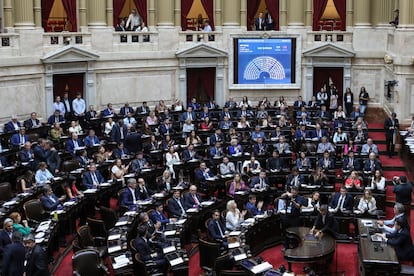
“Adult crime, adult punishment.” That’s the logic behind the bill championed by Argentine President Javier Milei to lower the age of criminal responsibility from 16 to 14, which was approved this Thursday in the Chamber of Deputies. The new Juvenile Criminal Code, which received 149 votes in favor and 100 against, was debated for more than eight hours and now goes to the Senate for final approval.
The hardline rhetoric has been a hallmark of the far-right president since his campaign. Once in the Casa Rosada, the seat of government in Argentina, lowering the age of criminal responsibility was one of the first initiatives sent to Congress and was debated in committees throughout 2024 and the first part of 2025. At that time, the ruling party, La Libertad Avanza (Freedom Advances), put the issue on hold until it could gather the necessary support for its approval, something made possible by the reshuffling of Congress following Milei’s victory in the midterm elections.
The murder of Jeremías Monzón, a 15-year-old boy who was stabbed to death by a group of minors in Santa Fe last December, gave new impetus to the debate. The boy’s mother actively participated in advocating for the reform and was present at Congress on Thursday.
The original bill proposed lowering the age of criminal responsibility to 13. This was changed during negotiations with allied parties such as PRO — associated with former president Mauricio Macri — and the Unión Cívica Radical (Radical Civic Union, UCR). If it were up to Milei, he would have gone even further: “We could also lower it to 10 [years],” he said in an interview with the channel La Nación+ last March, amid the shock over the death of a seven‑year‑old girl at the hands of two teenagers who had stolen a car.
Argentina’s current criminal code states that minors under 16 cannot be prosecuted. Those between 16 and 18 can only be tried for serious public‑order offenses or crimes that carry sentences of more than two years. Prison terms in regular adult facilities apply only from age 18 onward; before that, any time must be served in juvenile institutions.
The initiative approved on Thursday opens the possibility that 14 and 15-year-old adolescents who commit crimes can be criminally prosecuted, tried and, if proven guilty, receive a prison sentence of up to 15 years (the executive originally proposed 20).
According to preliminary statistics released last month by the Argentine Ministry of Security, the national homicide rate for 2025 was 3.7 per 100,000 inhabitants, the lowest rate in Latin America and the Caribbean. However, insecurity remains a sensitive issue for the public, and various polls show that at least 60% of respondents support the initiative that passed the Chamber of Deputies, with approval reaching as high as 80% in some cases.
According to a report by the Supreme Court, in the first half of 2025, criminal cases were initiated against 945 children and adolescents in the National Juvenile Courts. Nine out of 10 were boys, primarily aged 16 and 17. More than 80% of the crimes they committed were property crimes, specifically various types of theft.
Catholic bishops who sit on the Social, Prison, and Caritas pastoral commissions rejected the reform in a statement, arguing that it “responds to electoral opportunism” and lacks technical grounding. Instead, they called for prioritizing mental‑health and education policies over incarceration. “Early entry into the criminal system has not proven to be an effective security policy,” they said.
UNICEF also spoke out against the initiative, arguing that “the use of imprisonment as a routine measure has not served to reduce crime rates or prevent recidivism.” The organization argued that social policies that promote education, sports, and health for adolescents are the best strategy for preventing juvenile delinquency.
Sign up for our weekly newsletter to get more English-language news coverage from EL PAÍS USA Edition









































