
Cuba’s growing fuel shortages: ‘This feels apocalyptic’
With oil shipments suspended since December, massive blackouts and a collapsed transportation system, the regime is asking for new sacrifices and ‘creativity’ from an exhausted population
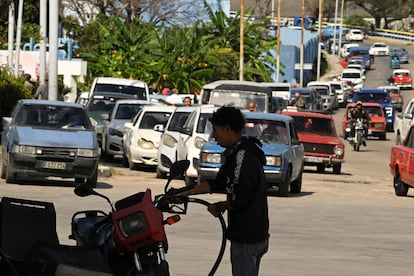
Andy is a young taxi driver from Havana who, in recent weeks, has settled into a grueling but effective routine to survive Cuba’s current fuel shortage. He dedicates one day a week entirely to waiting in line for 12 to 15 hours—the first time it was 26—to buy 40 liters of gasoline at state-run gas stations, which now sell the product exclusively in dollars. Just 40 liters: not a liter more, not a liter less, ever since the authorities regulated the amount each user can purchase starting last weekend.
This Thursday, while the taxi driver was carrying out his now-customary errand, President Miguel Díaz-Canel Bermúdez appeared on television for a news conference with state media and the foreign press. Amidst tensions with Washington, the president made it clear that “Cuba is willing to engage in dialogue with the United States,” admitting that the “economic strangulation by the world’s leading power” is taking its toll on the island’s already dire situation. He asked Cubans for “sacrifices” and “creativity” to confront the crisis. For nearly two hours, he attempted to answer questions related to the events of the past few days. “So much talk, only to leave us with more questions than answers,” remarked Andy, who listened to the proceedings on his car radio.
Those who were able to watch the president on television in Havana were fortunate, to a certain extent: having a screen on meant having electricity. At the time of his address, half the city—not to mention the rest of the provinces—was experiencing blackouts. “Whoever has power, let us know what it was about,” read messages in WhatsApp groups among friends. People were anxiously awaiting any announcement, measure, or solution to the island’s dire situation, shaken by a perfect storm combining economic crisis, deteriorating living conditions, growing unsanitary conditions in the streets, persistent blackouts, and medicine shortages, all seasoned with the renewed aggressiveness of the Donald Trump administration following the kidnapping of Nicolás Maduro in Venezuela on January 3rd.
“We are going to take measures that will not be permanent, but which, depending on fuel availability, will require effort,” Díaz-Canel stated, without specifying what these measures would be, although he hinted that they would be revealed in the coming days. True to his usual rhetoric, he again called for “sacrifice” from Cubans on the island and reiterated that “surrendering [to the United States] is not an option,” although he said he was willing to engage in dialogue with the Republican administration “without pressure.”
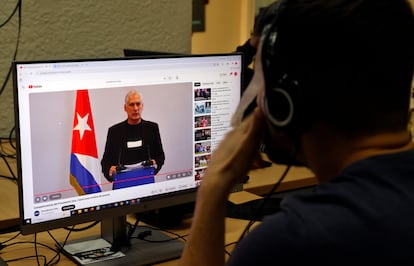
The president acknowledged that Cuba has not received fuel since last December and hinted at the need to readjust domestic consumption, promote energy conservation, and modify the distribution of basic food basket products, the already diminished state food system for Cuban families.
Following the president’s address, the University of Havana announced contingency measures, including a drastic reduction in in-person classes and academic events. “This feels apocalyptic,” says a psychology student who hopes to graduate next June and asks not to be identified for fear of reprisals. “I feel like this address is just a buffer against the blow that’s coming,” she adds. She doesn’t feel comforted by the official discourse and senses a growing tension in the air. “I fear for my safety, for my future.”
Stocking up on canned food
Confusion is spreading among Cubans, along with a growing frustration with the authorities’ outdated rhetoric. Many couldn’t even endure half an hour of listening to the president. “I don’t know what plan the Cuban government has for this country right now. But clearly, the priority isn’t the people, it isn’t the population,” reflects a young designer who lives in Vedado and has begun to gradually stockpile canned food, water, and charcoal. “Because this is going to get worse,” she explains. Faced with a government that speaks of more sacrifices, she, like other Cubans, is taking precautions in case some products disappear from the stores. “We don’t know what’s going to happen in March in this country,” she notes.
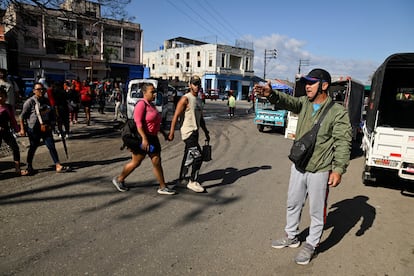
What did happen this Thursday in Havana, as a direct consequence of the fuel shortage, was the paralysis of a large part of the urban public transit system. Amelia lives east of the capital, on the other side of the Havana Tunnel, and every day she has to spend at least 1,050 Cuban pesos (a little over $2 on the informal market) to get to and from work, a journey of about six miles (10 km). The main challenge of her daily life for the past three years, she says, beyond getting food, is transportation. “My salary—about 5,000 pesos [around $11] a month—isn’t enough for this, and fares keep going up. No one can afford it,” she says.
Everything indicates that prices will continue to rise, at least in transportation. Taxi drivers’ profitability becomes unsustainable when gasoline is mostly purchased in dollars, compounded by the difficulty of finding it without resorting to the black market, where a liter can cost around 1,000 pesos, double the price at a state-run gas station. These days, that’s the only topic of conversation among chauffeurs and taxi drivers in Havana. Every car you get into leads, without even asking, to a conversation about complaints and demands.
One of the drivers for La Nave—a sort of Cuban Uber—says, while driving his pink Chevrolet, that he’s been waiting in line at a gas station in Miramar for three days, where the diesel he needs still hasn’t arrived. “If I don’t get it in two or three days, I’m going to have to park the beast,” he says about the vehicle on which his livelihood depends.
The situation doesn’t appear likely to improve anytime soon for Cubans. Havana, which suffers blackouts of between 12 and 14 hours daily, is in fact one of the “best-off” areas in the country. In the east, for example, after the national power grid went down early Thursday morning, several provinces were left in darkness for hours. There, the norm in recent weeks has been to have barely three hours of electricity in the morning and another three in the afternoon, says a young woman from Santiago who lives in the city center.
Faced with this reality, few believe in a short-term improvement. In Havana, a young man who spoke with this newspaper had spent 24 straight hours without electricity, between his home and his workplace. He followed Díaz-Canel’s address through messages sent by a friend. His conclusion is scathing: what the leader said is nothing more than a compilation of the narratives the Cuban government has used for decades to perpetuate its hold on power. “To say the same thing you’ve been saying for so many years,” he figures, “it’s better to say nothing at all.”
Sign up for our weekly newsletter to get more English-language news coverage from EL PAÍS USA Edition









































