
Bethlehem celebrates Christmas again after two years of mourning for Gaza
The City Council is resuming the festivities in the hope of boosting the economy of a city where 85% depends on tourism and unemployment has climbed to 65%
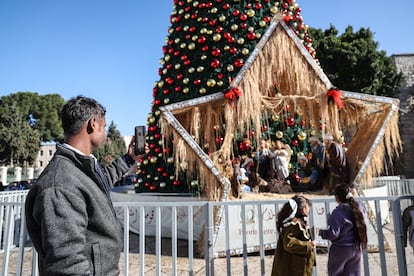

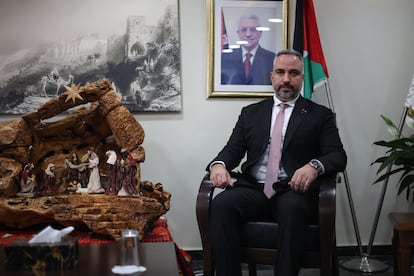
A 15-meter Christmas tree dominates Bethlehem’s Manger Square, vying in height with a key Christian landmark: the basilica built over the grotto where Jesus was born. It’s a familiar sight, but this year it has a new feel. The City Council has resumed Christmas celebrations, including the emotional tree-lighting ceremony, after a two-year hiatus in solidarity with the massacre of their fellow Palestinians in Gaza. “After two years of silence, we decided to rekindle hope and the Christmas spirit to strengthen people’s resilience. Many people lost hope, and when that happens, it’s the end,” explains Mayor Maher Nicola Canawati in an interview at City Hall. Across the square, foreign visitors are beginning to appear — albeit tentatively — taking selfies, and a Santa Claus is seen ringing his bell.
The decision is based on the optimism brought by the ceasefire in the Gaza Strip, in effect since October. In reality, there is little to celebrate. The Israeli army still kills an average of five people there each day, while settler violence, military operations, and the expansion of Jewish settlements continue to surge in the impoverished West Bank, which includes Bethlehem and has been under Israeli military occupation for decades. Conversations with locals reveal a mix of fatigue, a desire to move on, and economic hardship.
The conflict in the Middle East, following Hamas’s attack on Israel in October 2023, has driven away visitors and pilgrims (both independent and in organized groups) and cast a pall over the city. The once vibrant hotels and shops selling religious souvenirs (crucifixes, icons, Nativity scenes, etc.) are now empty or simply closed. This is the most visible sign of the change, but the drop in pilgrims has also had a knock-on effect on taxi drivers, restaurant owners, and tour guides, causing unemployment to soar from 14% to 65% during this period.
The blow is particularly devastating for Bethlehem because — unlike other West Bank cities such as Nablus, Hebron, or Ramallah — it does not have a robust industry, commerce, agriculture, or public sector workforce. This is compounded by other recent problems it shares with the rest of the West Bank: Israel has revoked entry permits for the vast majority of seasonal workers to its territory and settlements; and Palestinian Authority officials receive only a portion of their salaries. The Israeli government of Benjamin Netanyahu is holding back hundreds of millions of shekels in taxes collected from the West Bank, which it is obliged to transfer to the Palestinian Authority.
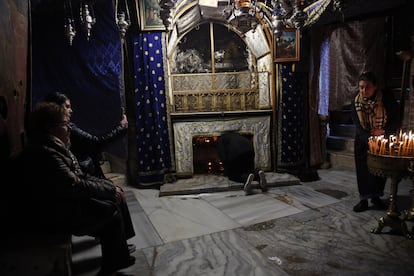
Bethlehem’s greatest strength lies in what it represents for hundreds of millions of Christians worldwide: the birthplace of Jesus and the cradle of his religion, along with Jerusalem and Nazareth. For this reason, 85% of local families rely — directly or indirectly — on tourism, primarily religious, which today is rare.
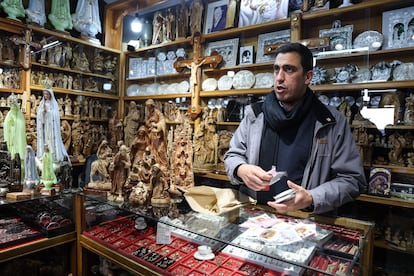
Rony Tabash, 44, a seller of souvenirs and religious and Christmas carvings, is one of the few who has managed to keep his shop open. Reluctantly, he admits. “Every day my father would tell me, ‘Rony, go open the shop.’ And I would reply, ‘But Dad, what for, if there’s no one here?’ And he would answer, ‘No! It’s for hope, for our history!’”
His grandfather opened the shop in 1927, and Rony has co-inherited a business that, he says, provides work for 25 families who carve the figurines. “No one has come to Bethlehem, and it’s been very difficult, for us and for them,” he says. His family, he adds, has been getting by with the savings they put aside during the good years.
Others have been less fortunate: they have less money and patience. Poverty has climbed to 60%, and up to 4,000 people, in a city of 32,000, have packed their bags in search of a better life in the last two years, laments the mayor. “Some have gone bankrupt; others have sold their land or businesses,” he explains. In fact, Bethlehem has experienced decades of emigration that have altered its historical religious makeup: the Christian majority — generally better connected, with more resources and relatives in countries like the United States or Chile — has been leaving, becoming a minority.
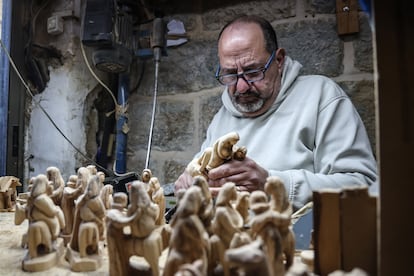
Among those who have left is a brother of Jack Giacaman, a third-generation merchant. He has settled in Dubai. Jack, on the other hand, has stayed, carving figurines and Nativity scenes from olive wood, as he has been doing for 35 years, even though few now buy them in the shop. He also struggles to export them due to the restrictions of a territory whose borders and shipping routes are entirely controlled by Israel, which has increased military checkpoints. “The last two years have been the worst of our lives,” he says after polishing a few figures. “Even during COVID-19 we had a hard time. There were no tourists, but at least we made some money.”
Given this context, the mayor often invokes the words “peace” or “future,” but above all another: “hope,” as a warning against the temptation of falling into its opposite — despair. “The suffering of the Palestinians didn’t begin on October 7, 2023,” he says. “And, even though things aren’t as we would all like them to be, we have to send a message of resilience and hope, because without hope we cannot go on.” He sums it up simply: “To tell people that there can be a better future for their children.”
The mayor says that tourism is gradually returning following the ceasefire. He adds that hotels have gone from virtually zero reservations to hosting 7,000 people on December 8, for the Christmas tree-lighting ceremony. This trend has been observed in other parts of Israel and the West Bank, such as Jerusalem.
On a typical weekday, however, the scene in Bethlehem still looks much the same. In front of the Christmas tree, it is mainly local Muslims or foreign residents living in the area, such as Indian Christian migrants. A group of about 20 Russian Orthodox pilgrims briefly revives the square’s old atmosphere, listening to their guide’s explanations.
Laure DeVries and Mike Bussay are on a scouting trip at the Church of St. Catherine, where the highest Catholic authority in the Holy Land, Pierbattista Pizzaballa, will celebrate Mass this Wednesday before midnight.
They used to bring groups of pilgrims through the Young Men’s Christian Association, better known by its acronym, the YMCA. The last one was scheduled for November 2023. “Obviously, it never happened,” says DeVries. After three postponements, they finally took the group to London to learn about the history of the YMCA, where it was founded. Now, they want to resume the pilgrimages, but they stress that they heavily depend on authorities lowering travel alerts, as these influence whether pilgrims’ willingness to travel and whether insurers will cover the risks.
Father Marcelo Ariel Cicchinelli, the Franciscan guardian of the Nativity, was born 51 years ago in Mendoza, Argentina, but has spent a quarter of a century in the Holy Land. He has witnessed firsthand the hardest moments, including the Second Intifada (with a famous Israeli siege of the Bethlehem Basilica, where around 200 Palestinian militiamen and civilians were trapped), the COVID-19 shutdown, and the past two years of intense bloodshed and suffering.
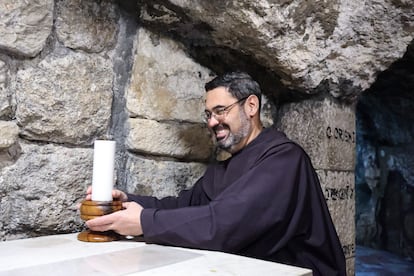
“Those who come now are people of faith, not the average tourist. Because those who come are taking risks, they’re afraid because of the news, they don’t know what they’re going to find,” says Ariel Cicchinelli. And what “for the pilgrim is an experience of faith,” where they touch the stones and visit sites without queues, represents “the return of work” for the locals. “For the people of Bethlehem, there is joy, there is a need to celebrate. But there is also a need for work.”
Sign up for our weekly newsletter to get more English-language news coverage from EL PAÍS USA Edition









































