
Palestinian reporter Youmna El Sayed: ‘My family told me I had to choose between being a journalist or a mother’
Al Jazeera’s English-language correspondent left Gaza with her children after being threatened. Now she continues to report on the war as a refugee and asks that Gaza’s plight not be forgotten
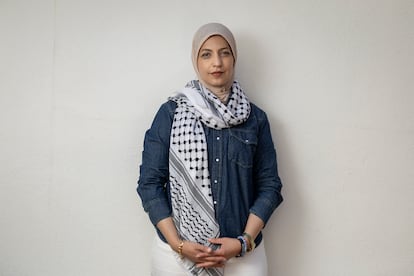
Youmna El Sayed was living in Gaza City with her husband and four children when the war broke out in October 2023. As a correspondent for Al Jazeera’s English-language network, she first reported on Hamas’ October 7 attacks that killed around 1,200 Israelis and saw 251 hostages taken. She then reported on Israel’s brutal response, which, to date, has left around 70,000 Palestinians dead. With Israel having banned foreign journalists on the ground, it was El Sayed’s work and that of other local reporters that allowed the world to know what was happening in Gaza. When she had the opportunity to leave Gaza at the end of 2023, she hesitated. “It was a very difficult decision for me,” she told EL PAÍS, speaking on November 18 in Barcelona, where she had joined the Association of Journalists in demanding that the international press be allowed into Gaza.
“There was a key moment, when my mother told me, ‘You have to choose between being a journalist or being a mother, because you can’t be both anymore,’” she says. El Sayed, 35, chose to take her children to safety. Now she lives as a refugee in her hometown of Cairo, but travels the world continuing to inform and report on Gaza post-ceasefire: “It is the genocide of a people in front of the eyes of the world,” she says.
El Sayed suffers from survivor’s guilt. “I am happy because now my children are safe, but my colleagues are still there and the genocide continues,” she says. During the time she covered the conflict, she and her children, who were between five and 12 at the time, lived through the bombings, forced displacement and hunger. “In three months, we had to flee six times,” she says. While she was looking for a way to feed her family, she reported live on the conflict. One of her reports went viral as Israel launched an attack on the building next door while she spoke. Working for Al Jazeera, El Sayed was known to the Israelis. “The Israeli army threatened me twice and that made me feel that I was the biggest threat and the biggest danger to my children’s lives,” she explained.
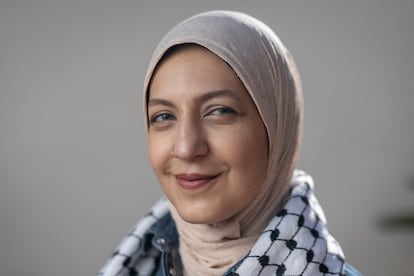
The Gazan journalist is highly critical of the international media, which she accuses of having bought into the Israeli narrative, of dehumanizing Palestinian victims and of not doing enough to independently verify the information of the Israeli Defense Forces (IDF). It is only very recently that Benjamin Netanyahu’s government has allowed foreign journalists entry into a specific area of Gaza under IDF escort. “Israel has been lying constantly, since the murder of Shireen Abu Akleh [a Palestinian journalist shot in May 2022 while covering clashes in Jenin, in the West Bank], regarding their attacks on hospitals, the flour massacre [in February 2024, 112 Palestinian civilians were shot dead trying to get food from a humanitarian convoy; Israel said it was a stampede], and the death of [the girl] Hind Rajab in a car that had 350 bullet holes...”
The international media have lost credibility, says El Sayed, and have pushed people to get information on social media, with the risk that entails of being fed disinformation: “Why do they talk about Hamas’ Ministry of Health when data on deaths or injuries is given? It is a way of manipulating, of indicating to people that they should be suspicious. It’s the Palestinian Ministry of Health.”
El Sayed can no longer work for Al Jazeera because the news outlet has been banned in Egypt since 2011. But she wants it known that she is very pessimistic about U.S. President Donald Trump’s plan for the Gaza Strip. “It is a continuation of the initial plan, which is to take over Gaza and turn it into a Riviera. Now it is destroyed, uninhabitable, but when they take it over, they will take its resources. Everyone wants a piece of the pie.” The plan, in El Sayed’s view, does not benefit the citizens of Gaza. “If they had wanted to do something for the Palestinians, they would have at least started by implementing the ceasefire agreement,” she says, adding that this is not happening. “It was agreed that there would be 600 humanitarian trucks a day entering, with fuel, cooking gas and medicines, but there are only between 100 and 160 going in. No fuel or medicine has entered and the food that arrives is sweets, chocolate, soft drinks, pre-cooked noodles. Real food, protein, vegetables, which is needed by a population that has been suffering from malnutrition for two years, is not coming in. It’s a strategy to make the people even sicker.”
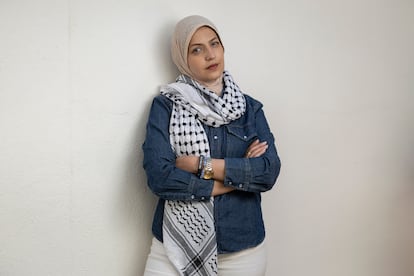
Despite her criticism of the international media, El Sayed believes it still has an important role to play in covering the war – that of investigating and documenting human rights violations. She says that in the 12 years she worked as a journalist in Gaza, she suffered continuous repression from Israel. “Nobody cared because it only affected us. Now that it has affected international journalists, there’s been surprise. They did not expect to be stopped from doing their jobs. Well, that’s Israel. For us, it is the reality we have always lived.”
Trained in languages and translation at Cairo University, El Sayed still has her entire extended family in Gaza. Sometimes they send pictures. “I don’t recognize anything because it’s nothing but a desert full of rubble.” Her departure to Egypt cost her father a lot of money. Now the Egyptian border is closed. In recent weeks, departures from Gaza to South Africa have been detected in exchange for between $2,500 and $5,000 dollars, she explains. “Israel is facilitating families’ travel from Gaza because it is moving ahead with its plan. It wants them out, so it can continue with the ethnic cleansing of the Palestinians,” she says.
After the interview, El Sayed stops in front of the exhibition that pays tribute to the almost 250 journalists killed during the Gaza war. A photo catches her attention. She touches it with her finger and gets emotional for the first time: “My partner, my friend,” she explains. Samer Abu Daqqa, 45, was a camera operator for Al Jazeera. He was killed by a drone strike while covering the aftermath of Israeli attacks on a UN school housing refugees in Khan Younis on December 15, 2023.
Sign up for our weekly newsletter to get more English-language news coverage from EL PAÍS USA Edition









































