
Colombia’s right wing pressures business leaders to take a stand against Iván Cepeda
Following a meeting between the leftist presidential candidate and a business association, supporters of former president Alvaro Uribe are urging the private sector to abandon its traditional caution
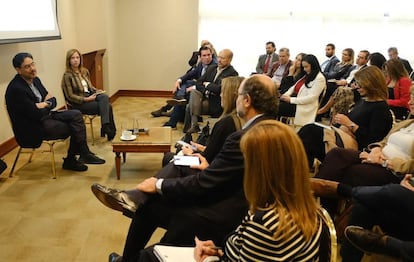

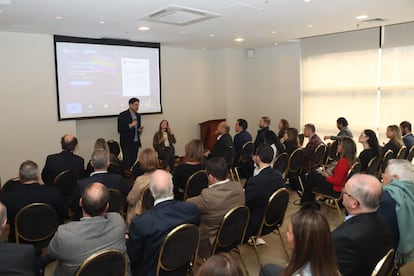
“Cancel culture” is such a new expression that it lacks a precise definition, but it’s generally associated with a collective call to boycott someone because their positions or background are considered unacceptable. Although initially said to originate from the political left or liberalism, it can equally come from the opposite side of the spectrum. This happened on Wednesday in Colombia, when the political right called on the country’s business leaders to completely shut the door on dialogue with Senator Iván Cepeda, the left-wing presidential candidate who is leading in the polls. This came after Cepeda met with business leaders affiliated with the Colombian-American Chamber of Commerce as part of what he has called a “great national dialogue.”
“I like the fact that the meeting has generated so much controversy,” Cepeda said by phone. “And more meetings of the same kind are coming; I’ll announce them as they are scheduled. Their publicity is agreed upon with the attendees, at their convenience, so I’m not doing it unilaterally or opportunistically.”
The first criticism came from former president Álvaro Uribe, who has sought to frame the 2026 presidential election against Cepeda, the candidate supported by current president Gustavo Petro, as a fight against “narco-communism.” “Colombia doesn’t need companies or trade associations that come to support those who want to implement Castro-Chavismo,” the conservative politician wrote on social media. He later elaborated in a radio interview: “Those trade associations and those companies do harm; that much needs to be said truthfully.” He accused the Chamber’s director, María Claudia Lacouture, a former minister under ex-president Juan Manuel Santos, of representing “Petro-Santism.”
Uribe was followed by other presidential hopefuls calling for a boycott. “Dear business leaders, we must learn to say NO, no matter the cost,” said Vicky Dávila. “It is concerning that AmCham Colombia, an organization that represents the interests of the business sector, is giving a platform to figures like Iván Cepeda, whose political history is aligned with the promotion of socialism, class struggle, and a narrative of hatred toward the business community,” added the Uribe-aligned senator Maria Fernanda Cabal. “When business leaders face the choice between country and money, if they choose money, they end up with neither country nor money,” criticized her fellow party member Paola Holguín. “Now they are opening the door to someone who represents the most extreme communist version, an heir to the FARC and its allies,” added the Uribe-aligned Representative Hernán Cadavid.
This dispute between Cepeda, Uribe’s supporters, and business leaders accurately reflects the current political climate for all three actors. Uribe associates Cepeda with left-wing dictators like Vladimir Lenin, Hugo Chávez, and Fidel Castro. His argument to business leaders is that the 2026 election is not just any election, but one in which the future of democracy is at stake, and therefore all sectors of society must take a stand, even to the point of refusing to speak with Cepeda.
“Behind this call to cancel Cepeda, what we really have is a call to take a stand,” says Angie González, a professor of political communication and electoral campaigns at Externado University. “Business leaders aren’t committed to any candidate because everything is still uncertain; it’s not clear that there’s anyone who can counterbalance the government’s candidate, and they can’t refuse to talk to Cepeda — that would be a big risk. They usually take a cautious approach, but the right wing is now pressuring them with the narrative that this could turn into Venezuela.”
Cepeda, for his part, defines that narrative as “fiction,” a “manipulation of public opinion based on prejudice.” He says he doesn’t identify as a communist, although he was active in communist organizations in the past, and that he sees it as one of several “outdated concepts.” He points out that he hasn’t supported an armed revolution, as his detractors who call him a guerrilla fighter claim, but rather an “ethical revolution,” a peaceful one that will end classism, racism, and war. He knows his challenge is to challenge the perception that Petro’s movement represents an anti-business stance, especially after the Colombian president’s growing clashes with business leaders like Bruce MacMaster, director of the National Association of Entrepreneurs, the largest organization in the private sector.
“In this administration, private property has been respected, thousands of companies have registered profits, and, to give an example of how we were able to work together, there was an agreement with the cattle ranchers’ association to buy land for farmers,” says Cepeda, referring to an alliance in which he played a key role, with the head of that association, José Félix Lafaurie. “It wasn’t as successful an agreement as we would have liked, but what I want to emphasize is that we managed to promote social reform, agrarian reform, without violence and with an agreement with the business community. Now we are beginning talks with them to break the ice. So that I can hear the prejudices they may have against me, and they can hear the prejudices I may have against them. I want us to have a real, sincere dialogue.”
Cepeda likes to highlight his role as a peace negotiator, both during the Santos administration and the current one under Petro. As a political leader, he offers civil society what he has been offering for years to former armed groups: the opportunity to sit down and reach agreements. This is what he has called the national dialogue, where everyone from business leaders to social activists would participate. “We want to reach an agreement, and if we do, we will sign it and find the implementation mechanisms. I have seen a positive attitude from business leaders; there are people committed to exploring the possibility,” he says.
Colombian business leaders haven’t always supported the hard right represented by Uribismo: some backed Santos in his clash with Uribe, and in the previous election, several extended a hand to Petro. But the vast majority supported Uribe when he was president, and he now wants to rekindle that affinity by portraying Cepeda as akin to Chávez. Meanwhile, the left-wing candidate is knocking on the doors of investors, who are calculating their best course of action regarding who might be the next president.
Sign up for our weekly newsletter to get more English-language news coverage from EL PAÍS USA Edition









































