
Washington links the Jensen family to the CJNG leadership in charge of fuel theft
A cooperating witness details the links with ‘El Tanque’ and ‘Primito,’ two cartel bosses sanctioned by the Treasury Department, and their business dealings with the tycoon accused of smuggling oil stolen from Pemex into the US
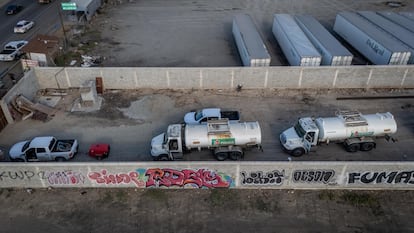

The trial of the Jensen family in the United States has shed more light on the criminal scheme that allowed thousands of shipments of crude oil stolen from Pemex, Mexico’s state-owned oil company, to be smuggled into the country. U.S. security agencies are collaborating with a protected witness who acted as an intermediary between the Jensens and leaders of the Jalisco New Generation Cartel (CJNG), whom the Treasury Department identifies as the masterminds behind the theft and smuggling of hydrocarbons in Mexico, known as huachicol. The Trump administration accuses the Jensens not only of smuggling crude oil into the U.S. disguised as other substances to evade taxes, but also of money laundering and financing a terrorist criminal organization, a category Trump used to classify a dozen cartels, one of them being the CJNG, led by Nemesio “El Mencho” Oseguera. The Jensens’ defense claims there is no evidence that they knew they were dealing with the transnational criminal organization, as their only proven contact was with the broker.
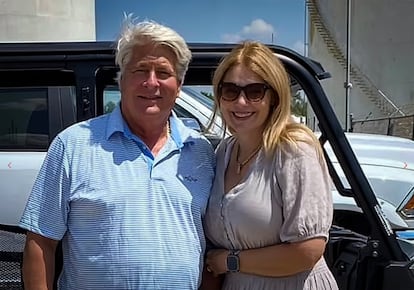
Court documents obtained by EL PAÍS show that Washington has strengthened the charges against the Jensens, especially against the family patriarch, 68-year-old tycoon James Lael Jensen, and one of his sons, Maxwell. They are now accused of illegally importing 4,170 shipments of crude oil between January 2018 and January 2025, falsely declaring them as waste or distillates (the original indictment cited 2,881 shipments). The oil was then transported to containers belonging to the family company, Arroyo Terminals LLC, located in Rio Hondo, Texas. According to the documents, the trafficked material yielded them profits of $300 million. James’s wife, Kelly Anne Jensen, and his second son, Zachary Golden, also accused of being part of the criminal scheme, have been released with conditions.
The cooperating witness, identified in court documents as CI-1 (the initials stand for “confidential informant”), has been speaking with the DEA since mid-2024. The individual revealed that he has a sustained and direct relationship with certain leaders of the CJNG cartel, especially Iván Cazarín Molina, “El Tanque,” and César Morfín Morfín, “Primito.” Cazarín Molina was designated by the U.S. Treasury Department in 2024 as part of a fuel theft network that generates millions of dollars in profits for the CJNG. The Treasury stated that El Tanque “reports directly” to El Mencho and is part of his “inner circle of trusted associates.” His main base of operations is in Jalisco and Veracruz. It is in Veracruz that he typically stores the fuel stolen from Pemex through clandestine pipeline taps, according to the bulletin issued by the U.S. agency.
In May of this year, the Treasury Department sanctioned Primito, whom it identified as the CJNG’s local boss in Tamaulipas. In that report, it indicated that Primito had focused his business on the theft of hydrocarbons and their smuggling into the United States, and that he controlled extortion payments for the crossing of fuel tankers at the border between Tamaulipas and Texas.
At the time the Treasury Department announced its sanctions, it was not known that the Jensens were linked to the cartel’s fuel theft leadership. The missing piece was the broker cooperating with Washington in the trial, who assured agents that he had befriended Primito and that they had even run a business together since 2021. He also knew Primito so well that in one of their conversations, he gave “specific references” about him.
Witness CI-1 testified that, before becoming corrupt, he had been a “legitimate and prominent businessman” with a Mexico-based company that imported oil, gas, and used oil between Mexico and the United States. He recounted that, at the time, he had to pay “the cartels” $2,000 per tanker to be able to transport his products in Mexico. He then added that he “was extorted by several cartels to do business.”
By associating himself with the leaders of the CJNG, CI-1 assumed criminal roles himself. “CI-1 explained that he acquired control of several highways in Mexico and was in charge of collecting extortion payments on behalf of the cartel, money that CI-1 would then use to bribe federal, state, and local officials,” court documents state. “CI-1 explained that, without the payment of the extortion, the cartels would not allow the transport of goods in Mexico. CI-1 then described a scheme where Mexican customs agents falsified documents to export certain crude oil products to the United States,” the court records say.
The witness specified that the oil smuggled to the U.S. was stolen from Pemex with the help of corrupt officials at the state-owned company and mentioned a U.S. company as a known buyer of the crude oil extracted in Mexico, although the company’s name was not included in the court documents. In several conversations with DEA agents in 2024 and 2025, the witness “detailed his knowledge of the CJNG hierarchy” and mentioned leaders such as Héctor Álvarez Álvarez, alias “El H”; Carlos Roel, alias “Chuy 7”; and other individuals identified only by their aliases: El X, Nareda, and Chimuelo.
Having detailed his dealings with the cartel leaders, CI-1 then discussed his business dealings with the Jensens, the documents indicate. The Jensens’ lawyers argue that they may not have known they were dealing with the CJNG or that the fuel they received was stolen. This is an effort to refute the serious accusation that they financed a terrorist organization. Regardless of this dispute, the court documents show that a business relationship did, at the very least, exist between CI-1 and the Jensens.
The witness agreed to wear a wire at meetings with the Jensens and to have recorded phone calls with them. Several of these meetings involved discussions about transporting crude oil to the United States and the payments that would be made in return. In mid-April, CI-1 summoned James and Maxwell to an urgent meeting in Dallas to discuss a supposed crude oil supplier from Mexico offering an unbeatable price. It was a staged meeting to obtain evidence against the Jensens.
There, in a crowded seafood restaurant, the intermediary spoke about his relationship with the CJNG (saying he “worked with those guys even though he didn’t like them”), mentioned the cartel leaders’ names, and recalled that just two months earlier, Trump had labeled them “damned terrorists.” The documents don’t record the Jensens’ reaction, but it served to support the authorities’ argument that they “knew” they were dealing with El Mencho’s cartel. Shortly after that arranged meeting, on April 23, the Jensens were arrested.
Sign up for our weekly newsletter to get more English-language news coverage from EL PAÍS USA Edition









































