
BBC faces unprecedented crisis over Trump documentary: ‘Error of judgment’ or manipulation?
Experts in journalistic ethics consulted by EL PAÍS analyze the trigger for the clash between the British public media corporation and the US president
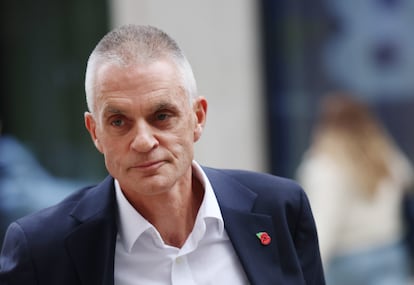
The BBC is facing an unprecedented crisis over the controversial editing of a speech by U.S. President Donald Trump in a documentary broadcast a year ago. The incident has profoundly impacted trust in the professional ethics of the prestigious British corporation, as well as journalistic practice in general. The resignation of the BBC’s director-general, Tim Davie, and the head of the news division, Deborah Turness, as those ultimately responsible for what the UK’s public broadcaster described as an “error of judgment,” has not stemmed the earthquake shaking the foundations of an institution whose founding principles stipulate its commitment to “public service.”
The debate surrounding the editing of Trump’s speech in the hours leading up to the January 6, 2021, riots at the U.S. Capitol raises the stakes for the BBC’s most crucial intangible asset: its credibility. Resolving this requires determining whether it was genuinely a disastrous lapse in judgment or a deliberate manipulation. For Rasmus Kleis Nielsen, professor of communication at the University of Copenhagen and former director of the Reuters Institute for the Study of Journalism at Oxford University, “the editing of the Panorama program that sparked the scandal is the kind of issue that worries those who fear that journalism can sometimes become a form of disinformation.”
Rasmus Kleis Nielsen: “An example that will endure”
Professor Nielsen has spent years researching the current state of journalism and the challenges it faces, and he notes that “Trump’s support for the January 6 [2021] insurrectionists is well documented.” However, the controversial editing of the documentary “created a substantially misleading representation of what he actually said in the speech in question.” When consulted by EL PAÍS, Nielsen concludes: “The team involved in the documentary, as well as the BBC staff who oversaw it, are responsible for providing critics of the network — and those who distrust public service media or fear that journalists try to distort the facts rather than report them — with an example that will endure.”
Faced with the threat of a lawsuit for “no less” than $1 billion from the president of the United States, the BBC has reacted with a show of unity. On Tuesday, Davie appeared via video call before the entire staff alongside the chairman of the BBC’s governing board, Samir Shah, to declare himself “very proud of this organization” and to assert that its journalists do “incredibly important work.” Although he admitted to “mistakes that have cost us,” his combative tone echoed the sentiment expressed 24 hours earlier by the outgoing head of news, who had denied the existence of any “institutional bias.”
This last point is relevant for Julie Posetti, director of the Centre for Journalism and Democracy at City St George’s, University of London. Posetti considers the case “an unfortunate error of judgment, but also unnecessary because Trump’s speech did not require editing to convey a message that clearly sounded like incitement to insurrection.” Posetti adds that, nevertheless, “a simple production error has been manipulated into an unjustified accusation of systemic bias and a political campaign to neutralize one of the world’s most credible news organizations.”
Renate Schroeder: “Deceptive editing; not institutional bias”
Renate Schroeder, director of the European Federation of Journalists (EFJ), emphasizes the importance of using the term “misleading editing” rather than “institutional left-wing bias” to contextualize this case. For Schroeder, “the latter is very dangerous when discussing the growing attacks against public service media.” She acknowledges that “the BBC has admitted that the editing of President Trump’s speech on Panorama was an error of judgment and has apologized.” She calls for a focus “on the future of the BBC.” And she warns that “successive government budget cuts have weakened the BBC’s core news output, both in its regional and national news programs and the World Service.”
Awaiting a response after Trump’s deadline of 10 p.m. GMT (5 p.m. EST) Friday to carry out his threat against the BBC, the corporation’s clear strategy is to acknowledge the error in the documentary Trump: A Second Chance? broadcast on the Panorama program on October 28, 2024, a week before the presidential election, while simultaneously defending its professional conduct. The argument thus becomes a simple axiom: combining two parts of the president’s speech — separated by 50 minutes — was a mistake, but not intended to “mislead” (the term chosen by the BBC in its defense).
The edited video showed Trump saying, “We’re going to walk down to the Capitol... and I’ll be there with you. And we fight. We fight like hell.” In the actual speech, however, the U.S. president said he would join his supporters “to walk down to the Capitol, and we’re going to cheer on our brave senators and congressmen and women” and “peacefully and patriotically” make their voices heard. The reference to “fight like hell” was made 50 minutes later, at the end of his speech. Edited in this way, Trump appeared to be making a direct appeal to the unrest, which left five people dead and resulted in more than 300 arrests.
The BBC acknowledges it was a mistake, but on Tuesday, Davie emphasized that it has already cost two people their jobs, including himself, and urged everyone to “move on.” His message echoes the stance already taken by the corporation, which has apologized for the “error of judgment,” clarifying that the intention was to summarize the key points of the message in a “condensed format” to illustrate what happened on January 6, 2021.
Jeff Jarvis: “Pretext for a right-wing attack”
This is where Jeff Jarvis, an expert on media transformation since the rise of the internet, considers the video’s editing “unfortunate for not making it clear that it was a fabrication.” Author of the influential blog BuzzMachine.com and classic essays on the subject such as Death to the Mass, Jarvis argues that “it was consistent with what Trump intended to do, which was to incite the crowd to anger.” He concludes that “the most unfortunate thing is that this mistake is being used as a pretext for a right-wing attack on the BBC, journalism, and freedom of expression.” This “relentless attack on journalism and other social institutions” means, according to Jarvis, that “there will be informational chaos until we build new media institutions.”
According to the BBC’s own analysis of the controversy, management concluded that the segment containing the phrase “fight like hell” should have included a visual effect, such as a flash, to clearly distinguish it from the original segment. Additionally, the BBC denied deliberately omitting Trump’s use of the word “peacefully.”
The documentary did not generate any complaints after its initial broadcast over a year ago. However, the BBC has now received over 500 complaints following the leak early last week of an internal report alleging bias on the part of the network, not only in its coverage of the U.S. presidential election but also of the Gaza conflict and its reporting on transgender rights.
For Josep Carles Rius, president of the Catalan Information Council (the only body in Spain associated with the international Press Council network that oversees journalistic ethics), and author of books such as Journalism and Democracy in the Age of Emotions, the dilemma presented by this case “does not have an easy or simple analysis.” He adds: “Journalists have a legitimate right to draw conclusions from the facts, but when explaining them, they must be careful not to distort reality. The Trump statements used in the documentary are verbatim, but those that are the subject of controversy were made at the beginning and end of a speech, and the result can give an impression that distorts the meaning.”
The prevailing opinion, Rius concludes, “is that [Trump’s] speech motivated the attack on the Capitol; that link existed, and the American justice system addressed it accordingly. It was therefore legitimate to connect both events in the report, but the complementary force of the speech’s editing magnified the first. It would have been more ethically sound for the journalist to have argued the link without needing to combine two parts of a speech.”
Rigor, credibility, and trust
The accusation of systemic bias goes straight to the heart of what the BBC aspires to represent: rigor, credibility and trust; and the resignations of Davie and Turness, for the moment, have not been enough to restore the reputation of an institution whose neutrality remains in the eye of the storm, especially in the current climate of gradual polarization.
The management team at Panorama, for its part, remains in place for the time being. The program Trump: A Second Chance? had been commissioned to the independent production company October Films, and since the controversy erupted, former editors of Panorama, a flagship show for the BBC, have suggested that highly sensitive, politically charged productions should be produced by the BBC itself, rather than outsourced to external companies. According to the most recent YouGov data, in June 2025 the BBC was the most-trusted British media outlet, followed by the Financial Times.
As a result, the corporation faces a difficult succession, just as the government is about to review the BBC’s Royal Charter (constitutional basis), once the current 10-year period concludes in 2027. At the center of the discussion is the funding model, through a compulsory license fee that households pay each year, currently set at £174.50 (about $230), a direct citizen’s grant that entails immense responsibility.
On Tuesday, Secretary of State for Culture, Media and Sport Lisa Nandy pledged to present her proposals shortly, but in an appearance before the British parliament, she adopted a conciliatory tone regarding an institution she praised for standing out above the rest in an era of blurred lines between fact and opinion. “It represents us all,” she told the House of Commons, where, faced with recent pressure, she cautioned against the difference between “raising awareness of serious allegations” and a “sustained attack” by a sector of British politics. Given this role as a “light on the hill” that Nandy described the BBC as performing, mistakes are paid for dearly and crises are managed in the public eye, with coverage such as the current situation, in which the British Broadcasting Corporation itself is both judge and jury.
Sign up for our weekly newsletter to get more English-language news coverage from EL PAÍS USA Edition









































