
Larry Changa, leader of the Tren de Aragua, is trying to negotiate with the Colombian president to stop his extradition
The story of the co-founder of the criminal gang, who has been imprisoned in Bogotá since June 2024, reveals how he turned Colombia into the group’s operational hub and financial refuge
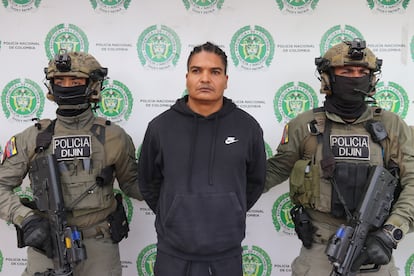

The name Larry Amaury Álvarez Núñez, better known as “Larry Changa,” is becoming increasingly prominent in Colombia. The 47-year-old Venezuelan, born in Maracay, Aragua state, is one of the founders of the Tren de Aragua, the transnational mega-gang whose criminal operations have expanded as far as Europe. One of Latin America’s most wanted criminals, who has been held in Bogotá’s La Picota prison since June 2024, made an unusual proposal to the Gustavo Petro government to enter the latter’s “total peace” process. Although the government rejected it just hours later, the attempt revealed his efforts to evade an imminent extradition to Chile by presenting himself as a figure with political negotiation skills.
Justice Minister Eduardo Montealegre was the one who rejected the initiative. “We will not allow criminal groups, under the pretext of participating in peace processes, to mock international justice to seek impunity for their crimes,” he said.
The Tren de Aragua is no small threat: it has a confirmed presence in 11 countries — from Chile and Colombia to Spain, Italy, and Portugal — and is being investigated by Europol for human trafficking and money laundering in Europe.
Between 2024 and 2025, Colombian authorities captured at least 60 members of the gang. Nine of them face extradition to the United States, Chile, or, in one case, Venezuela. A judicial source close to the case explains that the arrest of Larry Changa is particularly important. “This is the most representative capture we have due to his operational role in the organization and his seniority and recognition within the gang, but he is not the most criminally capable. There have been less high-profile arrests, but of more violent figures than him.”
For Chile, his arrest has been especially significant. “He is like the local Pablo Escobar, because he led the group’s expansion into that country,” says the source. Fifteen months ago, the Colombian Supreme Court approved Larry Changa’s extradition, but President Gustavo Petro has not yet signed it, and is not required to do so.
Meanwhile, the Attorney General’s Office has a case against Changa for drug trafficking, which has just produced its first results regarding assets. EL PAÍS obtained a report from an operation last September in which authorities seized nine vehicles and properties that were in the hands of individuals identified as Larry Changa’s frontmen, valued at nearly 3 billion pesos, or around $780,000. Three properties were in the Colombian city of Armenia, another in the nearby municipality of Circasia, in the coffee-growing region, and the remaining one in Cúcuta, on the border with Venezuela. Four more vehicles were found between Bogotá and the coffee region, in cities such as Pereira, Quimbaya, and Armenia.
The trail of the most powerful member of the Tren de Aragua in Colombia was first tracked in September 2023, when the Pozo Almonte court in northern Chile, responsible for protecting legal rights, issued an international arrest warrant against him. In early 2024, the Attorney General Offices of Chile and Colombia formed an alliance to carry out a joint investigation against Changa, the second most powerful man in the Tren de Aragua behind Héctor Rusthenford Guerrero Flores. The leader of the Tren de Aragua — commonly known as Niño Guerrero — has been held since 2023 in Tocorón prison in Venezuela, following a military intervention at the facility, which had operated for years as the group’s operations center.
According to intelligence reports, Larry Changa entered Chile in January 2018 to expand the Tren de Aragua’s power in that country. He did this through a small cell called La Compañía. He set up fronts such as a fast-food outlet and a bakery in the Chilean capital. In July 2024, he was captured in Colombia on a coffee farm in Circasia, where he was trying to stay under the radar by using a false name. By that time, according to authorities, he was in charge of Tren de Aragua operations in Venezuela, Colombia, and Chile.
Another country that has monitored his criminal activities is Bolivia, where authorities began tracking him for crimes related to human trafficking, migrant smuggling, and drug trafficking. At that time, they identified three names: Carlos González Vaca (“Estrella”), Hernán Landaeta Garlotti (“Satanás”), and, of course, Larry Álvarez Núñez. The first two were captured in March 2022 in three simultaneous operations conducted in Chile. However, at that time, authorities had limited information on Larry Changa and were only beginning to identify his role within the organization. In recent years, he has been sought by authorities in 196 countries.
In Bogotá, where several members of the mega-gang have taken refuge, the Tren de Aragua has been active since 2018. At that time, they specifically arrived in the neighborhoods of Bosa and Kennedy, in the southwest of the city, with the goal of recruiting and controlling territories for drug dealing, human trafficking, extortion, and kidnappings. A source close to the judicial process notes that intelligence indicates the gang is now trying to expand its reach to Medellín and Cartagena.
Authorities have not identified how many people work for the Tren de Aragua in Colombia. “It’s impossible to count them because the group is very disorganized and not hierarchical, giving each member a great deal of autonomy,” the source explains.
Colombia is no longer just one of the gang’s operational centers but also a financial refuge. According to reports from the newspaper El Tiempo, Larry Changa received profits from operations in Chile through crypto-assets, illustrating how the group has modernized its methods to move money and evade international control systems.
Sign up for our weekly newsletter to get more English-language news coverage from EL PAÍS USA Edition









































