
Journey to the epicenter of Mexico’s floods: Poza Rica calls for aid, and fast
Four days after the Cazones river overflowed, neighbors in one of the Mexican communities most seriously impacted by torrential rains are still clearing mud — and noting the absence of government assistance
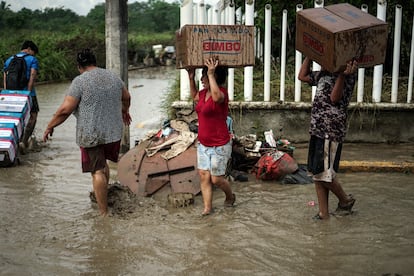

“The light is back, the light is back!” The euphoric shouts of neighbors in Ignacio de la Llave, Poza Rica, in the Mexican state of Veracruz, ring out. It is Tuesday and four days have passed since the Cazones river overflowed with devastating force, and only now are some sectors beginning to get back their electricity. The community’s residents run to charge their phones and the few devices that survived the water that rose up to 13 feet in some places, washing away everything in its path. Wall are still wet, there is mud up to their knees and the smell of rotting animals under earth and sun is inescapable. In this area, one of the most affected by the floods, disaster is as present as if the waters had risen just last night. Assistance and the authorities have been late to arrive, say the inhabitants of Ignacio de la Llave.
Rubber boots have become part of the daily uniform of the Pozarricenses, along with brooms and shovels. Some wear face masks as they try to salvage things from the debris, among which everything has taken on the same color as mud. Certain images repeat throughout different streets: entire families carrying mattresses, washing machines, furniture and clothing to piles that grow larger and larger. A convoy of about 15 water tankers and trucks carrying supplies travels along the highway toward Poza Rica. The vehicles bear signs with large letters announcing “Solidarity support from Mexico City to Veracruz”. Still, residents say that they have yet to receive any assistance.
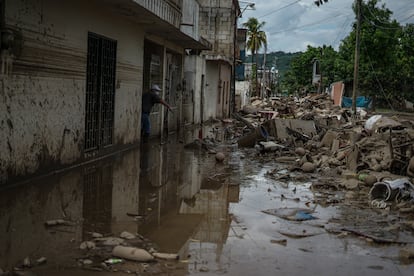
With the first rays of the sun, flood survivors begin their new daily routine of attempting to clean where it looks like a tornado has passed. In contrast to Huauchinango, in the state of Puebla, where members of the military, marines and volunteers work in coordination, in Poza Rica — a town of nearly 190,000 residents — government assistance has been scarce. During EL PAÍS’s visit to the epicenter of the disaster that left at least 64 dead and 65 missing throughout five states, military and civil service personnel is disperse, or simply absent altogether. “It’s already the fourth day and they haven’t arrived, or they came briefly. There’s a lot of work to be done on houses. Those of us who live here can’t cope with removing all the mud, and everything that has been ruined. We need a lot of help,” says 64-year-old Roberto.
Poza Rica is upset and its discontent with authorities is widespread. Their complaints reached President Claudia Sheinbaum on her visit to the area on Sunday. Residents received her with shouts and demands. They also criticize declarations made by their Morena Party governor Rocío Nahle, who classified what happened as “a slight overflow.” Families complain about the lack of warning and emergency plans. Their indignation blends with exhaustion and uncertainty, which is perhaps the prevailing sentiment. They say they do not know how many people actually died in the state — the official tally stands at 29 — or what will happen to their homes.
The main roads have been overwhelmed by chaos. Cars and trucks travel from one place to another looking for help, with no apparent plan, in trajectories made confusing by a lack of functioning traffic lights. Restaurants and stores are closed and many businesses were raided during the first days following the floods. “The looting started quickly,” Roberto says. “We stayed in our homes to keep watch, even though there is nothing left to steal.”

Residents say the only real help has come from the Red Cross and from influencers. The name of Yulay, a State of Mexico Youtuber with more than seven million followers across platforms, frequently comes up. He brought supplies and water to these neighborhoods. On his social media, he has called out how the government has blocked access to those bringing assistance to certain areas. When questioned on the subject on Monday at her daily morning press conference, Sheinbaum responded that, “the Mexican people are very generous and always want to help”, saying that her administration is working “with all transparency” on the distribution of donations.
On her command, Secretary of the Economy Marcelo Ebrard set up a work group to coordinate the mobilization of resources and private sector donations. The goal, according to Ebrard, is to identify the most urgent needs in collaboration with state governments and to channel support efficiently. Ebrard announced on Tuesday that once the emergency has subsided, economic reactivation programs will be designed for affected regions.
Trapped in Álamo Temapache
The rains hit hard in five states: Veracruz, Puebla, Hidalgo, San Luis Potosí and Querétaro. Last week’s torrential downpours left more than 100,000 homes damaged. Veracruz was the most seriously impacted, and Álamo Temapache, located some 34 miles from Poza Rica, is one of the towns that has been most vocal about insufficient government assistance. There, neighbors have been living in the mud for days, amid similar scenes of streets full of furniture, fallen trees and devastated houses. But the difference is that in Álamo Temapache, even less help has arrived. Its roads were blocked by landslides, leaving access difficult.

Here, disaster took them by surprise, at night. It was Thursday when “the nightmare”, as it is referred to by neighbors, came to call. Since then, showers have caused panic. “It starts to rain and we think it’s going to happen again. We don’t know what to expect,” they say, the sound of the stream that washed away their homes audible in the background. Electricity comes and goes.
On Tuesday, a Red Cross caravan with an ambulance and five trucks carrying food and water set out from Poza Rica towards Álamo. When they saw the vehicles, neighbors started running to them. “Leave food here, we are many families, help!,” shouts a woman from the other side of a bridge that no longer exists, leaving them stranded.
Volunteers park in front of a line of some 300 people. They pass out emergency kits and attend to wounds inside the ambulance. Gabriel López, head of the flood operations for the Mexican Red Cross, says as he passes out the supplies that the rains have created a complicated situation. “The operation is running into difficulties in access because of roadblocks and landslides and other mishaps like flat tires,” he says. The mission in this municipality is to deliver food, hygiene supplies and cleaning kits that have been provided by donors like Walmart, to around 2,000 families. “Many volunteers have also lost their homes, and they work under physical and emotional strain coordinating the delivery of aid and monitoring health risks resulting from the flooding,” says López.
Reluctant heroes

It was five o’clock in the morning on Friday in Poza Rica, and Alejandro Olarte was trying to get some sleep. Warnings about the rising levels of the Cazones river were multiplying on social media, but no one knew with any certainty how serious the situation had become. “Something wasn’t sounding normal,” he remembers. He decided to wake up his mother and some neighbors. They got into the car and left — minutes before the water reached their street. Having returned to his home, Olarte surveys what remains of what was once his small food store: nothing.
Stories like Olarte’s are repeated throughout Poza Rica. People who warned their neighbors, who ran door to door, who helped others to climb onto roofs. They speak of the man who activated the Pemex “whistle,” the municipality’s disaster alarm, presumably on his own volition, with no order from his superiors. “I don’t consider myself a hero,” clarifies Olarte. As is often said in the wake of natural disasters, most of the work falls to the survivors themselves. Young people carry heavy furniture, others prepare food for neighbors and distribute water. “We are the only ones who know how much we are suffering,” says Jorge, an Alamo resident. “Here we no longer ask ‘How are you?’ We just say, ‘courage’.”
Translated by Caitlin Donohue.
Sign up for our weekly newsletter to get more English-language news coverage from EL PAÍS USA Edition









































