
Attack on Daniel Noboa’s convoy reveals the mix of discontent and violence gripping Ecuador’s rural areas
The president has unsuccessfully tried to quell the social protests with heavy military deployments and economic announcements
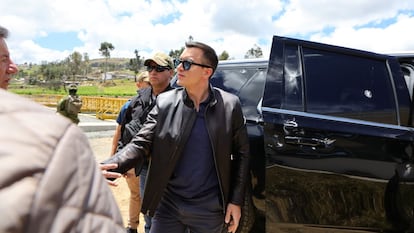
The presidential motorcade advanced on Tuesday along the rocky, dusty road of Sigsihuayco, a rural community perched in the Andean mountains of El Tambo, in the province of Cañar. At the front, a military tank led the way, followed by at least six armored vehicles carrying the president of Ecuador, Daniel Noboa. From the start, the air was thick with tension. On both sides of the path, dozens of gathered demonstrators unleashed their anger against the convoy. From both flanks, locals began hurling stones of various sizes. Others showed their fury by striking the black car bodies with sticks, while windows splintered, their shattering sound frightening the presidential staff inside, who recorded the attack on video.
In those images, released hours later by the government, the largest stones can be seen shattering the bulletproof windows of the official vehicles. The convoy did not stop, but the scene exposed the violence into which rural discontent has degenerated — fueled by a growing list of demands: the repeal of the decree that removed the fuel subsidy, the reduction of VAT from 15% to 12% (as it was before Noboa came to power), the resupply of hospitals without medicines, and a long-unanswered cry for security.
In recent days, the president has tried to contain social protests by showing up in person amid a heavy military presence and by promising economic aid. He has toured the provinces most affected by the Indigenous mobilization, escorted by soldiers and making announcements about public works and social welfare programs. But in El Tambo, the day’s photo did not turn out as the government had hoped.
Noboa had arrived in that area to announce the construction of a wastewater treatment plant and a sewage system for the region. According to Environment and Energy Minister Inés Manzano, around 500 people began to approach the convoy just as the president was about to begin the event. “They threw stones, and there are bullet marks on the president’s car,” the official reported, adding that she filed a formal complaint with the Attorney General’s Office. The president was unharmed. He took part in the planned event, and, according to the minister, continued with his schedule “as normal.” However, she warned that the attack “will not go unpunished.”
Police arrested five people who will be prosecuted for terrorism and attempted murder against the president. “There is nothing peaceful about this. Shooting at the president’s car, throwing stones, damaging state property — these are criminal acts,” Manzano declared outside the Attorney General’s Office.
The attack took place on the 16th day of demonstrations called by the Confederation of Indigenous Nationalities of Ecuador (CONAIE), the country’s largest social organization. The protests were an immediate response to the elimination of the fuel subsidy, a measure that raised the price of a gallon of diesel from $1.80 to $2.80. For most rural communities, that increase means more than just an economic adjustment — it represents a direct blow to their way of life.
Through its official X (formerly Twitter) channels, Conaie denounced “a brutal police and military action” during the president’s arrival in El Tambo. In videos shared by the organization, military vehicles can be seen firing tear gas indiscriminately, even at women and the elderly. The group also stated that five of its members were “arbitrarily detained.”
Cañar is one of the provinces that make up the Andean highlands of Ecuador’s Sierra region, home to Kichwa Indigenous communities that, for the most part, supported Noboa in the April elections. Back then, the young politician represented an alternative to Rafael Correa’s movement, whose candidate failed to win enough votes to return to the presidency. Today, barely six months later, those same communities have shifted from supporting the president to resisting him.
Sign up for our weekly newsletter to get more English-language news coverage from EL PAÍS USA Edition









































