
Witness to North Korea executions: ‘He was only 22 and shot for watching and distributing 70 songs and three South Korean TV series’
Defectors from the Pyongyang regime describe the growing repression and deterioration of human rights denounced by the UN

Article 1 of North Korea’s Reactionary Ideology and Culture Rejection Act, passed in 2020, outlines why Pyongyang believes the legislation is necessary: The law “contributes to the strengthening of our sense of ideology, revolution, and social class by launching a powerful battle to obstruct the inflow and distribution of reactionary ideology and culture and anti-socialist ideology and culture.” Article 7 adds that strict punishments, including the death penalty, will be applied to any citizen “bringing in, viewing, and distributing reactionary ideology and culture, depending on the severity, regardless of the reason and the offender’s social class.”
The measure is part of a trio of regulations that Kim Ilhyuk, a North Korean defector, calls “the three evil laws.” They were implemented during the Covid pandemic lockdown and intended to impose even stricter control on the population of the country, which Kim Jong Un, North Korea’s supreme leader, rules with an iron fist. The focus, to a large extent, was on young people and their interaction with foreign cultures.
The executions, Kim says, are public and carried out by firing squad. He has witnessed several. There are usually two every three months. Attendance is mandatory. And, among those executed, he remembers seeing someone he knew well. “He was like a younger brother to me. He was only 22, but he was executed by firing squad on the charge of watching and distributing 70 songs and three South Korean television series.”
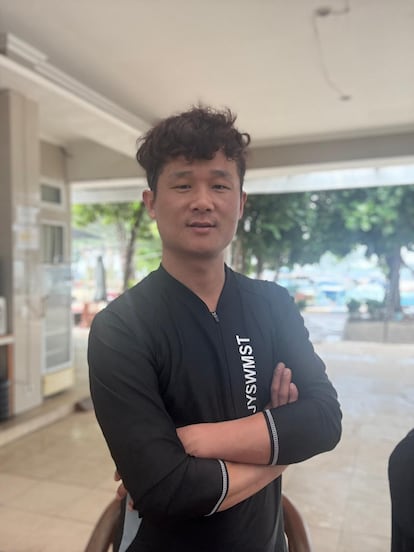
It took place around July 2022. A year later, Kim managed to escape with his pregnant wife and his mother. They fulfilled a plan his deceased father had made them promise to years earlier. They escaped by boat and reached the South Korean island of Yeonpyeong. They carried his father’s ashes with them in an urn.
Today, the family lives in Seoul. Kim is on a video call while devouring an ear of corn and holding his daughter, born shortly after the family’s arrival, on his knees. After a while of talking, he also takes a chubby baby in his arms, who looks at the camera.
The defector talks like a machine gun and apologizes for eating at the same time: he barely has time to tell his story between his day job at a restaurant, which he has just finished, and his night job driving a forklift at a logistics center. He says he works hard to support his family. “But I’m happy.”
He decided to flee after he and his wife were sentenced to re-education through forced labor under another of the “three evil laws,” the Youth Education Guarantee Act. They were punished for living together as a couple without registering. They evaded punishment for a while with bribes, but they convinced themselves it was better to escape.
His account echoes the conclusions of a report by the UN Office of the High Commissioner for Human Rights (OHCHR) published on September 12. The document states that the death penalty has been “more widely allowed by law and implemented in practice” in the last decade, and that the regime carries out executions even for consuming or disseminating foreign information (such as publications, films, or music) from nations it describes as “hostile.”
Pyongyang, the document asserts, has introduced “more laws, policies and practices that are subjecting citizens to increased surveillance and control in all parts of life”; it has “institutionalized” forced labor and intensified its disconnection from the rest of the world. “In 2025, the country remains more closed than at almost any other time in its history,” it notes. “No other population is under such restrictions in today’s world.”
The findings are based, among other things, on interviews with 314 victims and witnesses who fled the country during the period analyzed (from 2014 to 2025), which largely coincides with Kim Jong Un’s reign.
“The essential message is that things haven’t improved, but they have worsened in some areas, such as freedom of expression, executions, food, and technological surveillance,” said James Heenan, representative of the UN Office of the Human Rights Commissioner in Seoul, via videoconference.
For Heenan, the key is “how to move forward” and to extract gestures from Pyongyang in certain areas, such as political prisons. North Koreans can end up incarcerated for reasons as arbitrary as using a newspaper carrying a picture of one of the leaders’ faces to plaster a wall (a genuine case, according to Heenan). He believes there is the possibility of “gradually improving” if there is a political space for some openness. “The background to all of this is the current isolation. The country has never been so isolated.”
Seongyun Ryu, who fled North Korea in 2019 while completing the seventh of his 10 years of mandatory military service, says that when Kim came to power in 2011 he tried to introduce changes, until he was warned by those at the top of the “hierarchy” that it was dangerous to change course and better to maintain the system. “Kim went back to being like his father [Kim Jong-il].”
According to the UN, the “sense of hope” of Kim’s early years was followed by purges and repressive measures. “Government control over all aspects of citizens’ lives was the most absolute in decades,” the document states. This control accelerated during the pandemic, facilitated by “surveillance technology.”
Seongyun, 30, is answering a video call from the Philippines, where he’s studying Western Philosophy. He would like to be a teacher, giving classes on “the importance of freedom.” He speaks in excellent English, which he has learned since arriving in South Korea by walking across the Demilitarized Zone (DMZ), the line that divides the Korean peninsula into north and south at the 38th parallel and serves as a border between two countries that are technically still at war — they never signed a peace treaty after the 1950-1953 Korean War.
He prepared his escape for three years. He never shared his plans with anyone. “You can’t even trust your best friend.” When he set foot on South Korean soil, he thought that even in 100 years, the North would not be able to match the South in terms of mentality, infrastructure, or health conditions. He then weighed 52 kilos (he is 1.68 meters tall), and his condition corroborates the malnutrition that affects more than 40% of North Koreans according to the UN.
Seongyun believes that what Pyongyang fears most is the population’s exposure to the rest of the world. “If people had other information, they wouldn’t obey the Workers’ Party [the country’s single ruling party].” He adds: “Kim Jong Un says we’re strong because of nuclear weapons. But for North Korea, information coming from other countries is like a nuclear weapon.”
Internet access is almost nonexistent; there is only a strictly controlled national intranet, available primarily to research institutions and civil servants. The media is under tight government control. And everyone must participate in weekly self-criticism sessions, the primary goal of which is collective surveillance and indoctrination.
In Seongyun’s words, it is a “brainwashing” process carried out through Juche ideology, the official ideology developed by North Korea’s founder, Kim Il-sung, grandfather of the current leader. “It’s like a religion,” in which members of the Kim dynasty are like “gods,” and an offense can lead to death.
Lina Yoon, a senior researcher at Human Rights Watch focusing on North Korea, believes the increasing repression is related to the failure to achieve the prosperity promised by Kim Jong Un. At the beginning of his reign, there was a period of economic experimentation and slight opening. Then came new rounds of sanctions for the country’s nuclear program, the short-circuiting of trade, and the fiasco of international negotiations in 2018 and 2019. Since then, signs of repression have begun to emerge. “There are suddenly a lot of ideological campaigns to demonstrate loyalty, especially among young people.” They are a generation, says Yoon, exposed to unofficial information, especially among those living near the borders. “They’ve seen a lot of Chinese or Korean films and series, and are more accustomed to expressing discontent with government policies.”
Kim Ilhyuk, the other defector, explains that since he was a child, he grew accustomed to watching South Korean television and listening to the radio. His father did so every day. Being close to the border, they were able to tune into the neighboring country’s frequencies. He was struck by the “realistic,” “sincere,” and “truthful” content, compared to that of North Korea. The news openly criticized the government, pointed out the president’s mistakes, and reported on accidents. “In North Korea, national incidents were never reported. There is absolutely no criticism of the party institutions. All we receive is fake news.”
He believes the repressive shift is related to the widespread consumption of foreign culture among young people. Series, music, and movies were shared on USB drives and could easily be watched at friends’ houses. “I guess the North Korean government sensed something was seriously wrong”; that it was a sign of “corruption,” a threat to the “socialist way of life,” he concludes.
Sign up for our weekly newsletter to get more English-language news coverage from EL PAÍS USA Edition









































