
Milei’s ‘immortalist’ guru seeks followers in Spain
José Luis Cordeiro, the Argentine president’s friend and muse, talks about his ideas of eternal youth, which he claims will be available by 2045
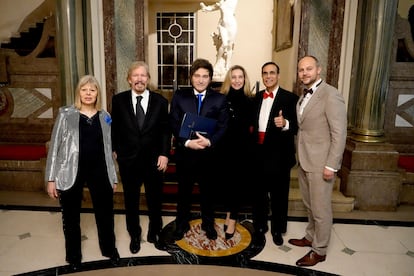

“Inspiring”, “impressive”. These are the words Argentine President Javier Milei uses to praise his “dearest friend” before quoting said friend’s belief: “We are going to see the death of death.”
It is August 16, 2025, in Buenos Aires, and Milei is delivering a speech for the Torch of Freedom Award hosted by the non-profit group Liberty International. In the auditorium, along with Milei’s sister Karina, Milei’s friend applauds. It is José Luis Cordeiro, a self-proclaimed “immortalist” and “visionary”, a 63-year-old from Caracas who considers himself as much Venezuelan as he is Spanish, and who aims to turn Madrid into the epicenter of his movement and the main platform from which to launch his message.
What message? Well, that we are not going to die, that we will live forever. Not the children or grandchildren of those who inhabit the Earth today, but all humans who make it to 2045 and wish to keep going. It is a message that produces fascination in Milei, according to Cordeiro: “He [Milei] is an immortalist. He believes that soon we will be able to cure aging and prevent death,” he said in an interview broadcast in February.
Things have changed for the worse for Milei since that speech. A corruption case is dogging both the president and his sister, and an electoral setback in Buenos Aires province has kickstarted a crisis in the Argentinian right. Consequently, Milei cancelled an appearance at an event hosted by Spain’s ultranationalist party Vox in mid-September. It did not seem like the right time to cross the Atlantic.
On shaky ground, Milei can at least depend on support from Cordeiro, a man who has been considering Milei “a genius” for 20 years, he says. It is a support proportional to the backing that the president has given Cordeiro, who is now trying to sign Madrid’s conservative regional premier, Isabel Díaz Ayuso, and the mayor of the Spanish capital, José Luis Martínez-Almeida, up to his Madrid initiative.
But who is José Luis Cordeiro? He presents himself as an “economist, futurist and transhumanist”, but also as an engineer from the Massachusetts Institute of Technology, though neither his international conference agenda nor his curriculum have spared him from scientific questioning and refutation.
In 2017, El PAÍS published a story in which researchers from the fields of biochemistry, neuroscience and artificial intelligence dismantled some of his wildest claims, including those promising eternal youth. “In 30 years, I will be younger than today,” he said in 2017 in the local daily La Voz de Galicia. In 2045, “death will be optional,” he told El Mundo in June. His choice? “I plan to be immortal.”
–Will the planet be a viable place to inhabit if none of us die? A journalist asks.
–Of course, he said. The planet could cater to trillions.
He replayed his “immortalist” speech in August in the Spanish news outlet Ok Diario, insisting that within two decades new technology will be available and we will enter an era in which human and artificial intelligence will merge.
Summit in Madrid
Cordeiro is in the midst of promoting the International Summit on Longevity, which will take place in October in Madrid and in which he himself appears as president. As he told El Mundo, his intention is to get this event, which has been held since 2021 in the Spanish capital, inaugurated by either Ayuso or Almeida. He is a big Ayuso fan. In 2023, Liberty International awarded the regional premier of Madrid the same award granted to Milei two years later. As for Mayor Almeida, the summit program has already penned him in as a potential participant. Consulted by EL PAÍS, Almeida’s team noted that “nothing has been confirmed.”

The summit is not Cordeiro’s only activity in Spain, where his Madrid Singularity Forum also talks about life extension, robots and space travel. Then there is the so-called “March for Longevity”, also to be held in October.
Friendship and collaboration
While Milei’s relationship with the Madrid economist Jesús Huerta de Soto is well known in Spain, the link with Cordeiro has gone almost unnoticed. And not because Cordeiro has not wielded influence over Milei. In an interview broadcast in February by the ZZEN YouTube channel, Cordeiro said that Milei told him in 2016 that his dog, Conan, was dying of cancer. “We can clone him,” Cordeiro proposed. There followed the alleged creation of at least four dogs cloned from Conan’s cells in an American laboratory.
“Within Milei’s complex and contradictory world, the cloning of Conan, together with the belief that the dog’s spirit helps him to communicate with God, was key to the emergence of the idea that he had a calling to be president,” says journalist Juan Luis González, author of the biography El Loco.
Milei and Cordeiro met at the University of Belgrano 20 years ago, according to González. Over time they struck up a friendship. But it has been more than that: it has been a collaborative relationship, with mutual influence and promotion. If Cordeiro says that the first time he saw Milei, he struck him as a genius and maintains that he is “the best thing that has happened in a century in Argentina,” Milei says that Cordeiro has been his inspiration.
In 2016, when Milei was just a noisy economist with fringe ideas, he already shared billing with Cordeiro at a conference on “singularity in economics.” Two years later, Milei used Twitter – now X – to promote the book The Death of Death, co-authored by the “FORMIDABLE” Cordeiro. It is a book that has brought them even closer. Presented by its co-author as an “international best seller,” The Death of Death is central to Cordeiro’s promotional activity – he has even worn a tie bearing the title. However, its best publicist has been Milei.
According to Cordeiro, Milei attended the presentation of the book in 2019 in Buenos Aires. During the presidential campaign, two articles in the newspaper La Nación underlined the importance of the book to him. The first, in 2022, mentioned it taking pride of place “on the living room table.” The other, in 2023, stated that Milei quit therapy after reading it. EL PAÍS asked Milei’s team if, as Cordeiro claims, Milei is an “immortalist.” There was no response. EL PAÍS has also tried to speak with Cordeiro or obtain his answers in writing, but to no avail.
Religious echoes
Milei’s praise of Cordeiro one evening in August in Buenos Aires in which they ended up hugging, constitutes the latest milestone in a relationship that, for biographer Juan Luis González, is crucial to the president’s worldview. “Cordeiro has contributed to the fact that, along with his obsession with hard economic data, Milei has developed a tendency to believe in what is beyond scientific explanation,” he says.
Cordeiro is not the only esoteric character in the Milei universe. He has also been attracted to Benjamín Solari Parravicini, known as the “Argentine Nostradamus”. Dead in 1974, his followers decipher predictions in his writings, like the attacks on the World Trade Center and the coming to power of Milei, who would be the “gray man” who would emerge to save Argentina, according to Parravacini’s 1971 prophecy. The tendency runs in the family: Karina Milei, who now acts as General Secretary of the Presidency, has been a tarot reader.
Más ecos de una noche de libertad.....Liberty International World Conference 2025.#LIWC2025 #LIWC #milei pic.twitter.com/qIksRzOAYM
— José Cordeiro #TransVision #Future #HumanityPlus (@cordeiro) August 20, 2025
Political scientist José Natanson, director of the Southern Cone edition of Le Monde Diplomatique, ascribes Milei’s interest in Cordeiro to two common phenomena in the extreme right. The first, the “fascination” with technology, as opposed to the “distrust of science”, which is seen as the domain of progressives. The second, the self-perception of far-right leaders as “embodiments of a national refoundation”, which is often dressed up as a “religious invocation” and “mystical echo.”
Similarly, Javier Cavanilles, a journalist specializing in conspiracy theories and author of books such as Satanism. History of the Cult of Evil, says “As messianic as Trump, Milei sees Cordeiro as a vehicle to combine technological fascination and mystical thought, a mixture that permeates the Dark Enlightenment movement, increasingly popular in Silicon Valley. Cordeiro is a pioneer of an esotericism that masquerades as scientific, and which is on the rise; it is not unlike Adventist evangelism in the United States. The difference is that here the prophecy does not refer to the second coming of Christ, but to a great discovery that will change everything,” he explains.
One sociologist specializing in digital politics, Iago Moreno, sees Milei as a representative of the “esoteric” school – more determined to follow “gurus who promise eternal life through technology” than to wage a purely religious holy war. Above all, Milei sees a clue in Cordeiro’s rhetoric that confirms his belief in market fundamentalism. “In his anarcho-capitalist fanaticism, where nothing is superior to the market, Milei considers that eternal life can be bought, whether through therapies that achieve immortality, cloning clinics or medium services,” says Moreno, who warns that there is an underlying message here to beware of: if life is an “object of consumption,” no one really “owns” theirs.
Sign up for our weekly newsletter to get more English-language news coverage from EL PAÍS USA Edition









































