
Nicolás Maduro entrenches himself behind the banner of foreign threat
Chavismo responds to Washington’s maneuvers with troop mobilizations, enlistment campaigns and nationalist messages
Political tensions between the United States and Venezuela’s revolutionary government have escalated to levels similar to — and even higher than — those seen in the early days of Juan Guaidó, the opposition leader who, with White House support, declared himself “interim president” of the South American country in 2019.
Three weeks ago, the United States doubled the reward for information leading to the capture of Venezuelan President Nicolás Maduro for his alleged ties to terrorism and drug trafficking. Days later, it announced the deployment of eight warships, submarines, aircraft, and 4,000 marines off the Venezuelan coast in a long-anticipated anti-narcotics military operation. “The Maduro regime is not the legitimate government of Venezuela. It is a narco-terror cartel. Maduro is not a legitimate president. He is a fugitive head of this drug cartel,” said White House spokeswoman Caroline Leavitt, commenting on the operation.
Venezuelan Defense Minister Vladimir Padrino López responded by saying that his country will patrol its coasts, including the Lake Maracaibo basin, with drones and warships. He also announced a coordinated border operation with Colombia that includes the deployment of 15,000 troops. The regular soldiers will join the four million reservists of the National Militia already deployed.
Chavismo organized two national military enlistment campaigns for volunteers, while public television and radio stations called for people to defend the dignity of the homeland and enlist against “imperial aggression.”
After both countries closed a failed round of negotiations regarding a commitment to democracy before the presidential elections in July 2024, the White House toughened its accusations against Maduro.
The Trump administration’s about-face toward Venezuela appears to be the result, among other things, of patient persuasive work by María Corina Machado, the Venezuelan opposition leader, who worked in areas of the U.S. leadership where the perception that Maduro’s presence in power is unsolvable and, moreover, not a U.S. problem, has been sown.
In her speeches from hiding over the past few months, Machado has tried to make Washington understand that Maduro is an objective threat to the United States and the entire region. “This is the Venezuela that is coming,” Machado said in her latest video, which went viral on social media on Wednesday. “The return of democracy to Venezuela will open up investment opportunities unseen in emerging markets… We are millions of Venezuelans, driven by hope, who demand democratic change.”
Since returning to office, Donald Trump has made decisions that have disenchanted the opposition in Caracas: mass deportations of Venezuelans and stigmatization in the internal debate; the travel ban and the end of visas for citizens born in Venezuela; and the end of international cooperation, which has overshadowed many democratic activities in the country, especially with the liquidation of USAID aid.
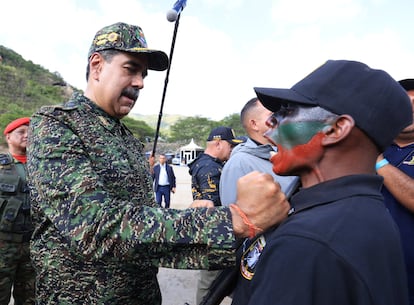
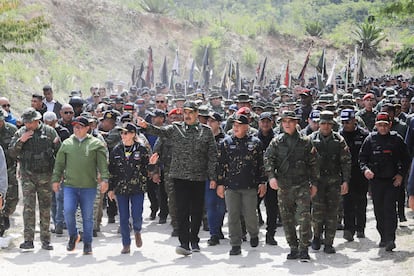
Meanwhile, Maduro receives demonstrations of support from his followers, amid a state of alert camouflaged by the everyday normality of the streets. “Here is the strength that Hugo Chávez sowed, a perfect fusion of the people, the Armed Forces, and the police. We are united in the defense of our beloved Venezuela, with the morale of patriots,” said Maduro at the closing ceremony of the second Revolutionary Special Operations Course, which is comprised of mixed armed forces, on national television amid repeated displays of support.
A threat to Venezuela
Without major obstacles, the ruling party has agreed with the country’s authorized political actors that the United States’ threat is against Venezuela, rather than Maduro or the Chavista government. The National Assembly, meeting in extraordinary session, approved a few days ago an agreement in support of Maduro, rejecting the possibility of foreign intervention. The text won the votes of the opposition parties tolerated by Chavismo.
“Any foreigner who enters Venezuela illegally will never leave; he will stay here,” said Jorge Rodríguez, president of the National Assembly and Maduro’s privileged political operative, in his speech during the legislative debate. “This is not bravado. We are obligated to defend our territory. Our sky, our sea. This is not a choice.”
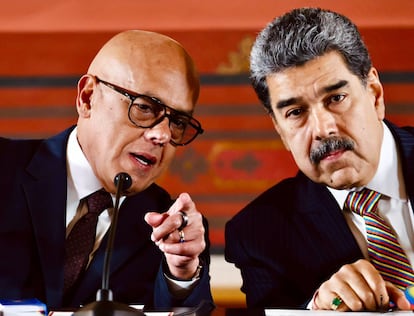
“We shouldn’t echo the stupidities invented by Washington,” Rodríguez added. “These psychological warfare strategies are increasingly futile and less elaborate. No country on the continent has had more victories against drug trafficking in recent times than Venezuela. In this country, not a single square meter is planted with coca leaves or marijuana.”
Although many Venezuelans, particularly those in the diaspora, seem hopeful, the possibility of a military intervention that would produce a change in power remains a difficult scenario to envision. It’s much more complex than it appears and has several potentially catastrophic consequences.
Machado and other spokespeople for her current faction in exile have asserted that military intervention would not be necessary to force a return to legality in Venezuela, and that the internal and external pressure the Chavista ruling class would receive could force a negotiated agreement to leave power.
“Take a count of how many attacks we’ve resisted since Commander Chávez came to power, 26 years ago,” said Diosdado Cabello, the regime’s second-in-command, on his television program. “How many times has the national and international right said, ‘That’s it, they’ve fallen, tomorrow is the day.’ Then no one apologizes. Anyone who still believes in the calls of the opposition, of the radicals, at this point, should be awarded the Honor of Merit for being an idiot,” he said.
Sign up for our weekly newsletter to get more English-language news coverage from EL PAÍS USA Edition









































