
Ortega orders increased ‘revolutionary surveillance’ to ‘capture and prosecute traitors’ in Nicaragua
The leader praised China and Russia on the 46th anniversary of the Sandinista revolution, in a ceremony that lacked any high-profile international guests

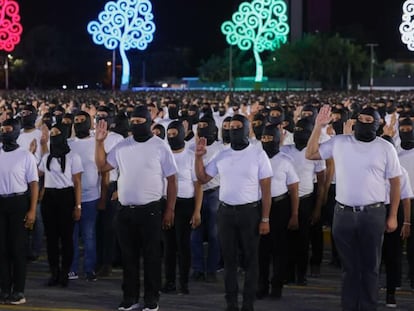
Nicaragua leaders Daniel Ortega and Rosario Murillo presided over the 46th anniversary of the Sandinista Revolution on July 19, in Managua’s Plaza de la Fe square, in one of the most foreign-inspired celebrations in living memory. In the absence of any prominent international guests, including the notable absence of the heads of state of Cuba and Venezuela, the Sandinista leader devoted much of his speech to praising China and Russia, while advocating for the dissolution of the United Nations and virulently attacking Europe. In his 81-minute address, Ortega ordered the redoubling of “revolutionary vigilance” to “capture and prosecute traitors” in the Central American country.
It was a speech that largely put to sleep the thousands of public workers, armed forces and special guests who attended the Sandinista celebration, but it also served to expose an Ortega whose speech was increasingly slow and stumbling, in keeping with his 79 years of age. Instead of presenting a national agenda or addressing the repression his regime maintains against any critical voice, a president accused of crimes against humanity showered praise on Beijing and Moscow.
The two most prominent figures on the flower-decked stage were Ma Hui, vice minister of the International Department of the Central Committee of the Communist Party of China; and Anna Yurievna Kuznetsova, deputy speaker of the Moscow State Duma. Both were low-profile officials within the Moscow and communist establishment.
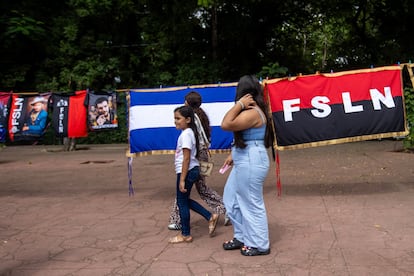
Ortega’s speech was disorganized and riddled with vague historical references. He referenced the era of Napoleon, ranting against the French, and moved on to Nicaragua’s independence in 1821 and Simón Bolívar’s struggle for liberation. The leader invoked Mao Zedong and the Red Army “as sources of inspiration” for the Sandinista Front. He attributed the defeat of Nazism to China and Russia and accused Europe of “continuing to commit colonial crimes” under the auspices of NATO. At the same time, he extolled a supposed “national peace” while 54 people remain imprisoned for political reasons and a sustained crackdown on dissidents persists in the country.
Just as it appeared that his slow-burning tirade might be coming to a close, Ortega issued a threat that, despite being a reality for years now, reaffirmed the terror that Nicaraguans live under in their own neighborhoods: the political surveillance and harassment faced by anyone who disagrees with the Sandinista regime, and who is often betrayed by their own neighbors.
“That’s why we must always keep up with all the tasks we have to accomplish: study, preparation, work, and various activities, without neglecting the place, the neighborhood where we’re working, without neglecting our revolutionary vigilance,” Ortega stated, ordering the redoubling of a practice that dates back to the first Sandinista regime in Nicaragua in the 1980s. “And that way, there will be no room for terrorists, conspirators, traitors, because they will know that as soon as they are discovered, they will be captured and prosecuted,” said the president.

Since 2023, the Nicaraguan Police have activated a new political surveillance structure in the neighborhoods “to ensure peace.” Officers coordinate with coordinators of the Citizen Power Council (CPC), the Sandinista officials who dominate the localities. The initiative was part of the ironclad police state imposed by the Ortega-Murillo regime since late 2018, when it crushed the rebellion that began in April of that same year with bullets. On July 19, Ortega made it clear that he was redoubling his efforts to deepen the practice.
In Nicaragua, raids against individuals considered opponents of the regime continue unabated. The latest major incident occurred a few months ago, culminating in the capture of retired General Álvaro Baltodano, one of the most influential figures in the Sandinista economic and military circles in recent years. Subsequently, some 20 retired military officers were arrested, thanks in part to intelligence gathered through this surveillance system used by the intelligence directorates of the Army and Police, and coordinated by the Ministry of the Interior.
The relationship with Trump
One of the most ambiguous passages of the speech was his reference to Donald Trump’s anti-immigration policies. Ortega mentioned the separation of migrant families and the labor shortage in the United States, but completely avoided naming the Republican president, who is primarily responsible for the current tightening of deportations.
Since returning to the White House in January 2025, the Trump administration has intensified the deportation of migrants to unprecedented levels. According to Immigration and Customs Enforcement (ICE) data, 30,000 immigrants were arrested and 18,000 deported in June alone. Nicaragua is among the top destinations: 22 flights carrying 2,527 Nicaraguans have been sent back to Managua in just six months.
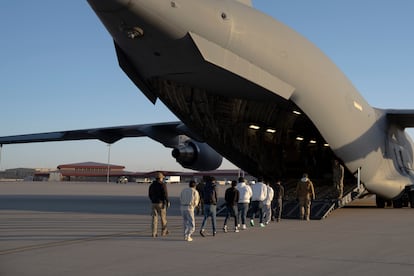
Despite this, Ortega made no reference to these flights or directly questioned Trump. He simply said that “migrants are the ones who do the hardest work” and that “American companies are complaining.” The omission of Trump’s name contrasted with his constant attacks on Europe, which he accused of racism, colonialism, and crimes against the Palestinian people.
Consulted last week by the media outlet Divergentes, the U.S. State Department stated that there is no formal bilateral agreement with the Ortega-Murillo regime for the latter to accept deportees. “There is no agreement. The Nicaraguan regime has the responsibility to promptly accept the return of its citizens residing illegally in the United States. The Murillo-Ortega dictatorship understands the consequences of not fulfilling this responsibility,” said an official from the department headed by Marco Rubio.
Sign up for our weekly newsletter to get more English-language news coverage from EL PAÍS USA Edition









































