
Mexican Church rejects dialogue with cartels to combat violence
Religious leaders are inclined to share successful experiences for peace without interfering in the ‘responsibilities of the state’
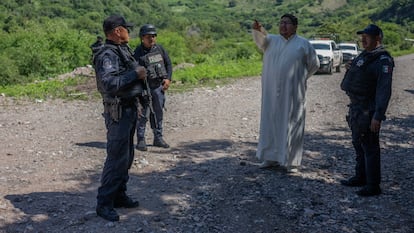

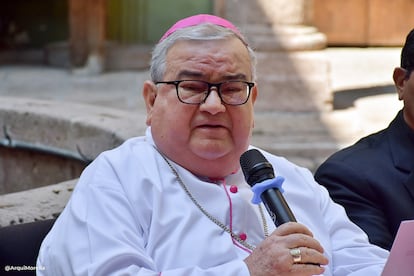
The Mexican Catholic Church has denied that it is training priests to engage in dialogue with criminal bosses in the country’s most conflict-ridden areas. This has emerged after a workshop was organized by the Pontifical University “to strengthen the negotiation skills of priests and agents” in which several dozen religious leaders participated. The controversy stems not only from this seminar, but also from insistent statements by the Archbishop of Morelia, Carlos Garfias, about the need for civil society and governments to engage in dialogue with drug traffickers to quell the violence experienced in states like his own, Michoacán.
Garfias has expressed his willingness to speak with President Claudia Sheinbaum to this end, but the Catholic hierarchy has distanced itself from these efforts, which “are the responsibility of the state.”
It has been three years since various religious groups launched the National Dialogue for Peace, a platform to unite and build experiences against violence, of which members of the Church themselves are recurrent victims. The initiative brings together universities, social organizations, community leaders, various institutions, and diverse faiths, seeking to share methodologies to “repair damage and strengthen peace at the local level” in dialogue with national and international actors, according to a statement. “Perhaps [Archbishop Garfias] has that interest [in mediating with drug traffickers], but it’s not the official proposal,” said the executive coordinator of the National Dialogue, theologian Jorge Atilano, although he does not rule out that in the communities where they intervene “there may be aggressors or people who have experienced difficult situations, but it’s only about generating meetings for security and justice in which they agree to participate.” According to Atilano, the dialogues would end there.
Garfias has insisted that it would be advisable to revisit Colombian experiences, but the Church has been quick to clarify that it refers to “seeking elements for conflict mediation, not dialogue with criminal groups,” in Atilano’s words. The executive coordinator of the peace agenda prefers to limit the Church’s initiatives to the systematization of experiences from municipal councils, the police, schools, universities, and businesses, among which they have already defined 300 practices that they intend to share. These are the frameworks for the training of stakeholders and the controversial workshop held at the Pontifical University last Monday and Tuesday.
Also controversial was the document that the Church presented in March 2024 for signature by the two candidates then running in Mexico’s presidential elections, one of them the current president: Sheinbaum signed it out of the desire for peace expressed therein, but she disagreed with the wording of the text, which referred to the “militarization” of the country — one of the major criticisms leveled at her predecessor in office, Andrés Manuel López Obrador, also a member of the ruling Morena party, who had several clashes with the clergy over his passive policy against crime. Once in power, Sheinbaum received the episcopate and tried to heal wounds and strengthen ties that still exist. The president has relied on the Church for her campaign to disarm the population, for example, and the Basilica of Guadalupe is one of the churches where weapons are received, which families decide to get rid of in exchange for state aid.
Atilano also acknowledges a fluid dialogue with the current Mexican federal administration, mentioning meetings with the Ministry of the Interior and the Ministry of Public Security, with which “we collaborate in the construction of peace and civic justice councils,” he asserts.
The Catholic Church has a long tradition of fighting the violence plaguing Mexico, so it’s no surprise that some of its members are showing their intention to act as mediators in armed conflicts. Its intervention in numerous rural communities, but also in the conflict-ridden outskirts of many cities, where it has always positioned itself as a defender of the most vulnerable, has made it a target of threats and murders.
In June 2022, the growing cruelty of organized crime led to the shooting of two Jesuit priests and a persecuted tour guide who had taken refuge in a church in the Sierra Tarahumara of Chihuahua. The incident marked a turning point in relations between Catholics and the López Obrador government, which was the target of bitter criticism. The Church was speaking out against the insecurity that has dominated the country in recent years. The death threats received by a rural priest in Chiapas were finally carried out in October of last year, after the van he was traveling in was riddled with bullets. This was another case that raised alarm.
Despite Mexico’s historically non-denominational nature, the country is deeply religious, and some faiths are gradually gaining ground, including in political life, such as those of Evangelicals and Christians. The Catholic faith has permeated the performance of some recent administrations, with presidents now attending rituals or publicly expressing their beliefs, something unthinkable decades ago. Sheinbaum visited Pope Francis, for whom she always expressed her admiration, while a presidential candidate, and she has been photographed at the Basilica of Guadalupe, a sacred site for Mexicans, where the largest pilgrimage in the world after Mecca is celebrated.
As in much of Latin America, Mexican authorities have not yet fully distanced themselves from the Church. Quite the contrary, it is the faithful who occasionally raise their voices to criticize the numerous instances of violence, but also of the poverty and discrimination suffered by millions of inhabitants, and to demand that governments fulfill their duties. The Jesuits and the Church in general took this stance midway through the previous term, following the high-profile murders. That is why they are now distancing themselves from the bishops’ initiatives that seek to go further in search of solutions toward peace.
Sign up for our weekly newsletter to get more English-language news coverage from EL PAÍS USA Edition









































