
White House says Putin and Kim Jong Un traded letters as Russia looks for munitions from North Korea
National Security Council spokesman John Kirby points out that the letters were ‘more at the surface level’ but that talks on a weapons sale were advancing
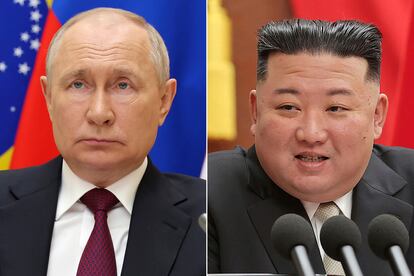
The White House on Wednesday said that it has new intelligence that shows Russian President Vladimir Putin and North Korean leader Kim Jong Un have swapped letters as Russia looks to North Korea for munitions for the war in Ukraine.
National Security Council spokesman John Kirby detailed the latest finding just weeks after the White House said that it had determined that Russian Defense Minister Sergei Shoigu during a recent visit to Pyongyang called on North Korean officials to increase the sale of munitions to Moscow for its Ukraine war.
Kirby said that Russia is looking for additional artillery shells and other basic materiel to shore up its defense industrial base.
He added that the letters were “more at the surface level” but that Russian and North Korean talks on a weapons sale were advancing. The leaders exchanged the letters following Shoigu’s visit, he said.
“Following Shoigu’s visit another group of Russian officials traveled to Pyongyang for follow-on discussions about potential arms deals between the DPRK and Russia,” Kirby said, using the acronym for the Democratic People’s Republic of Korea.
Kirby declined to detail how U.S. officials had gathered the intelligence.
Shortly before the White House unveiled the new information about North Korea and Russia’s weapon talks, North Korea launched a ballistic missile toward its eastern waters, according to South Korea’s military. The missile test came just hours after the U.S. flew at least one long-range bomber to the Korean Peninsula in a show of force against the North.
The Biden administration has repeatedly made the case that the Kremlin has become reliant on North Korea, as well as Iran, for the arms it needs to fight its war against Ukraine. North Korea and Iran are largely isolated on the international stage for their nuclear programs and human rights records.
In March, the White House said it had gathered intelligence that showed that Russia was looking to broker a food-for-arms deal with North Korea, in which Moscow would provide the North with needed food and other commodities in return for munitions from Pyongyang.
Late last year, the White House said it had determined that the Wagner Group, a private Russian military company, had taken delivery of an arms shipment from North Korea to help bolster its forces fighting in Ukraine on behalf of Russia.
Both North Korea and Russia have previously denied the U.S. allegations about weapons. North Korea, however, has sided with Russia over the war in Ukraine, insisting that the “hegemonic policy” of the U.S.-led West has forced Moscow to take military action to protect its security interests.
At the United Nations on Wednesday, the United States, the United Kingdom, South Korea and Japan urged North Korea to halt arms negotiations with Russia.
Any Russian-North Korean arms deals would violate U.N. Security Council resolutions, backed by Russia, that prohibit all countries from buying or obtaining any arms from the North, the four countries said in a joint statement.
“This sends the wrong message to aspiring proliferators that if you sell Russia arms, Russia will even enable your pursuit of nuclear weapons,” according to the statement that was read by U.S. Ambassador to the United Nations Linda Thomas-Greenfield, who was flanked by diplomats from the three other countries.
President Donald Trump traded letters with Kim during his administration in an unsuccessful bid to encourage the North Korean leader to abandon his nuclear weapons program.
Sign up for our weekly newsletter to get more English-language news coverage from EL PAÍS USA Edition









































