
US aid cuts severely undermine Senegal’s fight against HIV
By reducing staff and access to treatment, the suspension of USAID and other funding threatens the country’s progress in HIV care
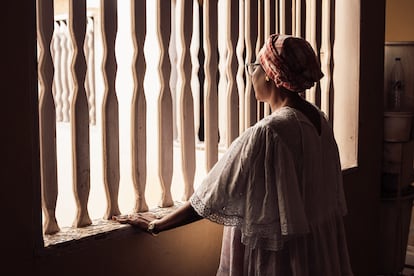

Mariam, a Senegalese mediator for the NGO Aboya who has been living with HIV since 2007, lowers her head and cries. In recent months, three of the patients she monitored to ensure they took their medication have died. She says that, due to the cuts in international aid, patients have faced difficulties in accessing their treatments consistently and discreetly with the help of a counselor.
“We even used to pay for people with disabilities to go to their appointments. We can’t anymore,” says Mariam who is a volunteer in the only NGO in the country that serves women living with HIV. Discrimination is intense; Mariam is still afraid of being discriminated against and asks EL PAÍS not to use her real name and to photograph her from behind.
“I also don’t have transport provided now. But I can’t give up, so I pay for it myself and visit them at their homes so they can continue their treatment. Today I am strong thanks to the fact that I also had a mentor,” she says during aninterview in a secret location to the north of Senegal’s capital, Dakar.
This is how Aboya has been operating since 2001, benefiting nearly 500 women and their children in three regions of Senegal, and guaranteeing their anonymity. Due to the slashing of funds from donors such as the United States, 15% of Aboya’s activities were suspended. Ndeye Astou Diop, president of Aboya, explains that, due to suspension of USAID, its mediators are no longer able to work in the care centers.
If mediators like Mariam do not visit patients, some of whom have been rejected by their families, there is no guarantee that they will take their meds and their physical and mental state cannot be monitored. This is one of the countries where people with HIV suffer the most discrimination: according to the 2024 Stigma Index 2.0, 18% of the population suffered stigmatization due to their HIV status, which adversely affects their diagnosis, treatment and follow-up. That’s why mediators and community workers are vital.
In 2024, Senegal had 48,000 people living with HIV, according to UNAIDS data. Of these, 79% were underantiretroviral treatment and 73% no longer carried a viral load. The adult HIV prevalence rate was 0.3 per cent, thethird lowest in West Africa, after Mauritania and Niger. The number of new cases had also decreased since 2022, together with a sustained drop in deaths since 2013.
But this progress is threatened by the closure of USAID and cuts to other funding, according to doctors from the National Council for the Fight against AIDS and the Ambulatory Treatment Center (CTA) in Dakar. The cuts, they say, have especially affected social organizations and community workers who were monitoring, educating and accompanying patients.
Not only is there a lack of resources for the mediators of Aboya and for community workers from other organizations but “we have observed a very rapid decline in all prevention-related activities,” said Dr. Fatoumata Ly, of the National Council for the Fight against AIDS, at a press conference in Dakar. The Council cites a survey in which 59% of actors on the ground and leaders of community organizations reported a reduction in adherence to antiretroviral treatment. This is due to the suspension of support groups and therapeutic education in 24 of the 156 care centers in the country.
Ly also spoke of a decline in the distribution of free condoms, the teaching of awareness and access to daily pre-exposure prophylaxis (PrEP) pills as well as a rise in the interruption of treatment due to the suspension of appointment reminder systems and problems with HIV data collection. This affects the eight regions of a total 14 in Senegal in which the U.S. President’s Emergency Plan for AIDS Relief (Pepfar) – set up by Republican George W. Bush in 2003 – operated. The National Council, whose 2024 budget was 24% dependent on the United States, is still assessing the impacts of the cuts on its operations and its beneficiaries.
Civil society organizations such as the National Alliance of Communities for Health (ANCS), with which some 200 community-based organizations fighting HIV are associated, are also in the process of assessing the impact. “We have not lost inputs, but we have lost activities and response capacity,” says Debia Dia, the organization’s legal representative.
ANCS lost USAID funding for the OVOD project, which provided technical assistance to health regions and districts to identify priority health needs while also providing assistance with communication and pedagogical activities. In all, USAID accounted for 12% of its budget. In January, with the suspension of USAID, there was a sudden cessation of activities in 430 community organizations and 45 community radio stations. Among the worst affected programs were those related to HIV and sexual and reproductive health.
Our moral duty is to continue and strengthen the programs. Otherwise, 20 years of struggle will be lost and all the advances made in our health system will have been in vainIbrahima Sy, Senegal Minister of Health
At another press conference, Senegal’s Minister of Health, Ibrahima Sy, said he will assess the effects caused by the cuts in order to mobilize resources from other donors, the private sector and the State. The government, he says, does not rule out raising money through taxes on tobacco and digital transactions. “Our moral duty is to continue and strengthen the programs. Otherwise, 20 years of struggle will be lost and all the advances made in our health system will have been in vain,” he said, adding that the government will prioritize prevention, to reduce the burden on the health system further down the line. But while the authorities work up a policy, patients are looking for a solution and putting pressure on the services that are still provided by other organizations. For example, the president of Aboya says that women and children who received support from USAID-funded programs are now seeking care in Aboya, which is still supported by resources from the Global Fund to Fight AIDS, Tuberculosis and Malaria. “We also had problems with the distribution of antiretrovirals, but we solved it by mobilizing other partners,” says Ndeye Astou Diop. The Global Fund, in turn, does its calculations. This year, amid cuts by several donors, it had to slash 10% of Senegal’s planned budget. “When I arrive in Dakar and they tell me that they count on the Global Fund because the other donors are withdrawing, I tell them that their donors were also our donors. We have the same problems,” says Mark Taylor,head of the organization’s team in Senegal. The U.S. contributed 33% of the fund’s resources. “If we don’t reach our goal [of raising $18 billion for the next funding cycle from 2027 to 2029] this November, we’re going to have to cut things back,” Taylor adds. Key Populations Experts and community organizations warn that the greatest risk is in losing progress with key at-risk cohorts, namely men who have sex with other men (with an HIV prevalence of 27.6%), female sex workers (5.8%) and intravenous drug users (5.2%). “We have to be closer to these demographics because they lead clandestine lives,” says Fatou Sow,president of the NGO National Network of Key Populations of Senegal (Renapoc), which brings together 37 organizations. The NGO, for example, offers a nursing service so that men who have sex with men or female sex workers can take their daily pre-exposure prophylaxis (PrEP) pills at its headquarters, with total discretion. Awa, another NGO that works with HIV-infected female sex workers, lost a USAID/Pepfar program that benefited 500 women. Mbaye Boye, spokesperson for AWA, explains to EL PAÍS that the project consisted of community-led monitoring. “You can’t reach them anymore in remote areas. We cannot sensitize them, offer them services in their homes or tell them to take PrEP,” she says, adding that among these demographics uncertainty and fear is rife.
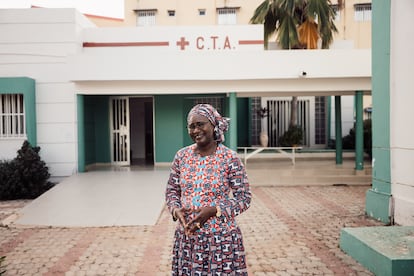
At the Ambulatory Treatment Centre (ATC) at Dakar’s Fann Hospital, which has been treating HIV patients since 1998, people have started asking questions, such as “Now where are we going to go?” According to Dr. Ndye Fatou Ngom, president of the CTA, which has treated some 4,800 people since it was set up, depression abounds. “In the context of [Donald] Trump’s cuts, how are we going to finance our activities? We need medicines, we need to look for the people we have lost sight of, to be on the ground to see what is happening. Stopping activities with these populations will slow down diagnosis and care and reinforce stigmatization,” says Ngom who has overseen Senegal’s progress over the past 20 years. One of the greatest achievements of the CTA is that 96% of its patients now have an undetectable viral load. That milestone is at risk of being reversed, says Dr. Ngom.
“Before the government made treatment free in 2001, access was very expensive,” explains Ngom. “Doctors were reduced to tears because the treatments weren’t available to everyone. But we made progress, we got free treatment, and the first CTA patients are still alive. But now as our partners withdraw, the question is what will become of us?”
Sign up for our weekly newsletter to get more English-language news coverage from EL PAÍS USA Edition









































