
The mysteries of the hangover: Why are some immune to its effects, while others suffer for days?
A genetic predisposition may explain the enormous variability of this phenomenon, of which up to 47 symptoms have been identified. Contrary to popular belief, age has not been shown to worsen it
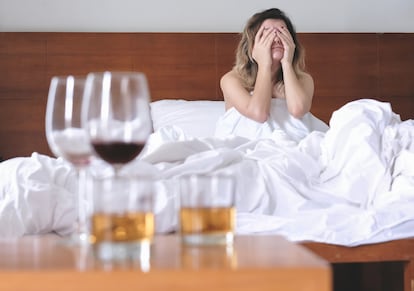

Anguish pulses through the veins, the stomach tightens like a prune, the head seems to throb, and the world moves a couple of revolutions faster than recommended. The symptoms are familiar, but the underlying mechanisms less so. Hangovers are a relatively unknown phenomenon in science. Researching them isn’t a top priority in terms of funding or healthcare interest. But hangovers can tell us a lot about our minds, our guts, and the epidemiology of alcoholism. Some studies have aimed to investigate what happens in our brains when we feel them exploding. And why the punishment seems so arbitrary: some people suffer hangovers that last for several days, while a lucky few (more than 20%) seem to be immune to the curse of the morning after.
When metabolizing alcohol, the body breaks it down into acetaldehyde, a chemical compound 20 times more toxic. A hangover may be the consequence of this process. Scientists aren’t entirely sure why this happens. “There are many hypotheses,” says Magdalena Sastre, professor of molecular neuroscience at Imperial College London. And studies like the one she supervised in 2020 are trying to prove them. In it, researchers analyzed how a hangover affected a handful of mice. They measured their neural circuits, the proteins and neurotransmitters they secreted, and also monitored their behavior. “We saw that it wasn’t just neuronal changes that occurred during alcohol intoxication. When blood alcohol levels dropped to zero, when the hangover began, changes occurred that could sometimes be even higher. That surprised us,” she explains.
These changes involved brain inflammation, neurotransmitter alterations, and mitochondrial dysfunction. Mitochondria are the organisms that produce energy in the cell, so if they don’t function properly, the entire system collapses. “There are other factors that contribute to this discomfort,” adds Sastre, “such as dehydration, fatigue, and sleep disturbances.” All of this translates into general malaise, affecting the stomach, the head, or even the emotions, generating a feeling of anguish or anxiety that has come to be known as hangxiety, or emotional hangover. “It’s not a myth,” confirms Sastre. “We also performed anxiety tests on animals and confirmed an increase.” But why does this phenomenon occur?
First, alcohol mimics a calming brain chemical called GABA, which is one of the reasons drinking can put us in a relaxed state. But when the binge wears off, the body struggles to normalize its chemistry, reducing the calming activity of GABA and increasing that of an excitatory chemical called glutamate, which has the opposite effect and makes us feel restless and excited. Furthermore, alcoholic drinks are very sugary, and after metabolizing it, blood sugar drops. In response, the body releases stress hormones. There’s one last addition, more psychological than biological. If you have a bad hangover, it’s because you got really drunk the night before. And who knows what you did? The memory lapses, the guilt after the inhibition, retracing the steps of the so-called walk of shame, isn’t always a good idea.
All of these processes create a hormonal cocktail that’s difficult to digest, which can lead to an anxiety attack. A hangover is such a broad condition that it’s difficult to describe. A study from Oxford University identified drowsiness and impaired cognitive function as its two main symptoms, but researchers identified as many as 47 overall. These manifest individually and are highly variable. Or they don’t even manifest at all. Because yes, there are people who don’t suffer from a hangover.
In 2008, researchers stumbled upon this phenomenon by accident. “We wanted to test a U.S. federal regulation that governs alcohol consumption in safety-sensitive professions — trucking, commercial aviation, merchant marine, nuclear power plant workers, that sort of thing,” Jonathan Howland, professor emeritus at Boston University School of Medicine and one of the paper’s authors, explains in a text exchange. The idea was to see if these people could perform their jobs after a night of heavy drinking. They expected some variability, but they didn’t expect to find people who were entirely unscathed by a hangover. “Over the course of six trials involving approximately 600 people, we found that about 23% of participants reported not having a hangover,” he explains. This wasn’t just their word; they didn’t display outward symptoms either. It was a subjective measure, but Howland reviewed the scientific literature and found similar percentages in experimental studies and surveys. “This led to the publication of the hangover resilience hypothesis,” he explains. “We even conducted an exploratory genetic study to assess whether there might be a genetic basis for this strange resilience.” Their results have been inconclusive, so Howland appeals to the scientific community: “This is potentially important and deserves further study because it could contribute to our understanding of alcohol use disorder,” he notes.
As for those unfortunate enough to suffer two-day hangovers, even after moderate consumption, researchers have a few theories. The leading hypothesis is that some people may be genetically predisposed to more severe hangovers; they have an abnormally intense reaction to metabolizing alcohol, which can lead to more intense and persistent headaches. Their immune system may struggle to defend itself against the effects of alcohol, which can exacerbate and prolong the overall feeling of malaise.
Other biological factors may also contribute, such as a greater sensitivity to brewer’s yeast or sulfites in wine. Reactions are highly individual and difficult to identify. The only thing that seems clear is that hangovers worsen with age. As we age, the liver processes alcohol less well and has a harder time metabolizing it, which could explain why hangovers are more intense over time. Alcohol is worse for those who suffer from stomach problems, and these are more common as we age. However, the limited scientific literature does not confirm this idea.
A 2015 study by the U.S. National Institutes of Health observed how young adults had, on average, more severe hangovers than their elders with the same amount of alcohol consumed. The explanation they found is that “increased experience with alcohol is associated with greater acute tolerance to it.” Gender, which was also analyzed in this study, did not appear to be a determining factor. Another study, from 2021, reached the same conclusion, speaking of milder hangovers as the years go by. The explanation it gave for them being even more painful: “Hangover severity decreases with age,” it concluded. “But pain sensitivity, which is lower with aging, could be a mediator.”
So, hangovers are less common, but we complain a lot more. These are population studies; they don’t explain the neurological mechanisms of hangovers, but rather analyze them based on the self-reports of those who suffer from them, so their results should be taken with a pinch of salt. In any case, all experts agree, more research is needed to understand the complicated mechanisms of hangovers, to explain their high variability and whether this may have any relationship with alcohol abuse disorders. Suffering from a hangover can be tough; understanding it will be liberating.
Sign up for our weekly newsletter to get more English-language news coverage from EL PAÍS USA Edition









































