
The Luigi Mangione phenomenon: just another murderer or pop-culture Robin Hood?
The admiration for the man accused of killing the head of the country’s largest health insurer reveals the nation’s deep political and social fractures
—Do any of you people know who Charles Whitman was?
—Sir, he was that guy who shot all those people from that tower in Austin, Texas, sir!
—That’s affirmative. Charles Whitman killed 12 people from a 28-story observation tower at the University of Texas. Now do any of you know who Lee Harvey Oswald was?
—Sir, he shot President Kennedy, sir!
In this scene from Full Metal Jacket, the sergeant questions his recruits about the perpetrators of infamous crimes in U.S. history. With this exchange, director Stanley Kubrick is telling us: the murderer is remembered because of the importance of the murdered. With Luigi Mangione, the alleged killer of the CEO of health insurance giant UnitedHealth Group, the opposite has happened.
Mangione, 26, allegedly shot Brian Thompson, the health insurance executive in New York, on December 4. The incident shocked Americans. Insurance companies removed executives’ photos out of fear of copycat killers, and a wave of criticism against the healthcare industry followed. Thousands shared experiences with their insurance providers, recalling people who couldn’t afford treatment and either died or suffered lasting harm.
Others praised the then-unknown shooter, labeling him a vigilante or a hero — turning him into what historian Eric Hobsbawm described in his essay Bandits as a “social bandit”: an individual who opposes an unjust system and is praised by ordinary people.
Five days later, police arrested Mangione, and when his photo was leaked, social media erupted. On X, he had 60 followers before the arrest. His follower count grew by 1,000 per minute until the account was suspended at over half a million. Memes flooded the internet about his looks, academic record, wealthy family background, musical tastes, and even his sex life.
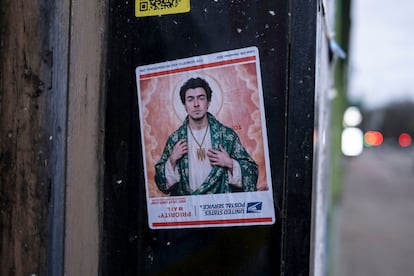
The “social bandit” merged with the “halo effect” — the cognitive bias that assigns positive traits based on physical appearance or first impressions — a tradition stretching from Bonnie and Clyde to Charles Manson. The $150,000 raised for his legal defense, prison warnings not to send him more letters, and graffiti reading “Free Luigi” are all evidence of this. Mangione had become a pop-culture Robin Hood.
Media coverage focused on understanding Mangione’s motivations — from his severe back pain to a possible mental health issue. This empathetic attempt to explain his motives is what Dr. Joseph Richardson, a scholar of African American studies, summed up in The Guardian as “white male privilege.” Numerous studies have shown that criminals tend to receive far more compassionate treatment when they are white. As Richardson put it: “We clearly know had he been a young Black man, the narrative would be different.”
Internet users also compared Mangione’s treatment to that of other white shooters, such as Patrick Crusius, who murdered 23 people. While Crusius is serving a life sentence for the largest massacre against the Mexican community, Mangione faces the death penalty. While Mangione was escorted away like a “Gotham City villain,” Crusius was described as a “normal twenty-something kid finding his way.”
Would anyone be talking about Luigi if he weren’t white, rich, or handsome — or if he hadn’t killed a CEO?
Sign up for our weekly newsletter to get more English-language news coverage from EL PAÍS USA Edition









































