
First miners go down shaft to rescue Spanish toddler Julen Roselló
Two rescue experts have been lowered inside a specially-made cage in a bid to reach the toddler, who is thought to be trapped in a 110-meter-deep borehole in Málaga
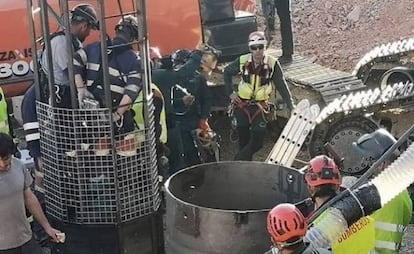
A team of miners trained in rescue operations has finally been called into action in the ongoing race to reach Julen Roselló, a two-year-old thought to be trapped inside a deep borehole in southern Spain.
At 5.49pm on Thursday, the first two miners were lowered inside a specially-made cage into a vertical shaft running parallel to the borehole, said government officials in Málaga.
Eight members of the Hunosa Mining Rescue Brigade will work in shifts, manually digging through hard rock in an effort to reach the trapped child.
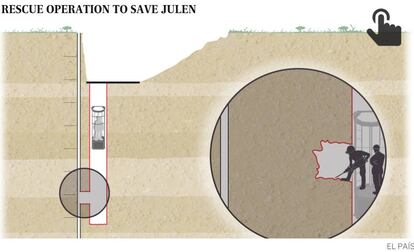
Eleven days have now elapsed since two-year-old Julen Roselló fell down a 110-meter borehole in Málaga, southern Spain. In that time, hundreds of people have organized an impromptu rescue operation that has been described as “not so much a rescue operation, as a work of humanitarian civil engineering.”
In the early hours of Thursday morning operators finished work to shore up a 60-meter deep vertical tunnel, parallel to the borehole where Julen is thought to be trapped. Another 12 meters of tubing were added later to protect the miners from possible landslides in the work area.
Digging the horizontal gallery connecting both shafts is a laborious task that will performed in 40- to 60-minute shifts to prevent fatigue and which is expected to take around 24 hours, according to Ángel García Vidal, the engineer who is supervising the technical work.
The miners are being lowered in a specially designed cage, with a grille on the bottom through which the rubble they remove will fall. They will be using a combination of machine and manual tools.
A tragic plight
Julen was playing on a relative’s rural property in Totalán, in Málaga province, when he apparently fell into a groundwater prospecting hole more than 100 meters deep and with a diameter of no more than 30 centimeters.
The child’s plight has triggered an outpouring of support on both a local and national level. Hundreds of people are on site to help with the rescue operation, and many companies have volunteered specialized equipment. But the abruptness of the terrain and the geology of the area have considerably slowed down the rescue mission.
English version by Melissa Kitson and Susana Urra.









































