
Why Vox really is a far-right party
Although its leader Santiago Abascal rejects the label, his ideology is based on populism, nationalism and an identity-based narrative
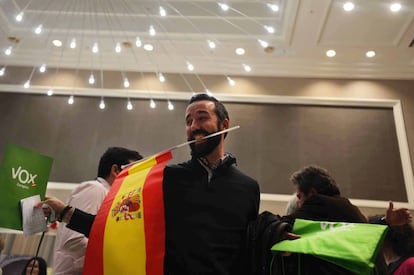
Marine Le Pen congratulated her pal Santiago Abascal before Vox’s victory had even become public. It was preventive praise; a premonition that took flight when the Spanish party managed the feat of getting 12 deputies into the Andalusian assembly; it was a symbolic welcome into Europe’s far-right club. Not that Vox had been turning its back to the right-wing magma bubbling beyond our borders; it’s just that it had yet to graduate into the sacred space of parliament: Vox now has a voice.
This message from Le Pen was the most eloquent illustration of the ideological and political affinities of the party headed by Santiago Abascal. Yet it is noteworthy how angrily the Vox leader and his sympathizers reject this far-right label, even as they do nothing else but underscore it through their words and deeds.
The local peculiarities of the Spanish party do not place it outside the far right’s natural habitat
Vox is indeed a far-right party, and this is so because its idiosyncrasy feeds on a nationalist-confessional model that hints at supremacy and thrives on an identity-based narrative. Its discussion of Spain’s decentralized system of government is not so much based on a conceptual position – the Jacobin ideal of a strongly centralized state – as it is on a questioning of the Constitution and on the notion of Madrid as a gravitational axis that would function as the core for a Spain that is great and free, prone to flashes of authoritarianism, and full of moralistic ambition. Abascal and his co-religionists proscribe abortion and gay marriage, they loathe feminism, and they encroach on individual freedoms from a paternalistic position that reeks of church incense and army barracks: God, country and family.
Vox is also distrustful of the media, when it is not altogether censoring or expelling members of the press, in best Beppe Grillo style. This is a party that has managed to appropriate the fast-moving, fleeting flag of indignation, yet the good intentions of its voters, who reject the system and are frustrated with conventional politics, cannot counterpoint the Le Pen-like rhetoric based on a nostalgic memory of the prim-and-proper Spain of yesteryear. Vox’s anti-EU, anti-globalization rhetoric thrives on fear – fear of immigration, of the Muslim half-crescent; it thrives on instinctive thinking and on historical superstitions, and its onanistic, unenlightened narrative exhibits an inertia that is quite in sync with the excluding xenophobia of Italy’s Matteo Salvini and the religion-imbued politics of Hungary’s Viktor Orbán. There is a name for this: the far right.
Vox encroaches on individual freedoms from a paternalistic position that reeks of church incense and army barracks
The parodic “Spain First” slogan establishes an unequivocal link between Vox and trending populist movements, from Trump to Bolsonaro and from Marine Le Pen to Geert Wilder. And while Abascal lacks the charisma and screen presence of these other personalities, he imitates their haughty, self-righteous attitude in the name of a patriotic and emotional incitement that has taken its imitative penchant so far that it is even promising to build an insurmountable wall in Ceuta and Melilla.
It is true that Vox’s economic model puts liberalism ahead of protectionism. And it is also true that Vox has made the most of popular reaction to the Catalan sovereignty push and to the outlandish exhumation of Franco’s remains. But the local peculiarities of the Spanish party do not place it outside the far right’s natural habitat – instead, they bring added variety to the fauna and flora of the obscurantism that seeks to transform Spain and disfigure Europe.
English version by Susana Urra.









































