
Spain’s Rajoy loses first investiture vote, prepares for Saturday victory
Left-wing groups call protest outside Congress; over 1,000 police officers called in
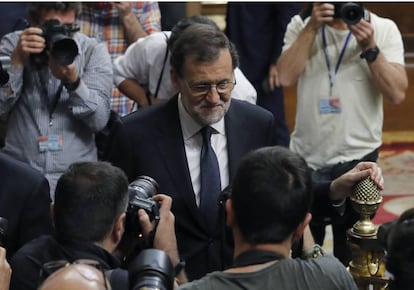
In an expected step on his way to attaining a second consecutive term in office and ending a 10-month political deadlock, Spain’s acting Prime Minister Mariano Rajoy lost the first round of a congressional vote on Thursday evening, falling six seats short of the majority he needed in the 350-member chamber.
But the Popular Party (PP) leader is widely expected to win a second vote on Saturday, thanks to the opposition Socialists’ pledge to abstain.
Organizers said they expect around 10,000 people to join the Saturday protest
The vote was cast after a heated debate in which speakers cited Vichy France and the failed Spanish coup of 1981 to respectively defend and counter claims that Rajoy is being eased into power undemocratically.
Addressing one of the most fragmented parliaments since Spain returned to democracy four decades ago, Rajoy attempted to build bridges by offering to work with other parties on national issues such as employment or education. But he fell short of offering to repeal the controversial reforms he introduced during his first term in office.
Rajoy was met with hostility from the anti-austerity Podemos, whose secretary general Pablo Iglesias acted – and was treated by the caretaker PM – as the de facto leader of the opposition despite having fewer seats than the Socialists, who are currently leaderless, following the resignation of Pedro Sánchez on October 1.
He was also harshly criticized by regional parties, while emerging center-right grouping Ciudadanos warned that it will withdraw its support if Rajoy fails to deliver on his pledges for reform.
March on Saturday
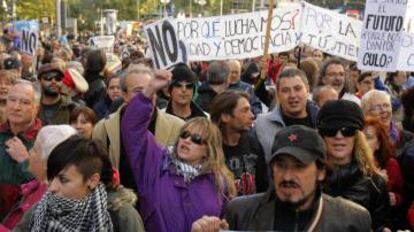
Two far-left groups have called a protest march outside Congress on Saturday, coinciding with the second vote that will presumably usher in Rajoy as prime minister.
The organizers are a group called Izquierda Castellana (Castilian Left) and EH Bildu, the party that is heir to ETA’s outlawed political wing Batasuna.
The central government's delegation in Madrid has authorized the march, saying it will send around 1,200 police officers to Congress.
Organizers said they expect around 10,000 people to join a protest whose slogan is “Ante el golpe de la mafia, democracia” (Against the mafia’s coup, democracy).
“Our starting point is the notion that we are still living under the 1978 regime, in a phony democracy built over a monarchy that was inherited from the dictatorship, and we want to propitiate a new constituent process, a necessary step to change the system,” said Alberto Albino Torre, one of two people who filed the request to stage the march. Torre has a police record for attempting to burn down an ATM. “I was arrested and released without charges,” he said.
Both the United Left coalition and Podemos have expressed sympathy for the march on Saturday. The former's leadership will officially take part in it, while Pablo Iglesias is adopting a wait-and-see approach.
English version by Susana Urra.









































