Supreme Court questions police use of firearms at immigrant holding centers
Judges throw out rules that keep immigrant families in separate cells

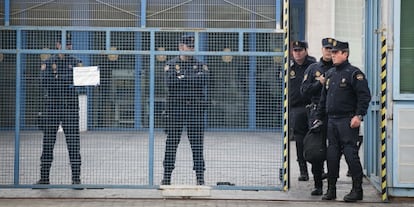
Spain’s Supreme Court on Monday questioned the government’s decision to allow law enforcement personnel to carry firearms while on duty inside the country’s immigrant holding centers (CIE).
In a ruling that strikes down various articles in the CIE regulations book, the court’s administrative chamber said it was “not appropriate” for security officials to be walking around with weapons “under normal circumstances” inside the centers. But the court stopped short of banning them from bearing firearms altogether.
NGOs believe the use of weapons should be limited to situations when serious altercations break out
In 2013, the Council of Europe criticized the prison-like conditions at various centers and noted the frequent use of rubber bullets by the Catalan police to quell protests inside the facilities.
Nevertheless, the court stated that the National Police, who are in charge of the centers, cannot be prohibited from carrying firearms, because the ruling made by the judges does not strike down any of the law enforcement body's regulations.
“The decision to put the National Police (CNP) in charge of security at CIEs could be considered mistaken. But now that it has been established, it is not contrary to their right to provide service with their regulation firearms,” the sentence reads in part.
In January, three NGOS – Andalucía Acoge, SOS Racismo and Asociación Pro Derechos Humanos de Andalucía (APDHA) – filed a challenge with the Supreme Court over various sections of the CIE regulations, including the possession of firearms.
According to the organizations, the use of weapons should be limited to situations when serious altercations break out at the centers, as is the procedure in prisons.
The court did throw out some sections of the CIE rules, including those that allowed the authorities to separate families at the centers; gave judges the power to send people back to a CIE for the same violation committed against Spain’s immigration laws; and allowed body searches without proper justification.
NGOs have long criticized the treatment of people held at CIEs, claiming that police and guards harass women and mistreat mothers who try to breastfeed their children.