The Franco victim's story the Supreme Court never got to hear
Jesús Pueyo wanted to explain why he needed help finding father's remains
Jesús Pueyo was nervous about the subpoena he received to testify in the trial against Judge Baltasar Garzón, who is facing a 20-year disbarment from the bench for opening an inquiry into human rights abuses committed during the Civil War and the subsequent Franco dictatorship.
With the help of his wife Ana, Jesús rehearsed over and over what he was going to say - he was afraid about being overcome with emotion on the stand. He needed all the strength in the world to describe to the seven justices on the Supreme Court bench how the Falangists killed his father along with two of his female cousins in Uncastillo (Zaragoza).
Like others, Pueyo had gone to the High Court, where Garzón began receiving petitions asking him to issue orders to open common graves, because they couldn't find their loved ones' remains on their own. But on January 5, weeks before he could finally explain this to the Supreme Court, Pueyo died.
Now his wife Ana has promised to "carry on his fight," which began long before anyone would dare think to speak openly about those executed in the Civil War. In 1977, two years after Franco died, Pueyo had written to King Juan Carlos asking him for his help to find the graves of his loved ones. The monarch never responded. Later, he wrote to Spanish Prime Minister José María Aznar, the Episcopal Conference of Bishops, the European Court of Human Rights, even the United Nations, yet no one responded.
"Well, there was one man," recalls Ana. "(Archbishop of Madrid Antonio María) Rouco Varela sent us a booklet that spoke about forgiving your enemies."
No one understood - they must have thought he was after revenge or even money. "It had nothing to do with that," she says.
"What Jesús wanted was for the courts to recognize that his father, his uncles and his cousins were all taken and killed for no reason at all. And now he wanted the legal system to help look for them. He wanted to let the courts know that the families couldn't find out what happened to these disappeared loved ones on their own, and that this democracy, with thousands of people buried in common graves, still had its hands tied behind its back."
No one seemed to understand this until Garzón, the famous investigative judge on the High Court bench, began receiving petitions in 2006 from individuals and groups asking for help in finding their missing family members. The judge began to see a pattern and opened a human rights abuse inquiry into crimes committed during the Civil War and Franco period.
He was immediately attacked by far-right groups, including the Falange de las JONS party and the obscure union Manos Limpias, which filed the complaint over which he is now being tried before the Supreme Court. Manos Limpias says Garzón overextended his bench power by purposely ignoring the 1977 general amnesty provisions that were approved during the Transition. Garzón believes that human rights crimes are not covered by the amnesty and do not have statutes of limitations anywhere in the world.
For Jesús Pueyo, the Civil War began on July 21, 1936 - three days after the uprising. He was coming back from gathering wood when he was stopped by young men in two trucks and a car. "Salute us," they challenged him. "Say, 'Arriba España!'"
Instead, Pueyo raised his fist in the leftist salute. "That got them very angry," he later wrote in his memoirs. "They started to beat the bejesus out of me with the butts of their rifles."
They started discussing whether to kill him or not. Then one of the guys asked how old he was. Jesús told him he would turn 15 in a month. "What does this kid know about these things?" said the guy who asked, and decided not to execute him.
Later that month, the Falangists killed his aunt Francisca "just because she was on the left," says Ana. Then they raped and killed her daughters, Lourdes, 20, and Rosario, 24, "for making a republican flag that the PSOE had asked them to make."
Next would be Pueyo's father. "My mother and my siblings were in shock - there was nothing we could do," he wrote.
On August 2, 1936, Jesús saw a truck carrying away some men. His father covered his bloody face with his cap so his son wouldn't see him. "One of my father's friends, a carpenter, had one of his eyes popped out of its socket. It was horrible seeing them that way," Jesús later wrote. Jesús Pueyo Prat was 44 years old and left behind five children, who for many years would hear people say: "There go those reds."
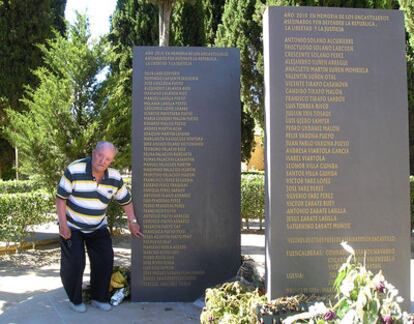
"All I want is help to find my mother"
"They killed my mother in 1936," explained the 81-year-old María Martín López to the Supreme Court on Wednesday. "Please, excuse me, my voice is raspy," said the 81-year-old, whose voice sometimes breaks.
"All I want is help to find my mother so I can bury her - nothing more," she tells EL PAÍS afterwards from her home in Toledo. "What do they want? For us to wait another 75 years? I can't wait that long."
During the trial, María couldn't explain all she wanted to explain. "They shot my mother, along with 27 men and three other women, in 1936," she told the justices. But she didn't have time to tell them she was six years old at the time; that her sister was 12; and another sibling, only two.
"They also went after my father and put him in jail," she continued. "My sisters and I went to live with an aunt until they released him. The day he returned from jail he held me in his arms and wouldn't let go. My little sister died some days afterwards."
"Has anyone helped you find your mother?" asked Garzón's lawyer.
"No," the woman responded.
She was calm during her testimony. "I didn't do anything wrong, and neither did Garzón."
She knows all the names of the justices on the top court well. She wrote to Luciano Varela - the Supreme Court justice who decided to prosecute Garzón for overextending his judicial duties - explaining why she went to the High Court looking for help. "If it were your mother," she told him, "you would try to move heaven and earth to try to find her." He never answered her.
When she left the courtroom, she didn't like what she saw: two members from different historic memory associations arguing among themselves.
"This is a serious thing," she said. "We are at a funeral with missing bodies."