Voices of Franco victims at last heard in top court
Octogenarians give testimony for defense in Garzón trial
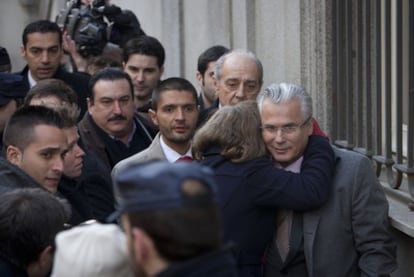
For the first time in history, the Supreme Court heard testimony from victims of Franco's repression when a group of octogenarians recounted childhood memories of seeing their parents taken away.
Their testimony was part of the defense in the ongoing trial against Baltasar Garzón, the High Court judge who was suspended from his duties in 2010 for trying to investigate these very same crimes. A right-wing group called Manos Limpias filed a suit against Garzón, alleging that he had overstepped his authority in trying to investigate human rights violations during the Spanish Civil War (1936-1939) and the subsequent dictatorship of General Francisco Franco (1939-1975).
By just one vote, the Supreme Court on Tuesday refused to throw out the case against Garzón despite growing international criticism of what is widely considered an ideological attack by right-wing groups against the judge. If convicted, Garzón faces being disbarred from the bench for 20 years.
The third witness in the defense, Ángel Rodríguez Gallardo, an historian and member of the Historical Memory Committee of Ponteaereas (Pontevedra), stated that his association turned to the High Court to denounce the perpetration of "violent crimes, many unresolved."
"We wanted to know how those deaths occurred and where the disappeared went. Many people did not know where their parents ended up," he said. The witness said his own historical research in Galicia suggests "a systematic plan" to eliminate all the political heads of the Second Republic, but that he met many obstacles in trying to access historical archives.
"If we could really access penitentiary, Civil Guard and police records, we could determine the existence of that systematic plan," said Rodríguez Gallardo, who spoke of "acts of genocide."
Besides this case, Garzón also faces a second simultaneous trial for ordering wiretaps of prison conversations between members of the corrupt Gürtel business network, and a third one over courses he taught at New York University in 2005 and 2006 that were allegedly sponsored by Banco Santander.