Last winter for barley market
Conservationists fight planned privatization of much-loved Madrid landmark
"If you look at the historical part of Madrid on Google Earth, the first thing you notice is not the dome of the Church of San Francisco el Grande, nor Plaza Mayor - it's the red vaults of the Mercado de la Cebada," says José Balsa, a knife-grinder who works in this legendary square.
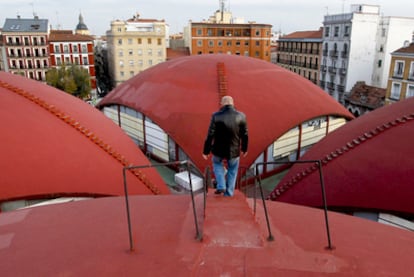
It's true: from a bird's eye view, the six concrete bubbles that have covered the food market since the early 1960s are the most recognizable element of downtown Madrid - because they are red, and because there is nothing quite like them anywhere else. And yet the city has been planning their demolition for years.
But do they deserve saving? "Absolutely," says Javier García-Gutiérrez Mosteiro, a scholar who specializes in the conservation and restoration of landmark buildings. "They are of unquestionable architectural value, but they are also a record of a very specific historical period, a brutal parenthesis within the ruling rationalism of the city's contemporary architecture."
Within what came to be known as 'new monumentality', the Mercado de la Cebada (literally, the barley market) distanced itself from the international building style because of its nearly flat scale and the expressiveness of its concrete shapes.
"Let's not kid ourselves," notes the architect Javier Alau. "It's a clunky building that needs a makeover, but it's a powerful space, and even if its vaults are not the most streamlined in the world, they have a bare, elemental kind of force to them."
Alau and other architects are part of the Platform Against the Privatization of Mercado de la Cebada, which also includes small business owners, neighborhood associations and representatives of the Slow Food movement. This assorted group is fighting to prevent the disappearance of the social and economic model represented by the traditional food market, which is increasingly giving way to large supermarkets and gourmet boutiques. Its members also lament, "the loss of a unique building."
To what extent does the future of the businesses inside the market depend on the fate of the building itself? "One thing is for sure," says Alau. "Nobody is going to put up money to erect a new building for a traditional public market."
The city's plans, which the association is collecting signatures against, are basically to find an investor to finance the construction work in exchange for the right to manage the giant supermarket that would go inside. If all goes according to plan, work will begin next summer, when the market turns 50 years old.
"The current building never worked, it's very uncomfortable," says Carlos Rubio, founder of the municipal project, which aims to "free up the square, retain many of the stalls and adapt them to the times." He adds, "Nostalgia leads nowhere, you can't remain stuck in the past."
If there is one thing that both sides agree upon, it is that the original market was better than the one that took its place. Erected in 1875, it lasted 80 years. Its supervisor, the scholar García Arangoa, defended its preservation, but the city tore it down anyway and Arangoa ended up building its replacement.
Yet it is hard not to feel a pang of nostalgia thinking that the vaults of the market have only one winter left to live. It is a Martian sort of place, as though six UFOs had landed right across from San Francisco el Grande. A concrete ladder leads up to their top, like the crest on a dinosaur's back. To climb it is to undertake a strange journey that causes an odd kind of vertigo: one is scared not of falling down, but of rolling off.
"Just imagine if we could rent out the terrace to a restaurant - this would fill up with people!" exclaims José Balsa, who sharpens knives in the very same spot where his parents and grandparents did before him.
Meanwhile, small business owners are on the lookout for ideas to make them look more modern without losing sight of their roots. Next weekend they have asked a few chefs in the Slow Food movement to demonstrate how to make recipes using mussels, since this product is now on sale. And sales are of the essence, because for now at least, this place is definitely not San Miguel, another downtown market that was recently revamped into a super-trendy gourmet food hall.