A way out of the bunker
The "respect module" program offers high-risk prisoners a chance to escape solitary
"You wanna know how I'm doing? This is Hollywood, Miss. Pure bliss."
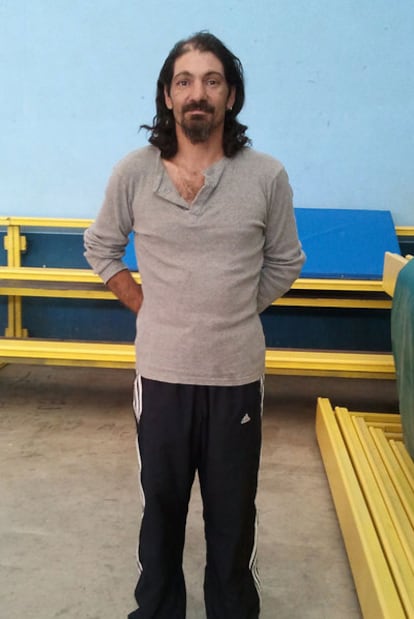
Ángel, 27, a self-described "Gypsy from Donostia [San Sebastián]," was convicted of theft and kidnapping. He has been behind bars since 2002 - apart from when he briefly escaped - and is now serving his sentence at Mansilla de las Mulas penitentiary in León, in a new section of the compound known as a "respect module."
"You gotta understand, it's pure bliss, although jail is really bad. When I say that, I'm comparing this with the bunker, where I was before. You don't know what that's like. You go nuts in there. Really nuts. You're always alone and turning things over in your head."
The "bunker" is the isolation unit, where prisoners are kept in solitary confinement. It means two hours in the courtyard in the morning, pacing around a tiny space in groups of four or five, and two more hours in the afternoon. The remaining 20 hours of each day are spent inside a cell, where each prisoner has breakfast, lunch and dinner by himself. There are hardly any activities available - just the odd conversation with a fellow inmate through the window.
Such has been Ángel's life for the last eight years, when he was classified as a first-degree prisoner - one who is considered extremely dangerous or socially maladjusted and cannot participate in ordinary prison life. There are 900 first-degree inmates in Spain, according to penitentiary authorities.
The problem is that solitary confinement creates more troubled personalities. Far from progressing toward rehabilitation and a return to ordinary prison life, the inmate enters a spiral of depression, madness or violence from which it is difficult - and sometimes impossible - to escape. This level of incarceration can last the entire sentence, say 20, 30 or even 40 years in the worst cases, with no chance of parole or leave. This is a problem not just for the inmate, but also for society, since at some point the prisoner will return to its fold without being prepared to do so.
"I was lucky because at least my family was able to buy me a TV set," says Ángel, who sports long hair, tattoos and piercings, and who refused to be photographed for this story. "Some people don't even have that. What can you do when you're spending 20 hours a day by yourself, for years, all alone and without knowing what's going on in the world?"
That is why he now says he's in "Hollywood." For the last two months Ángel has been living inside Respect Module 11 at Mansilla de las Mulas penitentiary. He can - and indeed, must - take part in daily activities with 30 other prisoners. This conversation took place inside the sports hall while he waited his turn to play soccer. Ángel has joined a special program that is being offered at this particular facility to give these difficult convicts another chance. If they meet the goals, they are transferred to the ordinary wing of the prison. More than 70 have managed it. The others go back to the bunker.
"People really think it over before making trouble around here," says Ángel. "In jail there are fights over everything. There are also snitches here, but it's better to keep your hands to yourself if you don't want to go back to the hole. Peque was taken away for squaring up to a prison officer. I'd rather keep cool. I think that next week I'll be able to move to second-degree level. I hope so."
The experiment has been underway for three years, and it is based on trusting that some of the more difficult prisoners can adapt to regular prison life as long as the rules are made very clear. The reward is being outside their cell for eight hours a day, during which time they may move around freely within the wing, and go out twice a week to the soccer field or sports hall. In exchange for that privilege, their cells must remain impeccably clean; the prisoners are divided into groups that take turns cleaning, handing out food and clearing the mess hall. They have to participate in one to three activities a day. Any failure to comply with these rules results in a negative point that can be cancelled out with a positive point, earned by performing an activity such as cleaning a dirty window. Every morning at 9.30am there is a meeting to see how everything is going.
"It's a bit childlike, but you live better," notes one inmate.
"We've seen historic first-degree prisoners with lots of years of solitary confinement behind them progressing to second degree," say Armando García, Rafael Martínez and José María Egido, respectively an educator, a lawyer and a social worker at the León prison. "There have been some spectacular changes."
Antonio Gutiérrez, a 43-year-old inmate from Bilbao with drug and alcohol problems, who was found guilty of 18 counts of larceny, robbery and one homicide (he claims it was an accident), is a complicated case. He has just joined the rehabilitation program, and prison workers are uncertain whether it will work for him. But Gutiérrez is confident he can adapt. "In solitary confinement you just break down. You're in a bad way, a very bad way."
What this program essentially does is extend the philosophy of "respect modules" to the most dangerous inmates. The system was originally designed for ordinary prisoners and it started right here, at the León prison, in 2001. Since 2004, the regular respect modules have been rolled out to 68 prisons. A little over 15,000 inmates - out of a total of 66,000 - form part of these programs.
Jail feels a bit less like jail in here. Everything is clean and orderly, there is no loud noise, and there are special committees to deal with new arrivals and conflict resolution. There are no fights over the right to sit in a specific chair or the use of the payphone - this would mean expulsion from the program. Conflicts are in fact anecdotal, and there is less drug use overall. "Just the odd joint now and then," says Francisco, an inmate at Navalcarnero penitentiary in Madrid.
But not all prisons work the same way, and the system - or its implementation - has some shadows. Above all, there is a risk of "good" prisoners progressing quickly inside the respect modules and the other wings becoming ghettos for the toughest inmates who are difficult to handle. Some inmates complain that prisons with few respect modules fill them with people who had never been in jail before - traffic offenders or spouse abusers, mainly - and who at least need to be taught how to lead an orderly life.
"It should be a reward for people who deserve it and an opportunity for those in whom nobody trusted before," says Marcos, an inmate since 2002 who is now in a respect module in Navalcarnero. There is no easy solution to the dilemma, as neither does it seem reasonable to put a first-time inmate into a difficult wing. In any case, the special program in León opens a window of opportunity for the toughest cases.
"There's no way I'm moving from here," says Ángel. "I'm not going back to the bunker."