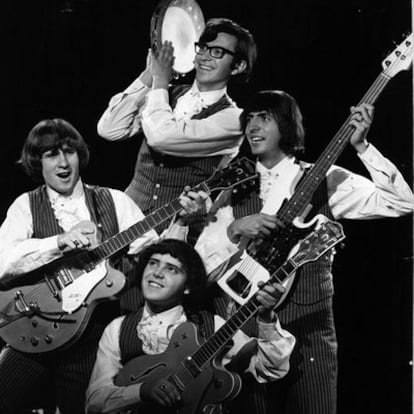
"Right now 'Libérate!' is just a record by the most reviled man in music"
The arrest of SGAE head Teddy Bautista has put paid to a re-release of his admired past work
It couldn't have come out at a worse time. Since the early 1980s, fans of Spanish soul have been complaining about the impossibility of getting their hands on the powerful recordings of Los Canarios, the band led by Teddy Bautista, until recently the head of Spain's main copyright-management association SGAE. But Bautista has just undergone a spectacular fall from grace, having been arrested on charges of embezzlement. By chance, a label called Rama Lama has also just released a Los Canarios double CD called All their recordings (1967-1972), which includes two LPs, Libérate! and Vivos!, as well as a wealth of singles.
But the initiative is doomed. The CD will find no sympathy anywhere: Bautista's excesses at the helm of SGAE have turned him into a pariah, an untouchable even in the radio world - a prestigious, normally SGAE-friendly station recently pulled a program looking back over his music as an artist and producer. The program was recorded prior to the scandal, but it now seems Bautista is a contaminating element everywhere.
True, right now this is the least of his problems, but it is nonetheless illustrative. Teddy's fame has turned to such notoriety that rumor has it he stood in the way of the re-release of his own music, finding it incompatible with his status as a big cheese in the music industry. In truth, Bautista was proud of his work. Los Canarios trained professionally in the US from 1965 to 1966, where they discovered soul, which they championed like a religion upon their return to Spain.
Although there were many Spanish bands who specialized in the genre, none of them had Bautista's black sound. His repertoire, filled with testosterone and messages of personal liberation, caused unrest among Franco's censors. In his upcoming book, Veneno en dosis camufladas (or, Poison in camouflaged doses), Xavier Valiño writes that the censors underlined the lyrics of several of the songs on Libérate! in red. The authorities also didn't fail to notice a song called Get on your knees, which suggested fellatio. According to Julián Molero of lafonoteca.net, Teddy came up with a patriotic explanation for it: the song was dedicated "to an English girlfriend he met in Ibiza who kept trashing all things Spanish, and whom he decided to take down a notch to make her accept the importance and quality of national products." It sounds far-fetched enough to be true.
Alain Milhaud, who discovered Teddy and then became his producer, also plays down the urban legend of an imperial Teddy shooting down the revival of his past musical glories. It is another issue altogether whether, caught up in obsessions such as the Arteria network, he did nothing to re-release his own work. Besides, we are only now finding out about the appalling way his legacy has been preserved by some record labels. Milhaud notes that, between 1967 and 1970, Los Canarios released music under the Barclay label. That French company was bought by Universal, but the master tapes of tracks such as Get on your knees are long gone. Also gone are the tapes that Milhaud kept in his company CFE, when it was bought by Zafiro, now part of Sony.
The ball was alternately in Universal and Sony's court. Hesitation at both multinationals paralyzed several attempts at a re-release. There was an agreement in recent months: Milhaud offered to remaster the recordings he produced for Los Canarios. The plan was to release them in vinyl format via Vampisoul, a subsidiary of Munster. It was all for nothing, considering later events. Label founder Iñigo Pastor admits to feeling downcast: "Libérate! will be remembered as the best Spanish soul-rock album in history, but right now it is simply a record by the most reviled man in the world of music."
In some way, the Teddy Bautista of Los Canarios is a different person from the Teddy Bautista of SGAE. The late producer Mario Pacheco had an anecdote about it: there was a flamenco artist at his label Nuevos Medios who had a very peculiar concept of intellectual property rights - he thought he owned the rights to any song he performed, even if he hadn't written it. Weary of arguing with him, Pacheco suggested he talk to Bautista. "Yes, I'd trust a colleague," said the flamenco man. So he and Pacheco went to the headquarters of SGAE, where Bautista, feeling good inside his palace, delivered a weighty lecture on the theory of intellectual property. When it was over, the flamenco artist stared in disbelief at the executive, who looked nothing like the old vocalist with sideburns, and said: "OK, fine, but you promised that Teddy Bautista was going to explain it to me." Bautista had to produce his ID, but since the name showed Eduardo rather than his nickname Teddy, the flamenco man left the premises far from convinced.