"Dear Blog, I'm fighting cancer"
The internet has provided a unique opportunity for thousands of people around the planet to tell the story of their struggle against disease
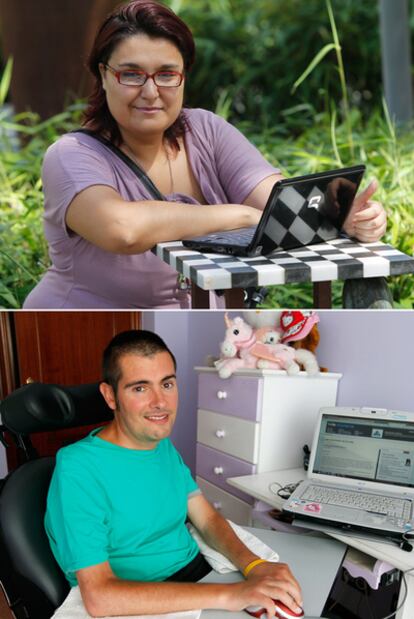
My name is Raúl, I'm 37 years old, and since the end of 2005, I have had a new companion in my life: ASL, or amyotrophic lateral sclerosis, a degenerative, incurable condition that attacks the central nervous system and is also known as Stephen Hawking's disease." April 2008, Raúl Miranda, who lives in Madrid and works as a consultant for a toy company, is writing the first entry in his blog. The illness has already taken over his body, but his mind remains lucid. Very lucid.
In Ya no puedo pero aún puedo (I can't anymore, but I still can) he tells the day-to-day story of his life, his dreams, his experiences. He says he wanted the world to know about a disease that affects some 4,000 people in Spain, and to show that despite the limitations it imposes, it is possible to continue living, to travel, to love, and to live life. Hundreds of people followed the development of the disease through his blog for more than two years. Thirty months of shared experiences, jokes, sarcasm, and bitter blows. Miranda died in September 2010. His last post, on the second of that month, told of his holidays with his wife, Nuria. On the 24th, Nuria signed a brief entry: "For all those who have followed Raúl, he has now gone, he is no longer here. He left me while I slept. Thanks for your support."
There are thousands of Raúls around the world, who tell the story of their illness through a blog. Cancer, ASL, Parkinson's fibromyalgia, and many others. They do so through poetry, photographs, stories, songs, and news. These blogs are a form of therapy, a routine that helps keep them anchored to something approaching a normal life, and that allows them to express their feelings. These blogs also help to keep them in touch with reality, and to contact other people living with incurable illnesses. As a result, there are now small online communities made up of blogs, support groups, and patient forums: a web within the web, which offers a way to share experiences and feelings with others dealing with the same problems and realities. A recent survey by the Journal of the Medical Library Association that looked at dozens of blogs, particularly those about cancer, found what patients want most is emotional support, and to know what is going to happen to them as the disease develops.
Take the case of Chus; she describes herself as between 55 and 60, and says she simply wants to be understood. Six years ago, she began to write Mis sentimientos (My feelings), where she intended to describe the minutiae of her daily life. She managed six entries. Three years later, in 2009, she started again. During the interregnum her life had changed radically. She changed the name of her blog: Como la vida misma. Ahora toca cancer (Real life. Now it's about cancer). By the time she decided to start writing again, Chus had hit bottom, and picked herself up. She had a lung removed, and had been through chemotherapy and radiotherapy. And she had become a grandmother. She was in full recovery when she asked herself whether there were blogs about cancer, in the same way that there are blogs about cooking or cars. "I looked on Google and there were ten million. I began to read a few; one blog led me to another," she says. "It was very inspiring. These people spoke about their problems, their hopes, about their uncertain futures. And they received a lot of comments. They all helped each other, they encouraged each other, they shared their pain. And above all, they understood each other," she says.
This is what she too was looking for. So she began to write about what she calls her inner loneliness, writing about the inability of most people to understand the impact of a long and tiring illness that often tires out friends. The fear, the check ups... but also the holidays, the support from family. She now has around 100 readers who follow her blog. Many of them also have cancer, or are family of those suffering from the disease. These blogs provide a powerful lifeline, says Chus, and are an opportunity to share experiences and practical information: how will I feel in a month? What will my family go through? Chus says that by reading other blogs she came across the diary of Samantha Kittle.
Aged 26, Kittle has a brain tumor. In A lie of the mind, the title of which comes from Sam Shepherd's play of the same name, the Chicago-based actress and writer tells the story of her fight against cancer, about her stays in hospital, about radiotherapy treatment, about losing her hair and her eyebrows. Her powerful, short texts, often accompanied by photographs, tell her story.
Derek K. Miller prefers to just write. A marine biologist, editor of scientific journals, musician, a father of two girls, and a passionate blogger, Miller told his story on www.penmachine.com for 10 years, covering his work, science, music, and the friends and family who accompanied him through the final stages of his life. In 2007, on May 3, he died. His family posted his last blog. Three million people read his farewell letter. "It's here. I am dead, and this is my last post," he says. "I have not gone to a better, or a worse, place. I haven't gone anywhere. Derek no longer exists." He was 41.
Miller's words were simple, but powerful. The Canadian was not afraid to expose his worst fears through his blog, and he made hundreds of friends on the web. None of them ever met him in person, but they now miss him.
Josef Rof had never heard of the Canadian blogger - he doesn't speak English - but he probably would have got on well with him. Rof, whose photographs show a man with an open face and a happy smile, lived with ASL for 10 years; almost 2,800 days with a companion who gradually reduced his ability to walk, and minute by minute stole his voice. Rof was one of the first Spaniards to write a blog about his illness. In 2001, when he was diagnosed with the neurodegenerative disease, he says he barely knew how to type. He now writes four blogs from his home in La Garriga in Catalonia's Girona province. He talks about his illness, and about literature and photography, as well as classic cars, the great passion in his life.
Rof says that he now knows more people who have died than he knows among the living. Sitting in his office, he scratches his beard, surrounded by books and photographs, and slowly explains, through a series of whispers, that he met many of the people in them through the internet. Through the web he has set up a network of fellow ASL sufferers in Spain, as well as in the wider world. Among them is a Chilean, a 24-year-old Swiss girl with whom he shares poetry and a love for the Argentinean writer Julio Cortázar, and whom he says he came to love like a daughter, before she died. "I am a veteran. I understand these people, sometimes they are more honest and open with me than with their own families. I understand them. I give them inner peace. Not hope though, because with ASL there is no hope."
At 58, and with four children and eight grandchildren, Rof is an extrovert. He smiles as his smallest grandchild pushes his wheelchair through the living room. "They are used to this. They are no longer surprised by anything. Not even when they see me sleeping with an oxygen mask, or when I fall over. I have fallen over 53 times since I was diagnosed with this. I have every one of them written down, the day, the time, the reason, and the collateral damage," he jokes. His blog is illuminating, like him. It is full of photographs of flowers, of landscapes, or stones... It is highly personal, his view of the world from a wheelchair. He says that writing makes him happy. "The blogs are a way for me to let it all out."
"Many people need to find a way to channel their feelings and needs. And to do this in a blog that the whole world can read, or at least some of it, is a powerful resource," says Miguel Gutiérrez, a professor of psychiatry at the University of the Basque Country. He says that blogs are the latest development in group therapy. "Obviously, they don't work for everybody, but sharing is a way of reducing pain, whether it is physical or psychological."
Nuria Moro, Raúl Miranda's wife, says that for her husband the internet was simply a way of keeping in touch with a world that he was no longer able to be physically part of. But through the internet, he reached out to, and was part of a bigger world than that he had lived in previously. "It was a way of seeing that the world still continued, still rolled round. He found it very encouraging to see that people replied to him, that they read what he wrote. It also made him feel that in some way he was helping others. People would ask him how this or that was going, or how he had managed to take a trip somewhere." That said, she points out that Miranda never gave anybody false encouragement. "He was always the first to say that there is no cure for ASL, and that the miracle cures that people talked about on the internet were lies. His message was simple: life continues for as long as it continues, despite the illness. Each day it takes something away from you, but you have to go on," she says.
Mikel Trueba describes his blog as a lifesaver. The 35-year-old industrial designer was diagnosed with ASL six years ago. "I suddenly found myself in a world where I was alone, robbed of my friends, of everything. I was faced with a problem that completely changed my life, and I began to think about life in a very different way, and not necessarily a healthy way. I was suddenly filled with doubts and worries. But writing them down, getting them out in the open, helped me avoid destroying myself, and to appreciate life more, and to appreciate those around me," he says from his house in Santurce, outside Bilbao. His blog, Sorpresas de la vida (Life's surprises) gave him hope, allowed him to see life differently, and even to smile again, he says. His words, and his photographs at home, in the swimming pool, in the street in his wheelchair, and with his wife and daughter, suggest a man who enjoys life.
His blog is a diary of the ways in which he finds happiness in life, while living with ASL. In one post he tells of the night his daughter Anne insisted on sleeping with him and his wife. "She stuck her nose up against mine, took me by the arm, and put it over her, and with her hand began to stroke my ear. After five minutes, she was asleep, while I looked at her. In that moment, I understood what happiness was. With that simple gesture, I forgot everything, and knew that I needed nothing more in life."
Shaila Oubiña describes Mikel as "a ray of sunshine." She is aged 31 and has Parkinson's. From neighboring Bilbao, she came to know Mikel through the internet. Her blog, Nos movemos delante (We are moving forward) is on the same platform, Vida Solidaria. She says that she is never without either her laptop or cellphone (which has a specially adapted keyboard), and describes the internet as her window on reality. "I will use any kind of technology," she laughs. She was diagnosed with Parkinson's six years ago, and had never considered writing a blog. She now tries to write something at least once a week, and says that it is a kind of therapy for her, as well as a way to meet new people and to explain that there is more to Parkinson's than the shaking hands typically associated with the disease: clumsiness, slowness, and a gradual stiffening of the joints. "I am young, I seem healthy, but I'm not: I can barely pick up a pen and write anymore," she says.
Oubiña receives a lot of mail. Some from professionals interested in the fact that she has developed the disease much younger than is usual; others from fellow sufferers, and from people with other degenerative illnesses. Like Mikel, she says that the internet has led her into contact with people she would never have imagined. "Those of us with chronic illnesses have to make an effort, and in the world we live in, the internet is the best way to reach out to others. It is difficult, and sometimes we are so self-involved that we forget about other people. but it all starts simply by looking around you; and if we bother to do that, then we see that we are all in the same situation, we have a lot to share, and a lot to learn from other people."