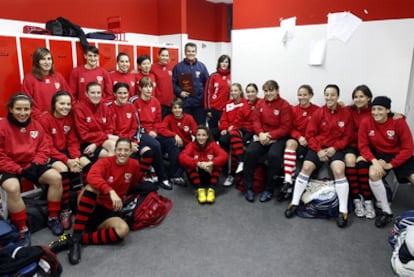
Rayo ladies see European dream ended by Arsenal in last minute blow
Madrid-based team was aiming to be first Spanish Superliga side into last 16 of Champions League
Last Thursday, 8,000 people attended the match between Rayo Vallecano and Arsenal Ladies at the Teresa Rivero stadium, a Champions League last-16 match. On the same evening, 19km south in Getafe, half that number went to the Coliseum to watch Getafe play Stuttgart in the Europa League.
The world in reverse? Not exactly. The Rayo ladies' team has Vallecas hooked. Enough so that traveling fans went to London for the return leg yesterday. Lola is one such fan who does not miss a match. She is 55 years old and has lived in the Madrid suburb for 30 years. Four years ago she started watching the team and now she and a group of dedicated fans follow Rayo all over Spain. Lola and her son had to take the day off to travel to London. As did some of the players; if the Rayo ladies' team were male, they would be in magazines and on television, but as they are women, the Spanish Football Federation doesn't consider them professionals. They are an elite team, with two league titles and a cup win in the last two years but when soccer finishes for them they are not even entitled to unemployment benefit.
That's why Saray had to ask her boss at the guest house she works at in Torrejón for three days off to play in London. "As it's a family business it's not a problem, but I have to make up the days when I get back." Every two weeks Rayo plays away: Las Palmas, Málaga, Seville and Gijón are all regular destinations. They get paid around 1,000 euros a month. Natalia Pablos is the team captain and scorer of the first goal against Arsenal in the first leg. She is 25 years old and has been playing for Rayo for 10. In 2009 she was the league's top scorer and was part of the Spain under-19 European championship-winning team. Her successes led to her think that soccer was the most important thing there was, but then reality scored a goal against her. At 22, she was left with nothing and decided to leave the national team to become a teacher. "My soccer career will last as long as work allows it to," she says.
Soni, who they call the female Messi, scorer of the second goal against Arsenal, says the same. She was born in Vallecas and started training with the men's team at seven years old. "Things have changed a lot. Our league is at a much higher level than five years ago," says Rayo's coach, Pedro Martínez Losa, who has been in charge of the team for five years. In the Superliga (the top division in the female league) players transfer between clubs, just as in La Liga. One of the most significant was that of Adriana two summers ago. Adriana is a forward and was the league's top scorer the previous season. She transferred from Espanyol to Rayo. "Every day it becomes clearer that I will stop playing soccer sooner than I thought I would. For us, sport demands a lot and gives back nothing," she says. She doesn't want to miss out on other options, so she spent the night before the team traveled to London studying for her qualification at the National Institute of Physical Education.
It was Adriana who scored Rayo's only goal in an eventual 4-1 loss to Arsenal at Borehamwood yesterday, a result that knocked the Madrid side out of the Champions League. Rayo, though, had one foot in the quarterfinals for 15 minutes. Had Adriana's 78th-minute strike been the last of the match, Rayo would have progressed on the away goals rule. However, a last-minute goal by England international midfielder Katie Chapman gave Arsenal the scoreline it needed to progress and simultaneously brought an end to Rayo's dream of becoming the first Spanish team to reach the last eight of Europe's elite club tournament. This battle may have been lost but, slowly, Rayo is winning the war to get a fanbase for the women's game.