
Shanghai Ranking shake-up: China and Taiwan now have more universities in the top 500 than the US
While the Asian country is increasing investment in education, American institutions are facing cuts under Trump
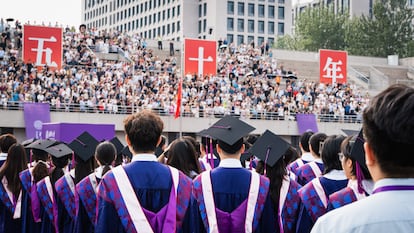

For the first time, China and Taiwan have more universities than the U.S. in the top 500 of the Shanghai Ranking, the world’s most prestigious international university ranking, which recognizes a total of 1,000 institutions.
Meanwhile, Spanish campuses are stagnating. The country managed to place 36 higher education institutions on the famous list — the same number as last year. This year, however, the University of Valladolid dropped out and was replaced by the University of Las Palmas de Gran Canaria.
“The Archimedes principle applies: China is clearly growing, so there will increasingly be fewer European and North American institutions in the ranking,” explains mathematician Domingo Docampo, former rector of the University of Vigo and one of the people who best knows the inner workings of the Shanghai Ranking. The Asian giant has been steadily rising in the rankings because, for several years now, “it has been investing in higher education and taking it seriously,” he adds.
The scores in the Shanghai Ranking are based on several factors, such as the number of faculty and alumni of the institutions who have received the Nobel Prize or the Fields Medal, the number of highly cited researchers on staff, or the number of articles published in the academic journals Science and Nature over the past five years. The citation indicator is extremely volatile, meaning that institutions can rise or fall in the ranking quite easily.
Asian higher education institutions are huge, which allows them to have greater scientific output and a significant number of highly cited researchers publishing in prestigious journals. The only limitation China faces is the relatively small number of people in its academic community who have received a Nobel Prize, since the country has only recently become deeply involved in scientific research, according to Docampo.
While China is investing in education, U.S. universities — always among the top-ranked and numerous in the top 500 — are facing challenges due to U.S. President Donald Trump’s ideological offensive. In May, his administration barred Harvard from admitting foreign students — a move that affects roughly 6,800 students. Several campuses have already seen their funding put at risk.
On March 7, Columbia University saw $400 million in funding compromised. It was followed by the University of Pennsylvania ($150 million, as a penalty for a sports program including transgender students), Harvard ($9 billion), Princeton ($210 million in research grants and nearly $4 million withdrawn for climate change projects), and Brown, which had $510 million in funding paused. Funds for Cornell and Northwestern were also frozen due to protests over the Gaza war, with the administration citing the fight against antisemitism.
If this trend continues and research funding is affected, the U.S. could risk its current leadership in the Shanghai Ranking. Historically, the top universities have been Harvard, Stanford, and MIT. They are closely followed by Cambridge and Oxford from the U.K., which has the third-highest number of highly ranked institutions. Among the top 20, 15 are from the U.S., three are British, one is French, and one is Asian: Tsinghua University, which rose from 22nd to 18th place.
For Spain, the results are mixed. Universities held their ground but scored lower than in 2024. Nine institutions dropped in score, six improved, and 22 remained the same. Last year, slightly more universities improved (11) than declined (7), with 18 staying the same. Economic factors partly explain this: Spain spends roughly 0.7% of its GDP on higher education, while the EU average is around 1.2%.
Julio del Corral, professor of economics at the University of Castilla-La Mancha, explains that funding is key. “Asian and Arab countries are increasingly investing in science. However, we receive less funding, or at least it isn’t increasing,” he says. To address this, the Organic Law of the University System (LOSU) sets a goal of allocating 1% of GDP to higher education by 2030. In principle, it’s an achievable target, but it’s unclear whether all regional governments are willing to meet it.
The most severe case is Madrid, the wealthiest region in Spain, which invests only 0.5% in universities. Even if the goal is met, Spain would still lag behind Europe, where many countries invest more than 2% of their GDP. The University of Barcelona has the best performance in Spain in the Shanghai Ranking, placing among the top 200. Its leading position reflects a high output of scientific publications and a consistent presence of highly cited authors.
Spain’s public university system
No Spanish campus can be considered globally “top-tier,” as none appear in the Shanghai Ranking’s top 100. However, several deserve international recognition for quality, being placed among the top 500, or recognized as internationally strong, appearing among the 1,000 institutions highlighted by this prestigious ranking. It’s worth noting that there are roughly 20,000 universities worldwide.
Del Corral and Docampo agree that, despite challenges, Spain’s public university system is efficient. “It is surviving a difficult period in which campus finances are strained. That’s a major achievement,” the mathematician emphasizes. Spain has 91 universities in total, 50 public and 41 private. Of the public institutions, 72% appear in the Shanghai Ranking, while only one private university — the University of Navarra — makes the list.
For Serra, the management of Spain’s public universities deserves recognition. If most campuses rank among the 1,000 listed institutions, it means that any student in Spain has access to a good university near their home — even if it isn’t Harvard.
Sign up for our weekly newsletter to get more English-language news coverage from EL PAÍS USA Edition









































