
Why six Nobel Prize economists back California’s Proposition 40: ‘It’s the first opportunity for the people to start reining in the power of billionaires’
Daron Acemoglu, Paul Krugman and Joseph Stiglitz, among others, signed a letter defending a one-time 5% tax on individuals whose wealth is above $1 billion. The initiative will be submitted to a vote on November 3


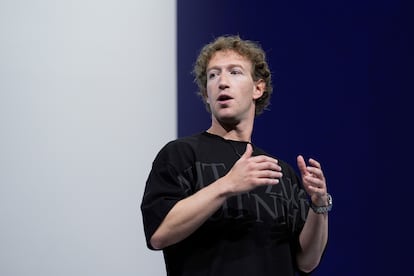
California is home to some of the world’s largest fortunes: Mark Zuckerberg, founder of Meta; Jensen Huang, chairman and co-founder of NVIDIA; and Larry Page and Sergey Brin, co-founders of Google. Together the four hold nearly $1 trillion. They top a list of about 200 billionaires who, if California’s Proposition 40 is approved at the ballot box on November 3, would be subject to a one-time 5% tax on their wealth (not their income).
This is an unprecedented initiative. And six Nobel Prize–winning economists — Daron Acemoglu, Abhijit Banerjee, Peter Diamond, Esther Duflo, Paul Krugman and Joseph Stiglitz — say the model should be extended worldwide in response to what they describe as an unequal tax contribution by the wealthiest families.
“If the state that houses some of the country’s most powerful billionaires votes to tax their wealth, it will kickstart a movement to tax ultra-high-net-worth individuals in other states — and eventually at the federal level and in other countries,” the letter says. “As Californians head to the polls, their vote may well come to be seen as a turning point in the battle between democracy and oligarchy.”
In California alone, the 200 ultra-rich individuals who would be subject to the levy hold an estimated $2.3 trillion in wealth — roughly equal to the state’s annual gross domestic product of a state that is home to 39 million people. Their mansions are in Beverly Hills, Los Angeles, Newport Beach and Silicon Valley. They represent just 0.001% of the population and, between 2023 and 2025, the wealth of several of them rose by 144% driven by the boom in artificial intelligence, according to a study by the National Bureau of Economic Research. Other large fortunes that could also be affected by the tax include those of Dario Amodei, co-founder of Anthropic; Travis Kalanick, co-founder of Uber; Peter Thiel, co-founder of PayPal; and Jan Koum, co-founder of WhatsApp.
Fewer taxes, but more power
Proposition 40 would require California residents with wealth above $1 billion to pay a one-time tax equal to 5% of the total value of their assets. Its backer, the Service Employees International Union–United Healthcare Workers West (SEIU-UHW), estimates the measure would raise about $100 billion. Ninety percent of those funds would finance health care, which the group says was harmed by cuts under the Donald Trump administration, while the remaining 10% would be split between food assistance and education programs.
If voters approve it on November 3 with more than 50% of the vote, the tax would apply to people who have been California residents since January 1 of this year. In other words, those who leave the state after the election could not avoid the levy.
“Over the 2019-2025 period, the total amount of California income tax paid by billionaires amounted to only 1.6% of their $1.4 trillion wealth gain, much less than what ordinary Californians pay on their paychecks,” the letter notes.
The economists also question how those fortunes were built and the political power these figures have amassed through contributions to political campaigns: “How did the billionaires get to be so rich? In many cases, they made important contributions, for which they have been amply rewarded. But our failure to tax their returns on capital—a myriad of loopholes they’ve taken full advantage of—has also allowed their wealth to compound, while ordinary Americans have paid higher rates.”
Sergey Brin’s campaign
Four people — Mark Zuckerberg, Jensen Huang, Larry Page and Sergey Brin — alone own about 40% of all wealth held by California’s billionaires. While Huang, NVIDIA’s chief executive, has said he is willing to give up 5% of his fortune, Brin, one of Google’s early backers, is leading a $100 million ad campaign to defeat Proposition 40 at the ballot box.
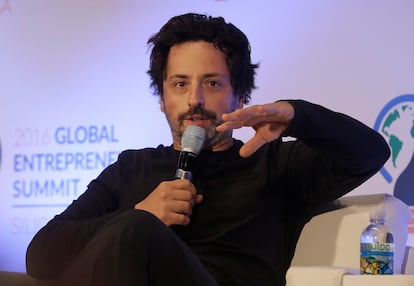
His argument is that the tax scheme is poorly designed and could drive some billionaires to other states, resulting in lost tax revenue, jobs and investments. “When the money runs out, Sacramento will come back with another tax,” warns one of the ads paid for by the committee Building a Better California.
Brin, whose family left the Soviet Union when he was a child, says the fight has become personal. “I fled socialism with my family in 1979 and I know the oppressive and devastating society that system created in the Soviet Union. I don’t want California to end up in the same situation,” he told the New York Times.
Those who drafted Proposition 40 dismiss Brin’s arguments. The SEIU-UHW says his wealth has doubled to nearly $300 billion since Donald Trump’s election, and notes that Brin was one of his donors. The union says he is part of a “small group of billionaires” who, it claims, spread falsehoods about the measure in order to avoid paying the tax.
Opposition is organized in several committees, including the California Business Roundtable, which presents the measure as a “tax on everyone.” Also opposing it are the California Chamber of Commerce, the California Teachers Association and the California Association of Children’s Hospitals.
The initiative has also opened a rift within the Democratic Party. Progressive Senator Bernie Sanders backs it. “The idea that they say it’s OK for kids to die, that people won’t get the health care they need, that they’re going to punish Californians... is outrageous,” he said. The state party leadership also supports it.
At the other end is Governor Gavin Newsom, who has presidential ambitions, and who questions the structure of the measure and says a tax of this kind should be applied nationally. He warns about the potential relocation of billionaires and their investments out of California. “This poorly designed state measure will take resources away from teachers, schools, clinics and public safety,” he said in a statement quoted by the Los Angeles Times.
Support hangs in the balance
The future of Proposition 40 is uncertain. Polls show a narrow edge for the “Yes” vote, although support drops among voters who say they are more familiar with the initiative.
The Public Policy Institute of California (PPIC) found in a poll published this week that 52% of voters support the measure, while 46% oppose it. A month earlier, a survey by the Institute of Governmental Studies (IGS) at the University of California, Berkeley recorded 48% support and 41% opposition.
Another poll, conducted by Politico and UC Berkeley’s Citrin Center for Public Opinion Research, put support this week at 45%, with 43% opposed and 12% undecided. However, among respondents who said they had heard “a lot” about the proposal, opposition reached 57% versus 38% in favor.
In 2022 Californians rejected Proposition 30, an initiative that would have raised taxes on higher earners. The result was 58% against and 42% in favor. The measure proposed raising the income tax by 1.75 percentage points on those earning more than $2 million a year and directing the new revenue to zero-emission vehicle programs and fire prevention.
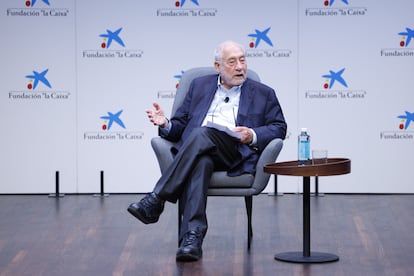
In that context, the six Nobel Prize economists argue that, while Proposition 40 would not by itself solve the problem of inequality in California, it would represent a step in the right direction. “What will allow California to thrive in the future is not letting a handful of billionaires live tax free: it is adequate public spending on health, education, and public infrastructure, key engines of economic growth to which it is only fair to ask the ultra-wealthy to contribute,” they write.
Sign up for our weekly newsletter to get more English-language news coverage from EL PAÍS USA Edition.









































