
Venezuela opens its electricity system to private investment
The policy shift aims to address the collapse of a grid that has been battered by blackouts and problems over the past two decades, and includes a tariff increase
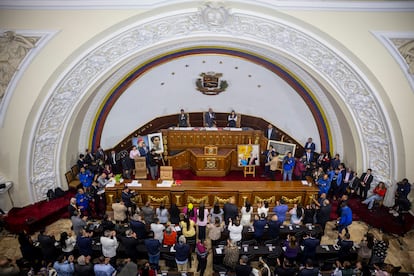
The National Assembly of Venezuela, controlled by Chavismo, has taken a step toward ending the state monopoly over the electricity service, which has been in crisis with blackouts and other problems for two decades. A draft reform to the Organic Law of the Electric System and Service was approved in first reading; it is aimed at opening the field to private capital within a framework of long-term concessions.
During the 15 years that the service has been exclusively managed by the National Electric Corporation, Corpoelec, the national electrical system experienced a collapse. The bill was approved with votes from the opposition, but the legislature still needs to give final approval to the text in the coming days in a second plenary reading.
The proposed reforms would allow private investment across all segments of the electricity service, while promoting mixed public-private arrangements. They would also entail a review of the tariff structure and an end to the prolonged subsidies that have become common in recent years, with the aim of obtaining net profits from the company’s management. Operational decentralization of the state-owned Corpoelec is also being envisaged.
This initiative from the ruling United Socialist Party of Venezuela (PSUV) in parliament is part of a series of institutional, economic, operational, legal and political adjustments that Venezuela has been implementing since Delcy Rodríguez assumed power as interim president, following the United States’ intervention in Caracas to capture Nicolás Maduro. The regime continues to review all its policy guidelines and to seek breathing room, with the help of private capital.
The Venezuelan electricity crisis has tormented citizens for 20 years, nearly the same length of time that Corpoelec has existed since its creation by decree at the behest of former president Hugo Chávez in 2007. The national grid, which used to operate under a mixed, regional model and had grown normally for decades, began showing signs of exhaustion at the start of this century due to lack of maintenance and difficulties attracting new investment. Two nationwide blackouts lasting hours, in 2006 and 2007, were the first warning signs.
The problems provided Chávez with an additional argument to dismantle the existing private-mixed model, in line with his anti-capitalist political views. Early in 2007, newly re-elected as president, he announced the nationalization of Electricidad de Caracas, one of the country’s oldest domestically owned companies, which had managed the service efficiently since the late 19th century.
That year he also created Corpoelec, and in a national broadcast he said: “There are still people here who will tell you that the private sector is more efficient, that I will scare away investment, that if we nationalize the electricity service the blackouts could worsen. Are they going to try to sell me that story?”
In 2009, two years later, Venezuela faced a severe drought driven by the El Niño phenomenon and entered a routine of electricity rationing from which it has not recovered. The Guri hydroelectric plant, which generated almost all national power, reached critical reservoir levels due to the lack of rain. That situation was compounded by massive distribution problems caused by poor maintenance of the grid. In 2010, the government of Hugo Chávez published the Electric Emergency Decree, which imposed harsh penalties on companies that failed to comply with rationing and promoted a program of direct purchases of thermal plants and spare parts. It also ordered the acquisition and manufacture of energy-saving light bulbs, a solution recommended by Fidel Castro.
Chávez’s measures — which demanded rapid implementation and saw him grow frustrated with bureaucratic delays — led to mass fraudulent purchases, overbilling and procurement of used or unusable spare parts by civilian and military officials. One of the best-known scandals involved Derwick, a company founded by businessmen Alejandro Betancourt and Francisco Convit, which received more than $2 billion in direct awards to buy obsolete and overpriced equipment, worsening the problem rather than alleviating it. Much of the money awarded by the government to Derwick ended up in private international accounts, according to reports from Transparencia Venezuela.
In 2013, after Hugo Chávez’s death, the first major nationwide blackout occurred, leaving 80% of the country without power for more than a day. Nicolás Maduro, then acting president, formalized the Load Management Program, a euphemism designed to make power shortages a permanent feature. These rationing measures always explicitly excluded the city of Caracas, which the regime considered a key pillar of the country’s governability. Service in the capital has deteriorated significantly since the nationalization of Electricidad de Caracas, but Caracas remains one of the few areas free from rationing.
Between 2018 and 2019, Corpoelec technicians and workers took to the streets to protest the company’s management, denouncing corruption and repeatedly warning of an imminent total collapse of service. Then, in March 2019, the country experienced the great six-day national blackout, the longest in Venezuela’s history, which caused a widespread collapse of water, telecommunications and health services, sparked public outrage and intensified anti-government protests in the streets. The then minister of Communication and Culture, Jorge Rodríguez, told the press on behalf of the executive that the failure was the result “of an international attack” orchestrated by U.S. intelligence services to weaken the Bolivarian revolution.
To this day, structural weaknesses in the electricity service pose serious bottlenecks to the definitive recovery of the national oil, gas and steel industries, and, according to experts, constitute a ceiling that prevents any program of economic growth in the country.
Venezuela was one of the first South American countries to fully electrify its territory in the 20th century and, after the consolidation of the Macagua hydroelectric system — which includes the Guri dam and several smaller facilities — it was, alongside Brazil, one of Latin America’s largest electricity producers until the 1980s.
In contrast, in western Venezuela — especially in the Zulia region and in the Andes — power cuts of up to eight hours a day now occur. In the plains regions they can last five hours. Only in Caracas, Guayana and the eastern part of the country is service somewhat more stable and predictable.
Sign up for our weekly newsletter to get more English-language news coverage from EL PAÍS USA Edition









































