Trump reviews potential entry of Chinese automakers with US auto industry
Ford’s CEO discussed with the president a framework for the arrival of these carmakers, which would involve the creation of joint ventures
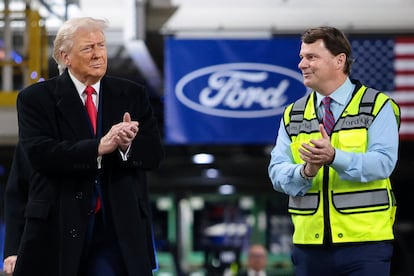
Ford CEO Jim Farley has held talks with senior officials in the Trump administration to explore a framework that would allow Chinese automakers to enter the U.S. market. If this framework materializes, it would require Chinese manufacturers to produce locally while offering some protection to domestic automakers, according to sources familiar with the discussions consulted by Bloomberg. The idea — which members of Trump’s Cabinet discussed with Farley in January — would involve Chinese automotive companies entering the market through local partners and creating joint ventures in which the majority of the capital would remain in U.S. hands.
These companies would be structured in such a way that both the Chinese and U.S. partners would share profits and technology within the joint venture, according to the same sources. No decision has been made, and the conversation was described by these individuals as informal and preliminary.
Such an arrangement would mirror what China required from Western manufacturers three decades ago, when they had to partner with Chinese companies in order to establish factories in the country. This was the case, for example, with the Volkswagen Group, which decided to partner with SAIC Motor — owner of the MG brand — to sell its vehicles in China. MG has since successfully entered Europe, especially Spain, where its ZS model was the eighth best‑selling vehicle in January.
These conversations are taking place as Chinese manufacturers move increasingly closer to the United States. Canada recently announced a plan to allow certain Chinese electric vehicles into the country, while cars from BYD — the world’s largest producer of plug‑in hybrid vehicles — are becoming common on the streets of Mexico.
Farley discussed the matter with U.S. Trade Representative Jamieson Greer; Secretary of Transportation Sean Duffy; and Administrator of the Environmental Protection Agency Lee Zeldin, during his visit to the Detroit Auto Show last month. The conversation took place just days after Trump indicated that he was open to allowing Chinese brands to enter the market if they built factories and hired U.S. workers.
Ford’s conversations with the Trump administration regarding China have consistently emphasized “the need to protect the domestic market from a flood of subsidized vehicles manufactured in China,” said Mark Truby, Ford’s communications chief, in a statement. The company added that Ford and the government “discussed various industry topics” during the Auto Show, but provided no further details.
Ford’s discussions with the Trump administration regarding China have consistently emphasized “the need to protect our home market from a flood of subsidized vehicles built in China,” said Mark Truby, Ford’s chief communications officer, in a statement. The company added that Ford and the administration “discussed a variety of industry topics” on the sidelines of the Auto Show, but offered no further details.
“We have also been clear about the privacy and national security issues associated with Chinese vehicles in the U.S. and we will continue to reiterate this in our discussions with policymakers,” Truby said.
Although Farley was not advocating for the joint‑venture option, it was discussed as a way to protect U.S. interests in a scenario where Chinese companies entered the U.S. market, according to the cited sources. Even so, the initiative received a cool reception from Trump officials, who believed it would face opposition in Washington. However, some members of the administration consider that such an investment agreement could be a possible outcome of Trump’s planned meeting in Beijing with Chinese President Xi Jinping in April.
A highly protected market
Chinese competitors gaining a foothold in America would be a watershed moment with massive implications for domestic automakers, their supply chains and consumers.
China’s carmakers have rapidly gained market share in Europe, Mexico and South America with lower-cost models that feature advanced electric-vehicle batteries and infotainment systems. They also receive significant government subsidies and can offer technology at low prices in part because they tolerate slim margins and losses, giving them a competitive edge that western rivals struggle to match.
Trump’s January comments surprised Detroit’s automakers, who’d felt formidable trade barriers erected by the U.S. would keep Chinese automakers out of the country long enough to allow them to catch up on China’s lead in electric vehicles, batteries and other automotive technology.
General Motors has told the Trump administration that the company opposes a Chinese entry to the market, one of the people said. GM has argued that existing companies would lose market share and a flow of parts from China could have a devastating effect on North American suppliers.
GM’s opposition echoes a wider view among Trump’s cabinet that the U.S. should keep China’s automakers out of the US market. While the president has said that he may welcome Chinese companies into the U.S. if they build cars here, many on his team oppose such a move due to economic and national security concerns. Farley too has warned that China’s low-cost, high-tech cars represent an “existential threat.”
“Their cost, their quality of their vehicles is far superior to what I see in the west,” Farley said last summer at the Aspen Ideas Festival, where he revealed he had visited China a half dozen times in the last year. “We are in a global competition with China and it’s not just EVs. And if we lose this, we do not have a future at Ford.”
Farley has sought to partner with Chinese carmakers and battery makers to learn from them, while at the same time developing its own low-cost electric vehicle coming in 2027 that aims to be competitive with China’s BYD. The company is struggling to make its electric division (called Ford Model e) profitable, so it has decided to roll back a large part of its investments in electric cars — an adjustment that has resulted in a negative impact of $19.5 billion on its 2025 accounts.
In recent weeks, Ford has held talks with BYD to expand their collaboration on battery supply and has explored a manufacturing partnership in Europe with Geely, the Chinese brand interested in producing at Ford’s underutilized plants on the continent — such as the Almussafes facility in Valencia, which currently only builds the Ford Kuga and is awaiting a multi‑energy model in 2027. Meanwhile, the automaker has decided to leave the production of two affordable electric models for the European market in the hands of Renault. These vehicles will be built on the same production platform as the Renault 5, the French automaker’s most successful electric model to date. They are expected to reach the market starting in 2028.
Ford has also expanded a licensing agreement with the Chinese battery giant CATL. A recent report from the Financial Times suggesting that Ford was considering creating a joint venture with Xiaomi to manufacture vehicles in the U.S. was firmly denied by both companies.
Sign up for our weekly newsletter to get more English-language news coverage from EL PAÍS USA Edition
Tu suscripción se está usando en otro dispositivo
¿Quieres añadir otro usuario a tu suscripción?
Si continúas leyendo en este dispositivo, no se podrá leer en el otro.
FlechaTu suscripción se está usando en otro dispositivo y solo puedes acceder a EL PAÍS desde un dispositivo a la vez.
Si quieres compartir tu cuenta, cambia tu suscripción a la modalidad Premium, así podrás añadir otro usuario. Cada uno accederá con su propia cuenta de email, lo que os permitirá personalizar vuestra experiencia en EL PAÍS.
¿Tienes una suscripción de empresa? Accede aquí para contratar más cuentas.
En el caso de no saber quién está usando tu cuenta, te recomendamos cambiar tu contraseña aquí.
Si decides continuar compartiendo tu cuenta, este mensaje se mostrará en tu dispositivo y en el de la otra persona que está usando tu cuenta de forma indefinida, afectando a tu experiencia de lectura. Puedes consultar aquí los términos y condiciones de la suscripción digital.