
Dollar slump shows no signs of ending: Analysts foresee more drops as traders move to protect portfolios
The currency has lost around 3% in just over a week against the euro and yen, as more investors bet on a decline in the futures markets
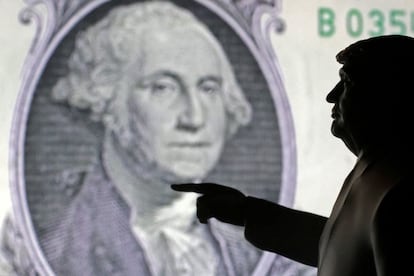

The picture of U.S. strength promoted by Trump, with flashy images and lofty statements, contrasts with weakness in the financial markets. While the tech frenzy is still driving the stock market, investors are focusing on keeping their portfolios safe from the White House’s capricious actions.
The whirlwind of events in January brought on by Donald Trump, along with the financial storm in Japan, have increased instability and fueled expectations of a weak dollar. Trump’s attack on the U.S. Federal Reserve through the investigation of its chairman Jerome Powell, the rift with Europe over Greenland, and the rapid rise in long-term interest rates in Japan have pushed the currency to trade at $1.195 per euro — the lowest level since 2021 — after falling 2.7% in one week. And the market expects it to fall even more.
“The recent weakness of the U.S. dollar seems to be largely due to inconsistencies in U.S. domestic and international policy, which have undermined investor confidence,” explains David Meier, economist at Julius Baer. “As a result, rumors of currency devaluation have resurfaced, pushing the dollar down even in the absence of macroeconomic factors. Although it has weakened, it remains highly overvalued and we continue to expect a further decline,” adds the analyst from the Swiss bank, expressing a view that is practically the consensus in the market.
Experts link the currency’s weakness to political fragmentation, which encourages portfolio diversification, and to the unpredictability of Donald Trump’s policies — both domestically, where challenges to the independence of the Federal Reserve play a key role, and internationally, with various threats of trade wars every week. If recently Europe was the target of the White House over its refusal to hand over Greenland, today it is South Korea’s turn.
“European assets continue to offer a safe and liquid alternative to the dollar for investors seeking predictability and stability in decision-making, which should favor the euro as long as Trump remains in the White House,” explains Enrique Díaz-Álvarez, chief economist at Ebury.
This shift is nothing new. The expectation that Trump would bring a period of dollar strength vanished shortly after the elections. The U.S. currency came close to parity with the euro in the days before Trump’s inauguration, trading at $1.02 per euro; since then, it has fallen nearly 20%.
“Demand for the reserve currency should be lower in a multipolar world made up of different blocs [...] geopolitical fragmentation should be negative for the dollar in the long term,” explains Claudio Wewel, currency strategist at J. Safra Sarasin Sustainable AM, who expects more instability in the currency market. “Looking ahead to this year, we anticipate a continuation of the dollar’s downward trend; the currency remains overvalued by historical standards.”
As market prices already show, this is not just talk — and the market expects more. Last Monday, the Depository Trust and Clearing Corporation (DTCC), the U.S. agency that handles, among other things, options and futures trading in currencies, recorded the highest trading volume since April 3 — the chaotic session following Trump’s so-called Liberation Day — according to Bloomberg. Looking at the last four days, trading is at a record high. Two-thirds of all dollar trades are bets on the U.S. currency falling.
Currency futures markets are used by investors or large corporations for different purposes: to hedge against future fluctuations or to speculate and profit from them. In any case, expectations point to further weakness in the U.S. dollar. Option prices reflect the same sentiment: the dollar-euro volatility index, which measures the cost of hedging against declines in the greenback, has doubled for one-week contracts since mid-month.
The situation in Japan, along with the possibility — raised by the Democratic opposition — of a government shutdown in response to the violent actions of Trump’s immigration police, has added pressure on the dollar. The U.S. currency has fallen 3.3% against the yen in six sessions, amid the potential for a coordinated intervention by Japan and the U.S. to halt a drop in the yen that could destabilize markets.
Jack Janasiewicz, portfolio manager at Natixis IM Solutions, explains: “The recent decline in the U.S. dollar is a consequence of the movement in the Japanese yen, following weekend rumors of a possible intervention. At the same time, the threats over Greenland have weakened confidence in the U.S. dollar.”
The loss of reserve currency status during times of uncertainty not only penalizes the dollar but also complicates the search for safe havens. It is this scarcity of certainty that has pushed gold to boiling point, already at $5,000 — up 27% this year and 93% since early 2024. As IMF Managing Director Kristalina Georgieva noted — and Janasiewicz highlights — this trend is inseparable from geopolitical fragmentation: “If the dollar is used as a weapon by sanctioning dollar-denominated assets, people will move away from the dollar. And that means gold.”
Sign up for our weekly newsletter to get more English-language news coverage from EL PAÍS USA Edition









































