
EU executive must decide whether to implement Mercosur deal despite setback from Parliament
The negative vote is widely seen as a delay tactic to stop a trade agreement that has already been 26 years in the making
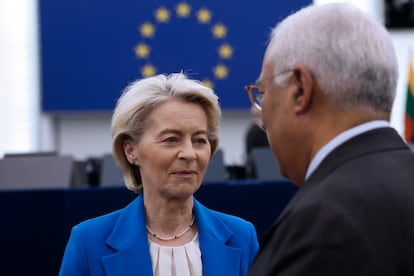
Despite the political setback that the European Union’s trade agreement with Mercosur has suffered in the EU Parliament, which voted against it citing legal concerns, its provisional implementation remains a possibility. The decision now depends on the Commission, the EU’s executive arm, and on the member states. The Commission has the power to request it, and the EU Council must approve it by a qualified majority, the same procedure that was used to sign the trade agreement last Saturday in Asunción, paving the way for the largest free trade zone in the world. Lawmakers are now seeking legal opinion from the European Court of Justice, a move that could take years to get resolved.
But what is legally possible could pose a serious political problem. Because, as the European Commission pointed out when remarking on the Parliament’s negative vote, the legal formula used to process the ratification of this agreement is the same one used for an agreement reached with Chile that did not raise any questions inside the European Parliament. In other words, the outcome of this vote suggests that the opposition for legal concerns is motivated less by legal reasons than by political ones. It’s a delay tactic to further postpone an agreement that has taken 26 years to finalize, as European legislators of various persuasions, displeased by the vote, have also stated.
The decision on whether to implement it immediately—pending approval from the Mercosur countries: Argentina, Brazil, Paraguay, and Uruguay—will be political. And there, once again, a major battle will erupt. “Enough delays. The agreement must be implemented now on a provisional basis,” German Chancellor Friedrich Merz demanded forcefully as soon as the vote result was announced.
The European Commission can ask the EU Council, that is, the member states, to approve the provisional entry into force of the trade agreement without parliamentary approval, explains legal expert Eva Poptcheva, a former liberal member of parliament. Her conclusions coincide with those of Professor of European Law, Alberto Alemanno.
But the legal argument doesn’t convince Paris: “France is prepared to say ‘no’ when necessary, and history often proves it right,” declared Foreign Minister Jean-Noël Barrot immediately after the parliamentary vote.
The division over what to do has also reached the European Parliament, even among supporters of the agreement. The European People’s Party (EPP), despite having around 30 dissenting members, is a firm believer in not waiting. Swedish MEP Jörgen Warborn, the group’s spokesperson on the Trade Committee, made this clear: “It should be applied provisionally because it could take two, three, or more years [for the judges’ decision, plus the subsequent parliamentary process]. Our partners are already very, very impatient. I am too. It doesn’t contradict the agreement to apply it provisionally,” he stated at the press conference following the vote.
For her part, the president of the Socialists and Democrats (S&D) group, the Spanish MEP Iratxe García, indicated that although the outcome of the vote “is not good,” her group “respects” it and will “wait” for the European court to issue its ruling before proceeding with the parliamentary ratification process. However, she also left the door open to a political decision: “We recognize that the Council and the Commission now have the prerogatives for the provisional application of the agreement in accordance with the Treaties,” she stated.
Bernd Lange, chairman of the European Parliament’s Committee on Trade and also a supporter of the trade agreement, is far more cautious. This veteran German social democrat called Wednesday’s vote “utterly irresponsible,” but also recalled that the last four European Commission trade commissioners had committed to the European Parliament that the agreement would not enter into force without its consent. “This is not a decision that should be rushed,” he reassured, noting that in some Mercosur countries, such as Brazil, the ratification process can take up to a year.
Ignacio García-Bercero, former senior official in the European Commission’s Trade department and researcher at Bruegel, also advocates for caution and even waiting for Parliament to complete its process. “There is a well-established tradition that trade agreements do not enter into force provisionally without parliamentary consent,” he points out, noting that this unwritten rule has only been broken with the United Kingdom and Brexit, due to timing issues, and more recently with Morocco. “It can be done legally, but I would advise against it,” he says, then suggests exploring ways to expedite the courts’ decision.
García-Bercero’s argument rests, firstly, on the fact that implementing the agreement without waiting for Parliament could provoke a greater backlash among MEPs. Secondly, it considers the message this could send to partner nations, by applying a pact that might later be challenged in court. Those advocating bypassing Parliament and implementing it quickly and provisionally counter that this is dangerously testing the patience of transatlantic partners who have been waiting for European approval for many years and accepting their constant demands for greater guarantees.
Delays in creating a large free trade area with over 700 million consumers are costing money. Negotiations have dragged on for more than 25 years. An initial agreement in principle was reached in 2019, but it was met with considerable indifference by European institutions. It was then renegotiated for another five years. According to calculations by the European Centre for International Economic Policy (ECIPE), the delays in implementing the agreement are costing billions of euros in exports. In the five years between the signing of the first and second agreements in principle, the cost would have been around €183 billion, at a rate of €3 billion per month. An updated figure would raise the cost to €280 billion if it takes another three years to come into force.
Sign up for our weekly newsletter to get more English-language news coverage from EL PAÍS USA Edition









































