
Delay in US financial support for Argentina rattles markets
Javier Milei’s government has spent about $2.5 billion in just over two weeks to prop up the peso
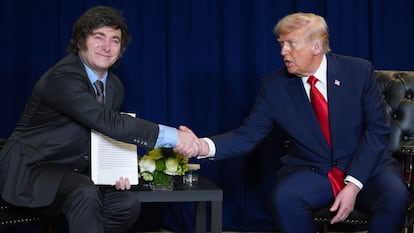

Argentina’s Economy Minister Luis Caputo traveled to Washington over the weekend to accelerate the financial bailout that U.S. President Donald Trump had promised to his Argentine counterpart Javier Milei. Markets had been expecting news last Sunday night, before trading opened, but the first announcement didn’t come until Monday. U.S. Treasury Secretary Scott Bessent, who is leading the negotiations, posted a message on Monday welcoming Caputo and anticipating “productive discussions on the several options” to support Argentina. He shared a photo with Caputo but offered no further details. On Tuesday, there was total silence — not even a hint of commitment.
Markets are growing anxious over the White House’s lack of concrete decisions, and Milei’s government is finding it increasingly difficult to keep the peso stable. On September 23, Bessent announced on social media that the Treasury was willing to grant Argentina a $20 billion currency swap, in addition to a stand-by credit line — the amount of which was not specified — and possibly purchasing Argentine debt bonds.
The enthusiasm that had accompanied Milei at the start of his administration — fueled by his success in curbing inflation and his commitment to a fiscal surplus — had begun to falter amid evidence that the Central Bank was running short of the dollars it needed to meet its debt payments. Investors began to pull out, Argentine bonds plummeted, and the peso collapsed. The White House announcement gave Milei some breathing room, but the relief proved short-lived.
Pleased to welcome @LuisCaputoAR and the Argentine delegation to the @USTreasury.
— Treasury Secretary Scott Bessent (@SecScottBessent) October 6, 2025
During their time here in Washington, we will continue our productive discussions on the several options that Treasury has at the ready to support Argentina’s strong policies. pic.twitter.com/MZVaxJIp1J
Since September 22, the Argentine government has poured about $2.5 billion into the foreign-exchange market, according to unofficial estimates from financial operators who monitor trading screens daily. In just the past six sessions, the Treasury has sold $1.6 billion, including the last $250 million this Tuesday alone. The total amount offloaded in recent days represents 72% of the $2.2 billion that the Argentine government had obtained from agricultural producers after suspending grain export tariffs for three days. “After Tuesday’s sales, the Treasury is left with $455 million. At this pace, it won’t make it past Friday,” warned a broker familiar with the market’s movements.
Once the Treasury’s funds — considered the Economy Ministry’s “petty cash” — run out, the government will have no choice but to tap into the Central Bank’s reserves, which are already in the red. U.S. support is the only thing that can save Milei if he hopes to retain any electoral chance in the October 26 legislative elections, which will determine the parliamentary backing for the second half of his term.
Trump’s pat on the back wasn’t enough to calm the markets. “Investors want hard cash, not just promises,” the same broker said. The expectation is that everything will come to a head on October 15, when Trump receives Milei in the Oval Office.
Milei’s main problem is that the market already assumes that after the elections — whatever the outcome — the government will have to recalibrate its exchange-rate strategy. For now, the exchange rate floats within bands, but the Central Bank is finding it increasingly unsustainable to keep the dollar’s value below the upper limit, currently set at 1,484 pesos. Allowing the market to float freely according to supply and demand would protect reserves, but at the risk of a devaluation that would ultimately feed inflation. The consumer price index (CPI) has fallen from 25% in January 2024 to below 2% in August, and Milei cannot afford to lose control of it if he wants to stand a chance in the legislative elections.
Economic instability — and the growing likelihood of a Milei defeat at the polls in October — is already weighing on growth forecasts. In a report released Tuesday, the World Bank cut its annual projection for Argentina from 5.5% to 4.6%, compared to its previous forecast, citing “electoral uncertainty.” The far right had already lost to the left-wing opposition in the Buenos Aires provincial elections on September 7. For now, the government remains far from mounting a comeback on the national stage.
On top of poor economic data, a series of corruption scandals has put the administration on the defensive, leaving it without the political firepower to drive its campaign agenda. The political crisis deepened on Sunday with the resignation of Milei’s congressional candidate for Buenos Aires province, José Luis Espert, due to his ties to a businessman jailed for drug trafficking. On Monday, Milei tried to get the campaign back on track with a rock concert before 15,000 people in Buenos Aires, though the electoral impact of such a spectacle remains unclear. Meanwhile, Washington remains silent.
Sign up for our weekly newsletter to get more English-language news coverage from EL PAÍS USA Edition









































