
Fed cuts rates by 0.25 points amid Trump pressure
In the most politically charged meeting in memory, Powell approved the first rate cut since December, with the central bank signaling that further reductions are likely
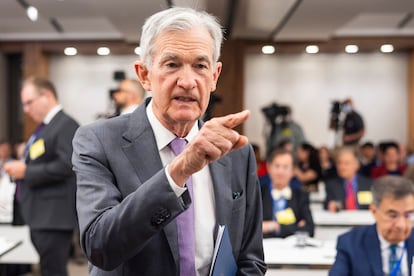

It was the most politically charged meeting in recent memory. The Federal Reserve followed the expected script and approved a 0.25-point rate cut — the first since December and the first since Donald Trump took office. Trump, a president who has repeatedly flouted norms of decorum with his pressure on Fed Chairman Jerome Powell — including insults and threats of dismissal — has pushed for lower rates to soften the impact of Washington’s aggressive trade policies. The new target range for interest rates is now 4%–4.25%.
For this reason, the focus of the news — more intense than at any other time in the Fed’s history — was not on whether the cut would happen, but on the projections for what comes next (the central bank expects to continue lowering the cost of money) and on Powell’s remarks in his subsequent press conference, where he is almost certainly bound to be questioned about the Fed’s independence, which Trump has repeatedly called into question.
Attention also fell on the behavior of four of the seven governors of the U.S. central bank’s board: Stephen Miran, an economic guru appointed by Trump in August to exert pressure from within after external attempts had failed; Lisa Cook, targeted by the White House, whose dismissal is currently stalled in the courts; and two other Trump appointees, Michelle Bowman and Chris Waller, who in the Fed’s previous meeting dissented from Powell — in an unprecedented gesture over the past three decades — and voted for a 0.25-point cut rather than Powell’s “wait and see” approach, which had kept rates unchanged for the fifth consecutive time.
On his second day in office, when most workers were still finding their way to the coffee machine, Miran — whose appointment had been approved at the last minute by the Senate on Sunday — made an immediate impact by voting for a 50-basis-point cut, in line with the wishes of Trump, who has even suggested he would welcome a 300-point drop. As for Cook — whose participation in the meeting was confirmed by a court of appeals the day before — and Bowman and Waller, who has been mentioned as a possible replacement for Powell when his term expires in May, all three joined the rest of the governors in voting for a 25-basis-point cut.
Economically, the Fed’s announcement comes at an extraordinarily delicate moment. With inflation on the rise (up 0.4% to 2.9% in August) and the labor market showing worrying signs of cooling, Powell faces a difficult balancing act. To curb inflation, rates need to rise; to support employment, they should be lowered. Thus, in a volatile economic climate — where the effects of Trump’s tariffs remain unclear and some economists warn of a potential U.S. recession — the Fed must carefully weigh its next steps.
Adding to the uncertainty, the Fed faces other conflicting indicators: consumer confidence has dropped to its lowest level since May, yet August retail sales exceeded expectations, suggesting that the U.S. economy remains strong.
Against this backdrop, the Fed’s dual mandate — controlling inflation and supporting employment — is joined by a third, increasingly urgent objective: finding a neutral interest rate that neither stimulates nor restrains the economy. How Powell will achieve this goal amid the relentless pressure and daily noise from Trump, who refers to him as “Mr. Too Late,” is one of the most difficult questions resonating in Washington today.
Sign up for our weekly newsletter to get more English-language news coverage from EL PAÍS USA Edition









































