
Lena Dunham’s body is back again… and her memoir, ‘Famesick,’ reads differently now
The writer and actress’s memoir takes on a new meaning now that it’s publicly known she became a mother through surrogacy. Her latest book isn’t so much a settling of accounts — it’s more like a justification of her decisions
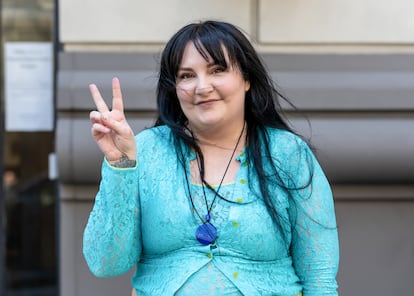

Lena Dunham — the child prodigy who wrote the HBO series Girls (the millennial version of Sex and the City) and later became the fallen star of her generation — published her second memoir this past April. And it reads quite differently now, after she recently announced that she has become a mother via surrogacy.
Before this became public knowledge earlier in September, the book could be interpreted as a necessary reckoning with her past. After all, her precocious talent fell victim to the usual misogynistic prejudices. She was targeted for her feminist stances, for her supposedly privileged background and, above all, for having a non-normative body (and displaying it unabashedly).
In Famesick (2026), the author describes — with disarming precision — the cruelty of the media, at a time when Twitter had become a global pillory and gossip magazines (disguised as outlets of intellectual analysis) sprang up everywhere. That’s perhaps the most interesting aspect of the book: understanding how the construction of 21st-century fame and the accompanying online harassment affected not only the star in question, but also her family; collateral victims throughout her story.
Taking advantage of the fact that the post-Me Too world has processed and acknowledged the new forms of male abuse denounced in Girls (2012-2017) — and drawing on the same fresh and comedic storytelling that made the series a benchmark in television — the creator presents herself as a kind of postmodern Marilyn Monroe, rewriting key moments of her rise and fall in her own terms.
The book is a veritable feast for gossips; it’s full of juicy details. She recounts what Adam Driver was like in private and how he treated her during sex scenes. She discusses her relationship with Judd Apatow and details her romance with Jack Antonoff (whom she portrays surprisingly favorably). And she describes each of the houses she moved into as she earned more and more money (and notes that Nora Ephron advised her to buy a pink Smeg refrigerator).
The book is full of these delightful little pop culture details, something that resembles the writing style of authors like Joan Didion. This makes the reading flow effortlessly. And, as with Didion, there are quite a few moments when Dunham’s self-absorption is jarring. She’s the center of the universe: everything must revolve around her.
The memoir begins with a big bang that takes place between the New York bohemian scene and the South by Southwest (SXSW) festival, where the embryo of the mumblecore film genre was conceived. Dunham describes how she started out her career alongside two of her favorite actors — childhood friend Jemima Kirke and Alex Karpovsky, whom she met at SXSW — and budding stars like Greta Gerwig (Dunham shared a creative workspace with during her early years in New York City). From there, the narrative unfolds, tracing her life’s evolution from the first season of Girls, up until when she founded a feminist newsletter with the producer who was with her throughout the show: Jenni Konner.
Konner bears the brunt of Dunham’s wrath. She’s portrayed as the wicked witch who tells her that she can’t lose weight if she wants to keep playing Hannah Horvath… and, according to the author, she ultimately advises Dunham’s mother to take her to rehab.
The other fascinating aspect of the book is the masterful way in which Dunham describes how, little by little, her body begins to physically manifest the anxiety that’s generated by a ruthless environment that offers her no respite (but from which she also doesn’t want to escape). She eventually becomes a bundle of excruciating and debilitating illnesses, including classic addictions (even though there isn’t a single mention of illegal substances in the entire book, the reader gets the hint). Above all, she struggles with a case of endometriosis so severe that it forces her to have a hysterectomy, depriving her of the possibility of becoming pregnant.
The book’s title reflects all of this. And the purpose of the memoir is interpreted entirely differently now that we know she has become a mother via surrogacy. It’s as if Dunham wants to convince us that if anyone in this world has reasons to undergo this process, it’s her.
Sign up for our weekly newsletter to get more English-language news coverage from EL PAÍS USA Edition









































