
Lack of self-esteem and poor mental health: Why Vincent Van Gogh didn’t always put his name on his work
The Dutch artist only signed 15% of his 840 known paintings
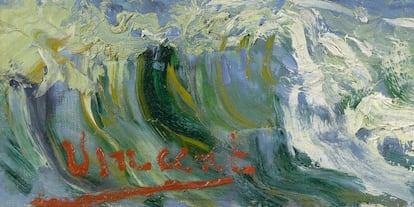

“Vincent.” That’s how Van Gogh signed his works, using only his first name. But the famous Dutch artist didn’t always do so. In fact, his name appears on only 133 of his 840 known paintings… and his mental health and self-critical nature influenced this decision.
Over 10 years of his professional career, he only used the name “Vincent” on about 15% of his work. This finding forms the backbone of the first systematic study of the painter’s signature, recently published by the Van Gogh Museum in Amsterdam. Researcher Julia Engelmayer examines the relationship that this decision had with different stages of his life.
It’s true that, beyond the Netherlands, the surname “Van Gogh” is difficult to pronounce correctly. Hence, the use of “Vincent” was also a direct and distinctive way to sign his work. However, the painter elaborates on various reasons why he preferred to sign his work this way (or not sign at all) in the letters he sent to his brother, Theo, an art dealer. In one of the letters, dated December of 1883, he even notes that he feels “rather different” from the other members of his family. “Essentially,” he writes, “I am not a Van Gogh,” referring to the fact that he didn’t identify with the traditional ideas of his clan.
In 1884, he put his name on a painting for the first time, although he had already been working as an artist for several years. He felt that he was still learning the craft, which is why he referred to a portion of his work as being part of his “studies.”
Throughout a career as dizzying as it was short (what is now considered to be Van Gogh’s professional period spans roughly from 1880 until his death in 1890), he confided in Theo about his artistic practice. He reflected on the quality of his work and revealed his self-critical nature. Van Gogh was very hard on himself.
“During his time in the Netherlands (1880-1885), he very rarely signed his work. Once he moved to Paris (1886-1888), influenced by his fellow artists, he hoped to sell more and may have signed [his paintings] more frequently,” explains Engelmayer, author of the study on the painter’s signature, in a telephone interview with EL PAÍS. “Based on the research data, there seems to be a link between his own well-being and the frequency of his signing, because his name appears more often during his time in Paris and Arles,” she adds. It was a period of hope: he had the desire to exhibit and sell.
The artist’s mental health declined shortly after leaving Paris for the South of France. He first settled in Arles, where he tried to create an artists’ community with Paul Gauguin. It was a very productive period for him, during which he painted The Night Café (1888) and Sunflowers (1888-1889), among other works. However, he also went through great emotional distress: the artistic project failed and he ended up cutting off his ear. He then moved to Saint-Rémy-de-Provence, about 15 miles away, and spent a year in a psychiatric hospital. “There, his mental health got worse. That must have affected his self-esteem and led to dissatisfaction with his work. Even though he painted 151 works, he signed very few of them,” Engelmayer points out. One of those paintings — without the artist’s name written in any of its corners — was The Starry Night (1889). And it was this painting that led the researcher to analyze and catalog the painter’s signature.
In 1890, Van Gogh traveled more than 400 miles north, to Auvers-sur-Oise, on the outskirts of Paris. Theo thought it would be beneficial for him to be under the supervision of Dr. Paul Gachet, a specialist in nervous disorders and a patron of the Impressionist movement. Vincent (a Post-Impressionist) worked frenetically for about 70 days, “but he only signed two works… and it must be said that, once again, his mental health and [lack of] self-confidence played a role in his reluctance to do so,” Engelmayer continues.
Van Gogh did sign some works as gifts and also ones that he exchanged with other painters. Hence, “it is possible to conclude that Van Gogh did so when he felt particularly proud of a painting to exhibit,” the researcher writes in her work.
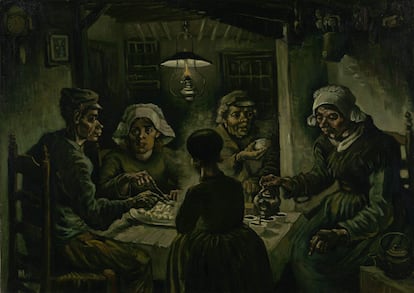
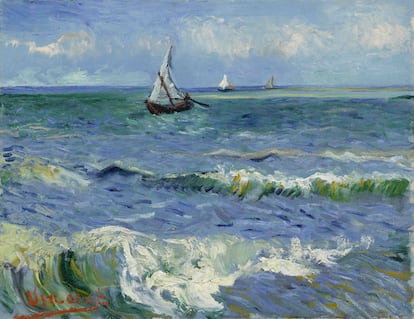
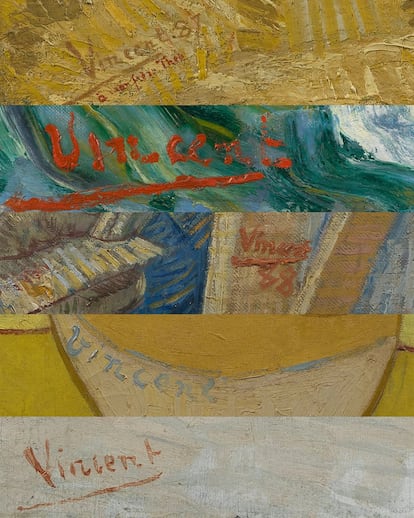
Although Vincent’s name appears in his works in various colors and places, the most frequent variant — whether light or dark — is red. In some cases, such as in The Potato Eaters (1885), which the artist himself considered to be his first masterpiece, the signature (which isn’t red) is integrated into the back of a chair, on the left of the painting. Today, however, it’s almost imperceptible. In other paintings, he included his name “as a stylistic device,” Engelmayer says. This occurs strikingly in Seascape near Les Saintes-Maries-de-la-Mer, an oil painting done outdoors and dated 1888. According to the Van Gogh Museum’s records, the painter wasn’t entirely satisfied with the color combination. He wrote to Theo that he put “a very outrageous red signature” in the lower left corner, “because I wanted a red note in the green.”
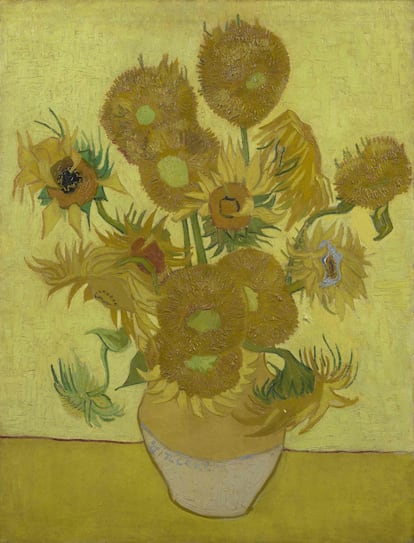
In Sunflowers — a famous series of five versions that he painted between 1888 and 1889 — his name follows the curve of the vase: it can be seen in red or blue. These flowers (disliked by his colleagues for their rough appearance) served as a vehicle for experimenting with color — yellow, in particular — and his signature stands out, even though it’s quite difficult to find.
How many of the great artist’s unsigned pieces have been presented as authentic? “Van Gogh died very young. And, since he wasn’t successful in selling his work, most of his paintings remained in the family collection,” says Teio Meedendorp, a senior researcher at the Van Gogh Museum. “From that safe place, some were sold by Joanna Bonger, Theo’s widow.”
The museum intermittently receives supposedly unknown works by Van Gogh. The experts analyze them, in order to establish authorship. “Since it’s well known that he didn’t sign his work much, we ask more questions when his name appears than when it’s missing,” Meedendorp explains.
During the last months of his life, while living in Auvers-sur-Oise, Van Gogh only signed Portrait of Adeline Ravoux (1890), an oil painting that depicts the daughter of the innkeeper at the Ravoux Inn, where he stayed. In another work, Daubigny’s Garden (1890), he wrote the title as if to clarify that it wasn’t just any garden, but that of an important painter: Charles-François Daubigny.
“Van Gogh sometimes exhibited paintings he hadn’t signed… and it’s possible he didn’t appreciate the pieces that we now consider to be masterpieces,” Engelmayer reflects.
Sign up for our weekly newsletter to get more English-language news coverage from EL PAÍS USA Edition









































