
Edi Rama, Albania’s prime minister and an artist exhibiting in Paris and New York
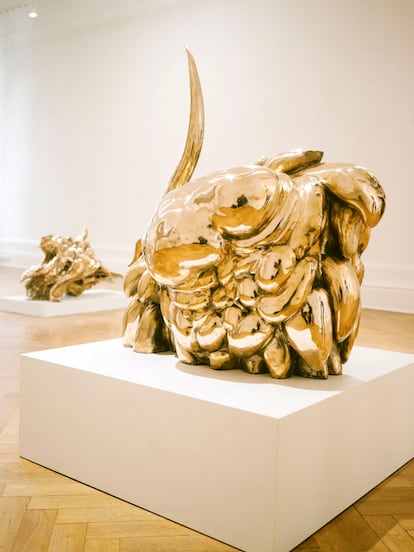
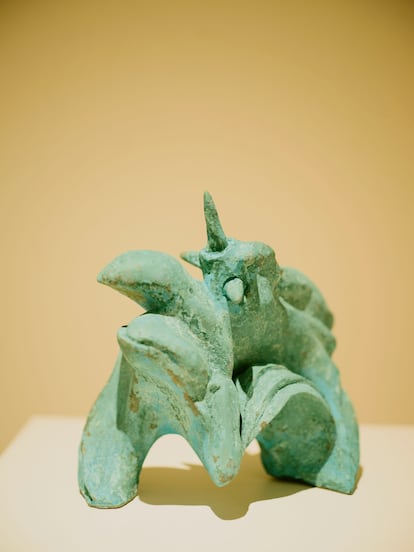
The leader of the European country has just unveiled an exhibition in Berlin featuring bronze sculptures created from 3D-printed designs
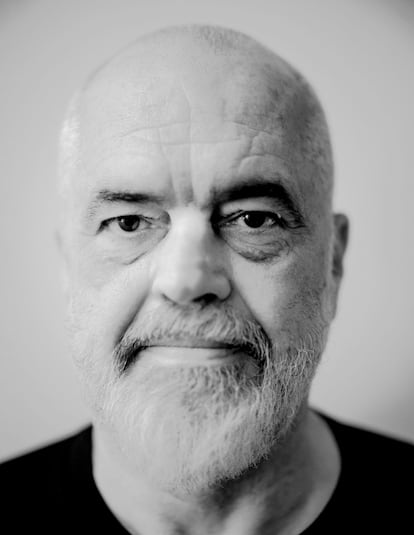
“Art is an attempt not to become totally insane. Because politics can be insane. And the risk of becoming totally stupid is really very imminent when you do politics.”
Edi Rama, 62, is the man behind this confession. And he knows what he’s talking about. Since 2013, he has served as prime minister of Albania, the highest executive position in the small Balkan country of 2.75 million inhabitants. He’s the only head of state to have won four consecutive terms. Before that, he served as minister of Culture, Youth and Sports and as mayor of Tirana, the capital and largest city. He’s also chairman of the Socialist Party.
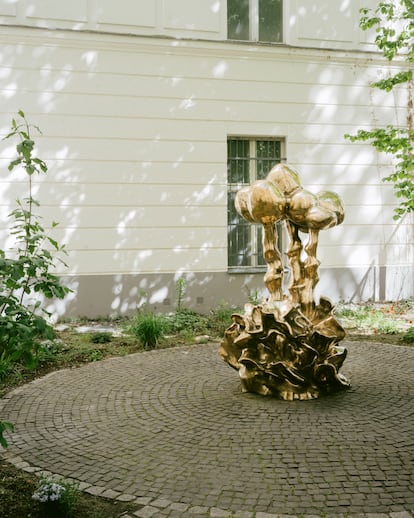
However, the Tirana-born politician defines himself, first and foremost, as an artist. He trained as a painter at the country’s Academy of Arts, where he later became a professor. Today, his work is featured in such influential galleries as Marian Goodman (New York and Paris), Nuno Centeno (Porto) and the Berlin gallery Société, where he met with EL PAÍS on a sunny May 1. This was the morning after the opening of his first exhibition at the German gallery, titled Chrysalizing, in which he presented his latest bronze sculptures.
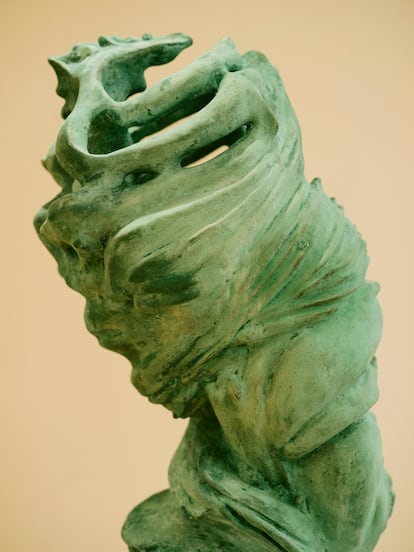
The exhibition’s title evokes the transformation of Rama’s artistic practice: a shift from painting, the medium for which he has so far been best known among critics and the public, to these zoomorphic sculptures, whose forms seem to belong to no known biological taxonomy. As goes the famous quip by the U.S. conceptual artist Ad Reinhardt, “sculpture is something you bump into when you back up to look at a painting.”
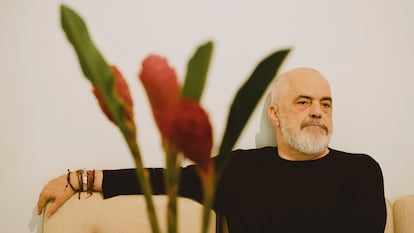
For Rama, sculpting is something that “came naturally” to him. He’s sprawled on a sofa, his bare feet on the carpet of one of the rooms at the Société gallery, which has brought him to Berlin for Gallery Weekend, the German capital’s grand annual art event. “All my sculptures here are paintings [of mine] that became sculptures. Using artificial intelligence, I create a digital model and then produce a 3D print from it. After that, I work with my hands.”
Dressed in black (except for his white sneakers, which rest beside the armchair), Rama is somewhat intimidating. This isn’t only because of his height (he’s six-foot-five) and imposing build, but also because of his initial seriousness. However, that gravity begins to crumble when he recalls his university days at the Academy of Arts in Tirana, during the dictatorship of Enver Hoxha, one of the most secretive and criminal regimes in the communist sphere. “It was a school that was based on the discipline and the method of the Soviet academic programs,” he recalls. “There was a strong emphasis on realistic drawing, painting and composition. Professionally, it was a very solid school, but there was no freedom. It was just socialist realism, full stop.”
Unlike in some other communist states, 20th-century art was effectively banned in Albania. “In fact, in 1986, when I finished my studies, art history at the Academy had ceased to be about visuals with Gustave Courbet. The last image we were shown was his work The Painter’s Studio, from 1855. After that, there were only lectures without images, only accusations and criticisms against the degenerate artists and that degenerate society that turned shit into art.”
Alongside his studies, Rama forged a modest career as a semi-professional basketball player. “I was tall and there were not many tall boys in Albania. I also suffered from asthma and my parents thought it was a good idea to play some sports. That’s how I ended up on the national team when I was only 20.”
But basketball was about more than athletics. The main attraction was the opportunity to leave Albania. “The only way to go abroad at the time was to play sports at the European level. And I wanted to be able to see a museum and see original paintings. This was my goal.”
However, the plan didn’t work out. In 1984, his first international destination was Paderborn, a city near Düsseldorf. “We made a stop in Vienna because there were no direct flights. In the afternoon, I snuck out of the hotel to visit the Museum of Art History,” he recalls. “I didn’t know how to find my way around; I didn’t even have a map. I didn’t want to take the bus, either: I was scared of getting lost. It was November and snowing, so I walked nonstop, asking people on the street for directions to the museum. It was already getting dark when I got there. I went up to the big door and found a sign that read: ‘Tuesday, Closed.’ I had to wait another five years.”
He finally made up for the disappointment in 1989, during another sporting trip, when he visited the Kunsthalle Bremen, an art gallery in Bremen. “It was mind-blowing because it was like meeting the ghosts that you’ve always dreamt of. At the entrance, there were stairs and I climbed it trembling. When I reached the top, I found myself standing before a sculpture by Rodin and a painting by Picasso. It was like being a virgin walking into a brothel. It was a very erotic experience.”
After the fall of the Iron Curtain, he moved to Paris in 1994, on a scholarship to the Cité Internationale des Arts. “My goal was to just travel the world. And so, what I was doing for some years was just selling paintings, buying tickets, flying and staying with people I knew.”
Then, in 1998, Albania’s new government came calling, offering him the post of culture minister. “It’s really a pity that politics has lost a lot of meaning in our part of the world,” he laments. “It’s the highest form of engagement and intellectual endeavor, because you have to make things happen not with colors, not with ink, not with a piano, but with people. And this is very difficult. It is a struggle to bring about change.”
Three years later, he became the mayor of Tirana, a city he governed for a decade. During that time, he transformed some communist-era buildings, giving them colorful, geometric facades. “The city was completely broken: we had no money. Tirana had only 78 working streetlights. Some flickered and the rest were useless. The situation was horrible. Illegal construction was everywhere. The whole budget was $6.3 million.”
At the time, he was presented with a proposal to restore sidewalks and building façades. “‘What colors are you going to paint the houses?’ I asked. ‘The original colors,’ they replied. But the buildings weren’t the originals anymore!”
Over the years, apartment blocks had been altered by residents: windows enlarged, extra floors added, balconies enclosed in makeshift ways. “Up until then, I had only worked in black and white. And that was the moment when colors arrived at my work table, to paint the exteriors and bring them to life,” he says.
He says the initiative reversed a trend that had taken hold in Tirana during the 1990s, when the focus was solely on private spaces, to the detriment of the common good. “For 50 years, people didn’t have private property. They were told that everything belonged to them, but they had nothing. So, they wanted to claim their own individual rights.”
Public space had come to be seen as something to occupy or use as a dumping ground. But that dynamic changed with the introduction of the brightly colored façades. At a time when Tirana was collecting barely 4% of local taxes overall, tax collection on the streets where the project was carried out reached 100%. “People started to pay the tax because they realized that the city was doing something for them,” he explains.
According to Rama, public safety improved as well. “I learned that the beauty and cleanliness of the public space is more intimidating than the police. So, if you want to make people less aggressive toward public common goods, you have to make sure that they feel intimidated by the beauty of the space.”
In 2013, Rama became prime minister of Albania, the pinnacle of his political career. But he didn’t abandon his artistic pursuits. His participation in the Venice Biennale in 2017 is evidence of that.
The 2026 edition was mired in controversy after the jury decided to exclude Russia and Israel from contention for the official prizes. When the organizers refused to ban the two countries’ national pavilions, the jury resigned en masse.
“Politics should not get mixed with art,” says Rama. “And the decision to accept or reject a country at the Biennale is not up to the jury: that decision belongs to the organizers. And if they want those countries to be present at the Biennale, they should be. The jury has to judge the art, not the politics. It’s not a jury for who is good and who is bad in this world.”
When Rama is asked if he doesn’t believe that art should be involved in these issues, he responds emphatically: “I don’t think art is supposed to change the world. Art is supposed to simply change people’s perspective and create a space where they can process their ideas and grow. It is not meant to stop wars or pass judgment. And art isn’t supposed to give people solutions for what politics is supposed to do. Mixing both is horrible.”
But what are his feelings about the current global situation? “I feel blessed not to be among those who occupy the positions from which major decisions are made today,” he says. “Albania is so small that no one expects me to make any major decisions for the world. And that’s a good thing, because I have no idea what I would do or what I could do. Things are going pretty badly on this side of the world, yes.”
However, in Rama’s case, his art is indeed political, if only tangentially, given that he creates some of his paintings during official meetings and conferences at the Kryeministria, the seat of Albania’s government.
Are these works a form of stream-of-consciousness drawing? Or are they more akin to subconscious creations? “I don’t know. All that terminology doesn’t apply to me,” he replies. “I do it because it makes me feel good. It’s similar to what happens when I have to drink herbal teas for my migraines. It’s a way of detoxifying, of diluting the poison of politics.”
However, he’s wary of the image in which politicians are depicted as perverse and artists are portrayed as being full of light. “It’s not true. Artists can be evil and politicians can be angels.” This duality doesn’t trouble him.
“The only thing I don’t do is sell my art to Albanians, or to anyone who has business interests in Albania,” he explains. “The point is to vet everyone who wants to buy one of my pieces. If any gallery I work with receives an expression of interest to buy something, they send it to me and they check the person’s background to make sure that there’s no connection to my job.”
Meanwhile, his paintings, a collection of brightly colored doodles, are piling up on the walls of his office in the Albanian capital, a mandatory stop for world leaders visiting the country.
“If there’s one thing I regret, it’s not having filmed their reactions,” he jokes. “I started doing it too late. You get all sorts of reactions, and it’s very funny. It would have made an incredible film. I think I have [former U.S Secretary of State] John Kerry and [NATO chief] Mark Rutte on video.” And Spanish Prime Minister Pedro Sánchez, too. “He has great taste. And he organized the most memorable NATO summit, in the Prado Museum! I’ll never forget that,” he remarks.
In his office, surrounded by those creations, some visiting leaders act as if nothing is out of the ordinary, others are visibly surprised, and still others seem unsure what to say.
“One of them, I’m not going to give you the name, wasn’t very comfortable. And suddenly, he asked, ‘Where’s your office?’ And I replied: ‘This is my office.’ ‘And what’s all that?’ he insisted. I explained that they were my drawings. ‘You draw on the wall?’ he asked. ‘No. I draw on the desk, and then I do wallpapers.’ He said, ‘You’re a strange man, Edi Rama. I thought this was where you keep the employees’ kids during the day, when they cannot go to kindergarten.’ All I could say was, ‘No, the only kid here is me.’”
Sign up for our weekly newsletter to get more English-language news coverage from EL PAÍS USA Edition









































